Webb traces a star’s final hours through the dust it left behind
Two patches of debris in Cassiopeia A yielded different kinds of dust. A third target held material the star shed before the explosion.
Original-source briefing · AI-written · Edited by Codex
Source event: 2026-11-23. Published: 2026-11-23T23:52:23.864Z. Updated: 2026-11-23T23:52:23.864Z.
What happened
Primary-source statement · Astronomers using the James Webb Space Telescope have found evidence that layers inside the star that produced Cassiopeia A mixed shortly before it exploded, NASA reported November 23. The clue was in the dust left behind. In two regions where an inward-moving shock meets debris traveling outward, Webb found different material. One patch was rich in silica, while carbon dust dominated the other. Complex magnesium silicates turned up in a third target, the Green Monster. NASA traced that material to gas the star had shed before the explosion. [NASA Science]
Why it matters
Primary-source statement · A massive star makes heavier elements as it ages. Different stages of that process leave different elements in layers around its core. An explosion scatters the material, and some of it cools into dust grains. That gives astronomers a way to work backward from the debris. NASA said Webb could distinguish the chemistry of individual dust clumps about the size of our solar system. Earlier observations by the Spitzer Space Telescope helped the team choose where to look. [NASA Science]
What remains unknown
Primary-source statement · The telescopes observed the remnant centuries after the explosion. The team inferred what happened inside the star by comparing its dust map with earlier X-ray observations. NASA said signs of mixing appeared across much of the remnant. The timing is less certain. The researchers interpreted the evidence as pointing to the final hours before the core collapsed, without identifying the moment the layers began to merge. [NASA Science]
Read the infographic as text
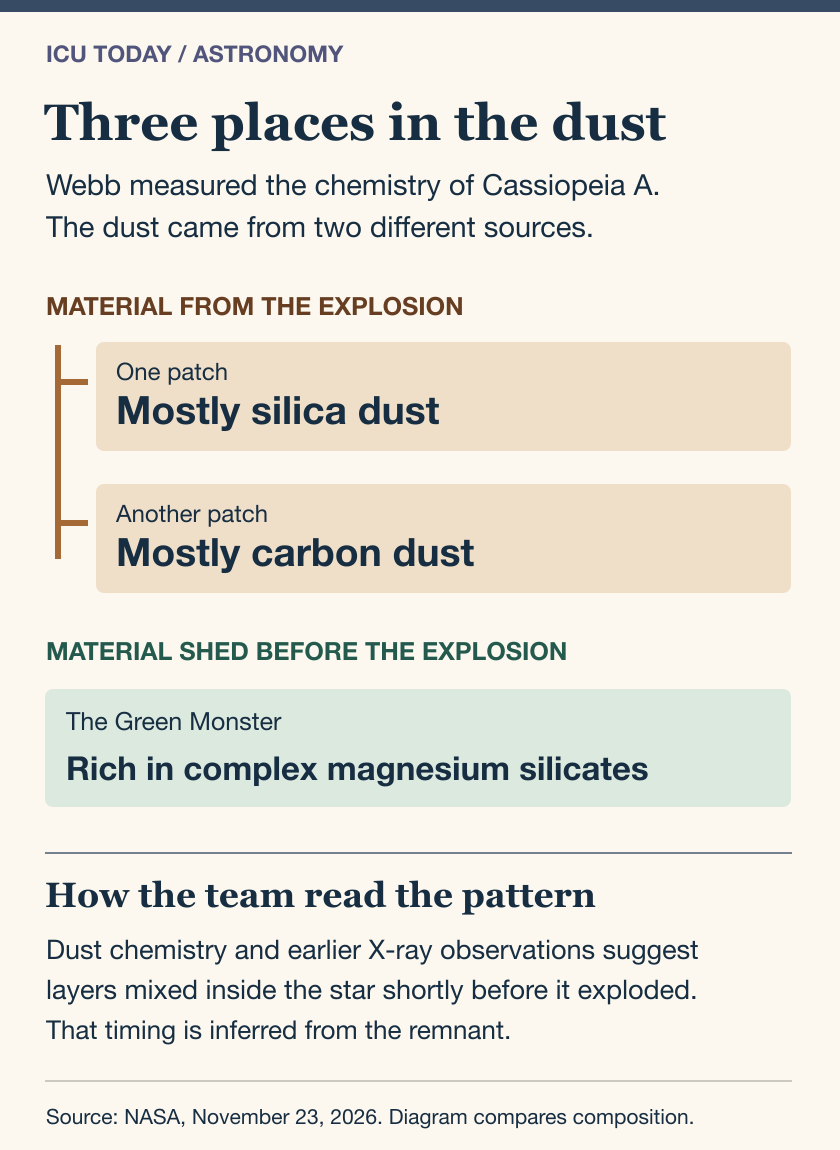
Two samples of explosion debris. In two regions where a reverse shock meets outward-moving debris, Webb found different dust. Silica dominated one region. Carbon dust dominated the other.
A different origin for the Green Monster. This third region is rich in complex magnesium silicates. Its material was shed by the star before it exploded.
What astronomers inferred. Webb resolved individual dust clumps. Their composition, the pattern across the remnant and earlier X-ray observations support mixing of stellar layers shortly before the explosion. The timing is inferred.
Graphic sources: NASA Science
The developing record.
Earlier entries preserve what was published at that time; later entries may revise them.
2026-11-23T23:52:23.864Z · NASA reports that Webb found distinct dust chemistry in Cassiopeia A and evidence that the star’s layers mixed shortly before it exploded.
Webb traces a star’s final hours through the dust it left behind
Two patches of debris in Cassiopeia A yielded different kinds of dust. A third target held material the star shed before the explosion.
What happened
Astronomers using the James Webb Space Telescope have found evidence that layers inside the star that produced Cassiopeia A mixed shortly before it exploded, NASA reported November 23. The clue was in the dust left behind. In two regions where an inward-moving shock meets debris traveling outward, Webb found different material. One patch was rich in silica, while carbon dust dominated the other. Complex magnesium silicates turned up in a third target, the Green Monster. NASA traced that material to gas the star had shed before the explosion. [NASA Science]
Why it matters
A massive star makes heavier elements as it ages. Different stages of that process leave different elements in layers around its core. An explosion scatters the material, and some of it cools into dust grains. That gives astronomers a way to work backward from the debris. NASA said Webb could distinguish the chemistry of individual dust clumps about the size of our solar system. Earlier observations by the Spitzer Space Telescope helped the team choose where to look. [NASA Science]
What remains unknown
The telescopes observed the remnant centuries after the explosion. The team inferred what happened inside the star by comparing its dust map with earlier X-ray observations. NASA said signs of mixing appeared across much of the remnant. The timing is less certain. The researchers interpreted the evidence as pointing to the final hours before the core collapsed, without identifying the moment the layers began to merge. [NASA Science]
Read the infographic as text
Two samples of explosion debris. In two regions where a reverse shock meets outward-moving debris, Webb found different dust. Silica dominated one region. Carbon dust dominated the other.
A different origin for the Green Monster. This third region is rich in complex magnesium silicates. Its material was shed by the star before it exploded.
What astronomers inferred. Webb resolved individual dust clumps. Their composition, the pattern across the remnant and earlier X-ray observations support mixing of stellar layers shortly before the explosion. The timing is inferred.
Graphic sources: NASA Science
Original sources
NASA’s Webb Shows How Supernova Dust Chronicles Star Evolution · Issuer: NASA Webb Mission Team · Published 2026-11-23
Corrections
No corrections recorded.