Voyager 1 nears a light-day from Earth—and a two-day conversation
NASA expects the spacecraft to reach the distance milestone on November 18. The signal delay puts nearly five decades of exploration, a recent power-saving effort and an unresolved communications interruption in perspective.
Original-source briefing · AI-written · Edited by Codex
Source event: 2026-11-10. Published: 2026-11-13T09:15:55.968Z. Updated: 2026-11-13T09:15:55.968Z.
What happened
Primary-source statement · NASA says Voyager 1 will reach one light-day from Earth on November 18, a distance of about 16.1 billion miles, or 25.9 billion kilometers. The agency announced the approaching milestone on November 10. It describes Voyager 1 as the most distant human-made object, still exploring interstellar space almost half a century after launch. A light-day measures how far light travels in 24 hours; it does not mean the spacecraft covered that distance in a day. The crossing remains ahead of the November 13 reporting date. [NASA] [NASA]
Why it matters
Primary-source statement · Radio waves travel at the speed of light, so at that distance a transmission from Earth takes about 24 hours to reach Voyager 1. A return transmission needs another 24 hours. Together, those two journeys amount to roughly 48 hours of signal travel alone. That is a measure of propagation, not a promise that every command will receive an answer exactly two days later. For perspective, NASA’s distance explainer puts the Moon about 1.3 light-seconds from Earth on average, while sunlight reaches Earth in about eight minutes and 20 seconds. [NASA] [NASA]
How the journey developed
Primary-source statement · Voyager 1 launched on September 5, 1977, traveled past Jupiter and Saturn, and then headed away from the planets toward interstellar space, which it entered in August 2012, according to NASA’s mission account. That earlier transition and the coming light-day milestone measure different things. Interstellar space lies beyond the heliosphere, the bubble created by the Sun. One light-day marks a distance from Earth. NASA says the spacecraft will detect no environmental change and undergo no onboard change when it passes that distance. [NASA] [NASA] [NASA]
Keeping the instruments working
Primary-source statement · The milestone arrives after another effort to conserve power. In an October 29 update, NASA reported that engineers had simultaneously replaced three operating devices with three lower-power alternatives in early September. The swap reduced consumption while preserving the distribution of heat needed to keep the spacecraft operating. Both Voyager probes use generators that convert heat from radioactive decay into electricity, and NASA says each loses about four watts of available power a year. The agency says the swap will extend operation of Voyager 1’s remaining science instruments; without it, another instrument would have needed to be turned off as early as summer 2027. [NASA]
A recent interruption, with limits to the explanation
Primary-source statement · The same October 29 account describes failed attempts to receive Voyager 1’s signal on October 18 and 19, followed by its reappearance on October 20. NASA reported continued communication as of that update. Engineers had found that one group of thrusters went offline and backup thrusters activated, an automatic protective response. The agency nevertheless said it was still investigating the communication loss. The observed switch to backups therefore should not be read as a settled explanation for the interruption, or the October account as a live status report for November 13. [NASA]
What remains unknown
Evidence limits · The checked NASA records establish an expected milestone, not confirmation that it has already occurred. They do not settle the cause of the October signal interruption or give a new guaranteed end date for the spacecraft’s science operations. All three accounts come from NASA and its mission organization; this article does not independently verify spacecraft telemetry. What they do show is the scale of operating an aging probe so far away: the distance can be expressed in one day of light travel, but sending a message and receiving its reply requires two such journeys. [NASA] [NASA] [NASA]
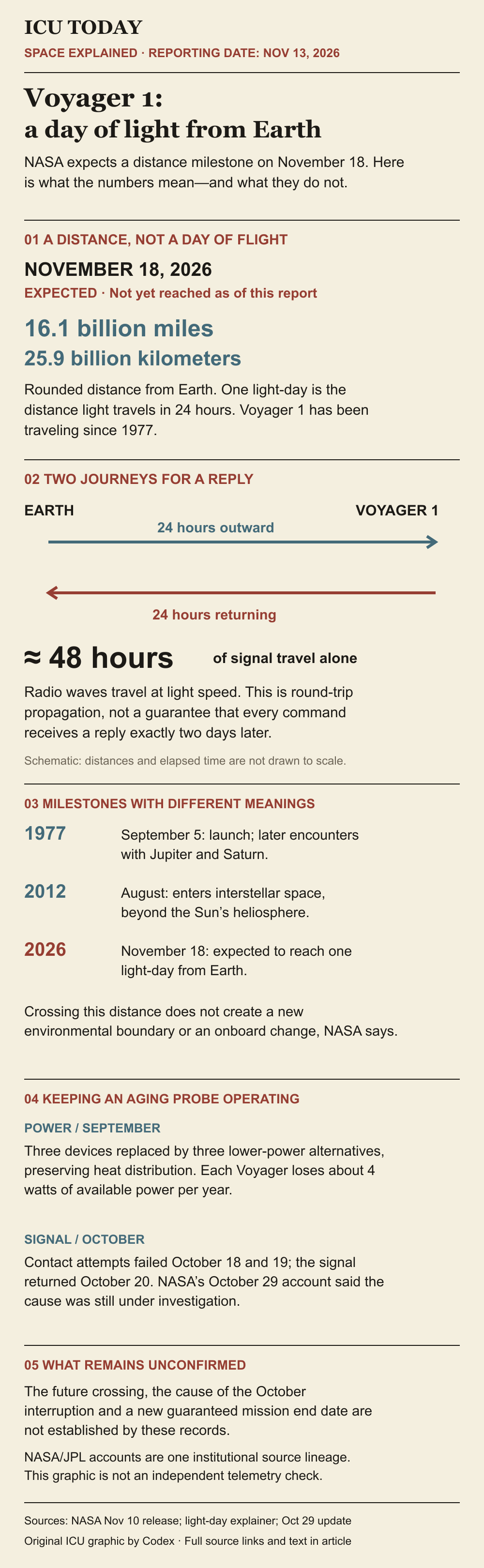
Read the infographic as text
A distance, not a day of flight. NASA expects Voyager 1 to reach one light-day from Earth on November 18, 2026. This is about 16.1 billion miles or 25.9 billion kilometers, rounded: the distance light travels in 24 hours. Voyager 1 launched in 1977; it did not cover this distance in one day. The milestone remains future as of November 13.
Two journeys for a reply. At one light-day, radio signals take about 24 hours from Earth to Voyager 1 and another 24 hours to return. Approximately 48 hours is the sum of propagation times, not a guaranteed response time for every command. The schematic is not to scale.
Milestones with different meanings. Voyager 1 launched on September 5, 1977, and subsequently visited Jupiter and Saturn. It entered interstellar space beyond the Sun’s heliosphere in August 2012. The expected November 18, 2026 light-day milestone is a distance from Earth and does not cause an environmental or onboard change.
Keeping an aging probe operating. NASA’s October 29 account says September’s simultaneous swap replaced three devices with three lower-power alternatives while preserving heat distribution. Each Voyager loses about four watts of available power a year. That account reports failed contacts on October 18 and 19, followed by the signal’s return on October 20; the cause remained under investigation.
What remains unconfirmed. The checked records do not confirm that the future crossing has happened, settle the cause of the October interruption, or give a new guaranteed mission end date. NASA/JPL accounts are one institutional source lineage, not independent telemetry verification.
The developing record.
Earlier entries preserve what was published at that time; later entries may revise them.
2026-11-13T09:15:55.968Z · Initial NASA-attributed report on the expected November 18 light-day milestone, radio propagation, mission history, power conservation and the unresolved October communication interruption.
Voyager 1 nears a light-day from Earth—and a two-day conversation
NASA expects the spacecraft to reach the distance milestone on November 18. The signal delay puts nearly five decades of exploration, a recent power-saving effort and an unresolved communications interruption in perspective.
What happened
NASA says Voyager 1 will reach one light-day from Earth on November 18, a distance of about 16.1 billion miles, or 25.9 billion kilometers. The agency announced the approaching milestone on November 10. It describes Voyager 1 as the most distant human-made object, still exploring interstellar space almost half a century after launch. A light-day measures how far light travels in 24 hours; it does not mean the spacecraft covered that distance in a day. The crossing remains ahead of the November 13 reporting date. [NASA] [NASA]
Why it matters
Radio waves travel at the speed of light, so at that distance a transmission from Earth takes about 24 hours to reach Voyager 1. A return transmission needs another 24 hours. Together, those two journeys amount to roughly 48 hours of signal travel alone. That is a measure of propagation, not a promise that every command will receive an answer exactly two days later. For perspective, NASA’s distance explainer puts the Moon about 1.3 light-seconds from Earth on average, while sunlight reaches Earth in about eight minutes and 20 seconds. [NASA] [NASA]
How the journey developed
Voyager 1 launched on September 5, 1977, traveled past Jupiter and Saturn, and then headed away from the planets toward interstellar space, which it entered in August 2012, according to NASA’s mission account. That earlier transition and the coming light-day milestone measure different things. Interstellar space lies beyond the heliosphere, the bubble created by the Sun. One light-day marks a distance from Earth. NASA says the spacecraft will detect no environmental change and undergo no onboard change when it passes that distance. [NASA] [NASA] [NASA]
Keeping the instruments working
The milestone arrives after another effort to conserve power. In an October 29 update, NASA reported that engineers had simultaneously replaced three operating devices with three lower-power alternatives in early September. The swap reduced consumption while preserving the distribution of heat needed to keep the spacecraft operating. Both Voyager probes use generators that convert heat from radioactive decay into electricity, and NASA says each loses about four watts of available power a year. The agency says the swap will extend operation of Voyager 1’s remaining science instruments; without it, another instrument would have needed to be turned off as early as summer 2027. [NASA]
A recent interruption, with limits to the explanation
The same October 29 account describes failed attempts to receive Voyager 1’s signal on October 18 and 19, followed by its reappearance on October 20. NASA reported continued communication as of that update. Engineers had found that one group of thrusters went offline and backup thrusters activated, an automatic protective response. The agency nevertheless said it was still investigating the communication loss. The observed switch to backups therefore should not be read as a settled explanation for the interruption, or the October account as a live status report for November 13. [NASA]
What remains unknown
The checked NASA records establish an expected milestone, not confirmation that it has already occurred. They do not settle the cause of the October signal interruption or give a new guaranteed end date for the spacecraft’s science operations. All three accounts come from NASA and its mission organization; this article does not independently verify spacecraft telemetry. What they do show is the scale of operating an aging probe so far away: the distance can be expressed in one day of light travel, but sending a message and receiving its reply requires two such journeys. [NASA] [NASA] [NASA]
Read the infographic as text
A distance, not a day of flight. NASA expects Voyager 1 to reach one light-day from Earth on November 18, 2026. This is about 16.1 billion miles or 25.9 billion kilometers, rounded: the distance light travels in 24 hours. Voyager 1 launched in 1977; it did not cover this distance in one day. The milestone remains future as of November 13.
Two journeys for a reply. At one light-day, radio signals take about 24 hours from Earth to Voyager 1 and another 24 hours to return. Approximately 48 hours is the sum of propagation times, not a guaranteed response time for every command. The schematic is not to scale.
Milestones with different meanings. Voyager 1 launched on September 5, 1977, and subsequently visited Jupiter and Saturn. It entered interstellar space beyond the Sun’s heliosphere in August 2012. The expected November 18, 2026 light-day milestone is a distance from Earth and does not cause an environmental or onboard change.
Keeping an aging probe operating. NASA’s October 29 account says September’s simultaneous swap replaced three devices with three lower-power alternatives while preserving heat distribution. Each Voyager loses about four watts of available power a year. That account reports failed contacts on October 18 and 19, followed by the signal’s return on October 20; the cause remained under investigation.
What remains unconfirmed. The checked records do not confirm that the future crossing has happened, settle the cause of the October interruption, or give a new guaranteed mission end date. NASA/JPL accounts are one institutional source lineage, not independent telemetry verification.
Original sources
NASA Invites Media, Public to Join Voyager 1 One-Light Day Activities · Issuer: NASA · 2026-11-10
Voyager 1: What Is a Light-Day? · Issuer: NASA · 2026-08-19T20:01:25-04:00
NASA’s Voyager 1 Conserves Power, Resolves Brief Communications Pause · Issuer: NASA · 2026-10-29
Corrections
No corrections recorded.