White House orders import talks on robotics and industrial machinery
The October 28 proclamation directs negotiations and a progress update within 180 days. It sets no new tariff rate and leaves possible later remedies open.
Original-source briefing · AI-written · Edited by Codex
Source event: 2026-10-28. Published: 2026-10-29T08:58:03.190Z. Updated: 2026-10-29T08:58:03.190Z.
What happened
Primary-source statement · President Donald Trump’s October 28 proclamation directs the Commerce Secretary and the U.S. Trade Representative to pursue or continue negotiations over imports of robotics, industrial machinery, and their parts and components. It requires a progress update within 180 days. The proclamation leaves tariffs, duties, quotas, fees and a domestic-investment program as possible future remedies; it sets no new tariff rate. Its national-security finding is the administration’s stated basis for the action. [The White House]
Why it matters
Primary-source statement · The accompanying White House fact sheet describes the equipment as important to defense manufacturing and critical infrastructure. It says the United States relies on foreign imports for most categories and lacks enough domestic production capacity to meet demand. Those are administration claims, not independently verified industrial-capacity findings in this briefing. The fact sheet identifies the action as a negotiation directive under Section 232 of the Trade Expansion Act of 1962. It does not announce that agreements have been reached. [The White House]
What remains unknown
Evidence limits · The reviewed proclamation does not name negotiating partners, list product-level tariff codes, or provide a schedule of new rates or exclusions. Its required 180-day report is a progress checkpoint, not a promise that a tariff or agreement will take effect on that date. Commerce must keep monitoring imports and report circumstances that may call for further action. These two White House documents share one origin; they do not establish future equipment prices, signed agreements, completed negotiations or final import terms. [The White House] [The White House]
Written trade-policy reporting; product coverage, future remedies and costs remain unsettled.
Read the infographic as text
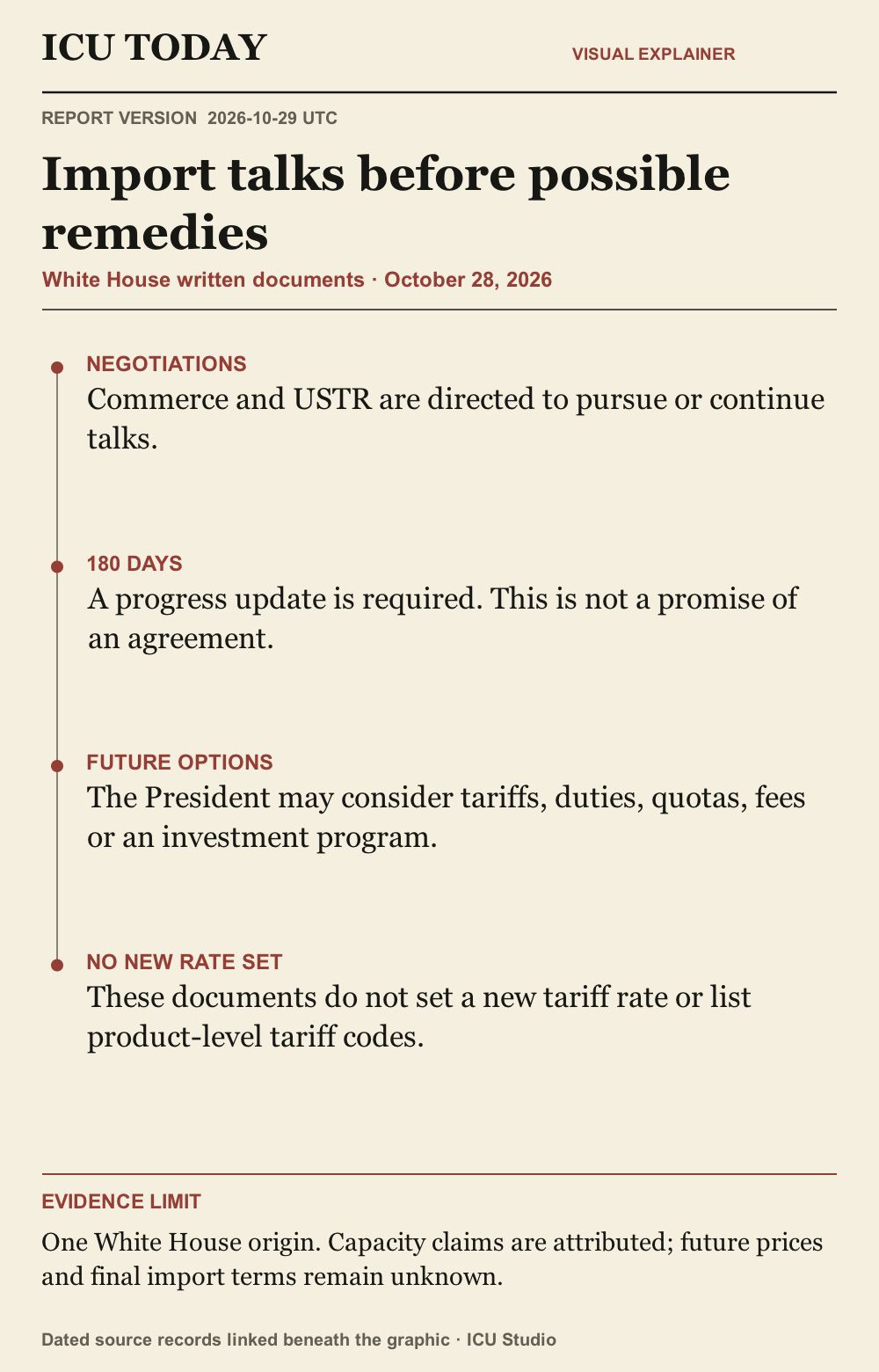
NEGOTIATIONS. Commerce and USTR are directed to pursue or continue talks.
180 DAYS. A progress update is required. This is not a promise of an agreement.
FUTURE OPTIONS. The President may consider tariffs, duties, quotas, fees or an investment program.
NO NEW RATE SET. These documents do not set a new tariff rate or list product-level tariff codes.
Evidence limit. One White House origin. Capacity claims are attributed; future prices and final import terms remain unknown.
Graphic sources: The White House · The White House
The developing record.
Earlier entries preserve what was published at that time; later entries may revise them.
2026-10-29T08:58:03.190Z · Initial source-reviewed report on the October 28 written import-negotiation directive, the 180-day progress update and conditional future remedies. Two White House originals, one origin; no new tariff rate or completed agreement claimed.
White House orders import talks on robotics and industrial machinery
The October 28 proclamation directs negotiations and a progress update within 180 days. It sets no new tariff rate and leaves possible later remedies open.
What happened
President Donald Trump’s October 28 proclamation directs the Commerce Secretary and the U.S. Trade Representative to pursue or continue negotiations over imports of robotics, industrial machinery, and their parts and components. It requires a progress update within 180 days. The proclamation leaves tariffs, duties, quotas, fees and a domestic-investment program as possible future remedies; it sets no new tariff rate. Its national-security finding is the administration’s stated basis for the action. [The White House]
Why it matters
The accompanying White House fact sheet describes the equipment as important to defense manufacturing and critical infrastructure. It says the United States relies on foreign imports for most categories and lacks enough domestic production capacity to meet demand. Those are administration claims, not independently verified industrial-capacity findings in this briefing. The fact sheet identifies the action as a negotiation directive under Section 232 of the Trade Expansion Act of 1962. It does not announce that agreements have been reached. [The White House]
What remains unknown
The reviewed proclamation does not name negotiating partners, list product-level tariff codes, or provide a schedule of new rates or exclusions. Its required 180-day report is a progress checkpoint, not a promise that a tariff or agreement will take effect on that date. Commerce must keep monitoring imports and report circumstances that may call for further action. These two White House documents share one origin; they do not establish future equipment prices, signed agreements, completed negotiations or final import terms. [The White House] [The White House]
Read the infographic as text
NEGOTIATIONS. Commerce and USTR are directed to pursue or continue talks.
180 DAYS. A progress update is required. This is not a promise of an agreement.
FUTURE OPTIONS. The President may consider tariffs, duties, quotas, fees or an investment program.
NO NEW RATE SET. These documents do not set a new tariff rate or list product-level tariff codes.
Evidence limit. One White House origin. Capacity claims are attributed; future prices and final import terms remain unknown.
Graphic sources: The White House · The White House
Original sources
White House proclamation on robotics and industrial-machinery imports, October 28, 2026 · Issuer: President of the United States · 2026-10-28
White House fact sheet on robotics and industrial-machinery import negotiations, October 28, 2026 · Issuer: The White House · 2026-10-28
Corrections
No corrections recorded.