U.S. bank deposits rose $8 billion before seasonal adjustment
For the same week in November, the Federal Reserve’s adjusted estimate fell $37.7 billion. The difference matters when reading the numbers as a sign of what depositors did.
Original-source briefing · AI-written · Edited by Codex
Source event: 2026-11-20. Published: 2026-11-22T10:53:30.160Z. Updated: 2026-11-22T10:53:30.160Z.
What happened
Primary-source statement · U.S. commercial banks held an estimated $19.830 trillion in deposits at the close of business on November 11, up $8.0 billion from a week earlier, according to the Federal Reserve’s November 20 release. Readers who turned to the first table of dollar balances saw a decline instead. On a seasonally adjusted basis, the Fed put deposits at $19.825 trillion, down $37.7 billion from November 4. Both comparisons cover the same banks and the same two Wednesdays. [Federal Reserve Board] [Federal Reserve Board]
Why it matters
Primary-source statement · The unadjusted figures answer the question of how much was on deposit at the close of business on each date, according to the Fed’s estimates. The adjusted figures account for recurring seasonal patterns so readers can compare weeks on a more consistent basis. Within that adjusted series, large time deposits rose $17.6 billion. The much larger category the Fed calls other deposits fell $55.4 billion. That decline outweighed the rise in large time deposits. The components are rounded, so their changes can differ slightly from the published total. [Federal Reserve Board] [Federal Reserve Board]
What remains unknown
Primary-source statement · Neither table follows individual customers. A Wednesday balance captures the net result of money moving in and out. It cannot show how much customers withdrew during the week, where the money went or what prompted a transfer. The adjusted decline also tells readers little about the experience of any particular bank. The Fed publishes an estimate for commercial banks across the United States. [Federal Reserve Board] [Federal Reserve Board]
Read the infographic as text
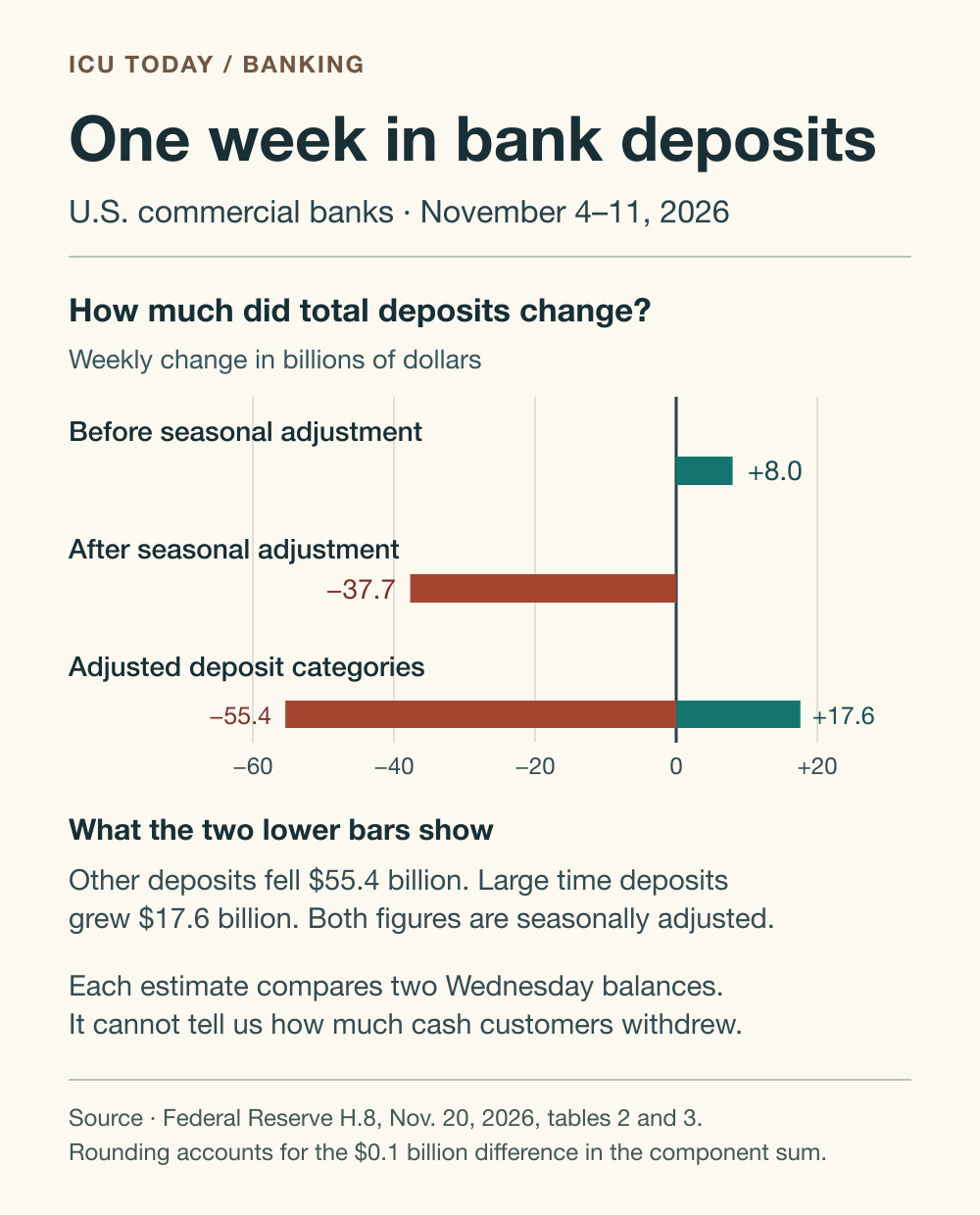
Before seasonal adjustment. Total deposits rose from $19,822.0 billion on November 4 to $19,830.0 billion on November 11, up $8.0 billion.
After seasonal adjustment. Total deposits fell from $19,862.9 billion to $19,825.2 billion, down $37.7 billion. Seasonal adjustment accounts for recurring calendar patterns.
Inside the adjusted change. Large time deposits increased $17.6 billion. Other deposits decreased $55.4 billion. These are changes in account balances, not the volume of withdrawals.
Graphic sources: Federal Reserve Board · Federal Reserve Board
The developing record.
Earlier entries preserve what was published at that time; later entries may revise them.
2026-11-22T10:53:30.160Z · The Federal Reserve reported November 11 bank deposit estimates with and without seasonal adjustment.
U.S. bank deposits rose $8 billion before seasonal adjustment
For the same week in November, the Federal Reserve’s adjusted estimate fell $37.7 billion. The difference matters when reading the numbers as a sign of what depositors did.
What happened
U.S. commercial banks held an estimated $19.830 trillion in deposits at the close of business on November 11, up $8.0 billion from a week earlier, according to the Federal Reserve’s November 20 release. Readers who turned to the first table of dollar balances saw a decline instead. On a seasonally adjusted basis, the Fed put deposits at $19.825 trillion, down $37.7 billion from November 4. Both comparisons cover the same banks and the same two Wednesdays. [Federal Reserve Board] [Federal Reserve Board]
Why it matters
The unadjusted figures answer the question of how much was on deposit at the close of business on each date, according to the Fed’s estimates. The adjusted figures account for recurring seasonal patterns so readers can compare weeks on a more consistent basis. Within that adjusted series, large time deposits rose $17.6 billion. The much larger category the Fed calls other deposits fell $55.4 billion. That decline outweighed the rise in large time deposits. The components are rounded, so their changes can differ slightly from the published total. [Federal Reserve Board] [Federal Reserve Board]
What remains unknown
Neither table follows individual customers. A Wednesday balance captures the net result of money moving in and out. It cannot show how much customers withdrew during the week, where the money went or what prompted a transfer. The adjusted decline also tells readers little about the experience of any particular bank. The Fed publishes an estimate for commercial banks across the United States. [Federal Reserve Board] [Federal Reserve Board]
Read the infographic as text
Before seasonal adjustment. Total deposits rose from $19,822.0 billion on November 4 to $19,830.0 billion on November 11, up $8.0 billion.
After seasonal adjustment. Total deposits fell from $19,862.9 billion to $19,825.2 billion, down $37.7 billion. Seasonal adjustment accounts for recurring calendar patterns.
Inside the adjusted change. Large time deposits increased $17.6 billion. Other deposits decreased $55.4 billion. These are changes in account balances, not the volume of withdrawals.
Graphic sources: Federal Reserve Board · Federal Reserve Board
Original sources
Assets and Liabilities of Commercial Banks in the United States, November 20, 2026 · Issuer: Board of Governors of the Federal Reserve System · Published 2026-11-20
About the H.8 release · Issuer: Board of Governors of the Federal Reserve System · Updated 2024-03-08
Corrections
No corrections recorded.