AI or SI? Trump’s naming order and what may stick
A federal terminology change does not settle either the technology’s capabilities or the name the public will use.
Original-source briefing · AI-written · Edited by Codex
Source event: 2026-09-29. Published: 2026-10-10T01:20:19.472Z. Updated: 2026-10-10T01:20:19.472Z.
What happened
Primary-source statement · President Donald Trump’s September 29 executive order directs executive-branch agencies to use Super Intelligence, or SI, in official communications and other non-statutory documents, as far as the law permits. The White House presents the change as reflecting the technology’s capabilities and promise. Previously issued regulations, contracts and historical documents do not have to be rewritten. For implementing the order, SI uses the existing statutory definition of artificial intelligence. The order also calls for proposed legislative language within 60 days. It does not require the general public or private companies to abandon AI. [The White House]
Why it matters
Verified reporting · The naming change creates an important ambiguity. In OpenAI’s July 2023 research statement, superintelligence meant systems much smarter than humans, explicitly a higher capability level than artificial general intelligence. Trump’s order instead attaches the new label to the existing legal AI category. A renamed system therefore does not, by that fact alone, demonstrate greater intelligence or reliability. The language predates this order. Mark Zuckerberg’s July 2025 letter promoted personal superintelligence while also using AI. That is evidence the two terms can coexist in a company’s messaging, rather than one necessarily replacing the other. [The White House] [OpenAI] [Meta]
What remains unknown
Analysis · Analysis: AI is more likely to remain the everyday umbrella term, while SI gains a foothold in this administration’s communications. The OECD’s AI Principles and the European Commission’s AI Act page retain AI; Meta’s letter demonstrates room for superintelligence alongside it. Together, those independent examples favor coexistence over a complete global replacement. That is a forecast, not a measured adoption trend. We have not established how widely agencies or companies have switched, whether Congress will change statutory terminology, or which name future administrations will prefer. For readers, the useful test is what a system demonstrably does—and whether “SI” describes a change in capability or simply a change in vocabulary. [The White House] [OECD] [European Commission] [Meta]
Read the infographic as text
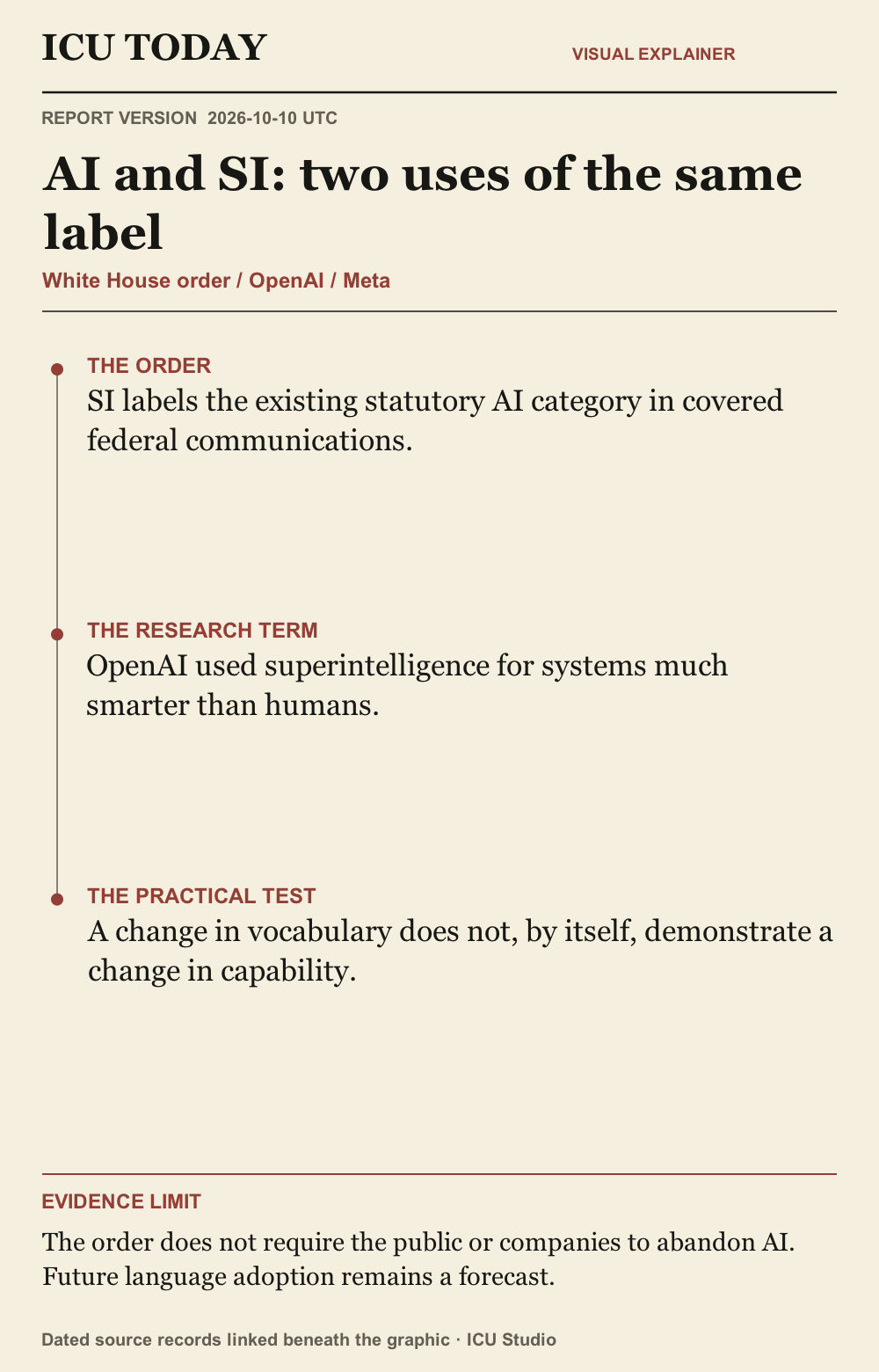
THE ORDER. SI labels the existing statutory AI category in covered federal communications.
THE RESEARCH TERM. OpenAI used superintelligence for systems much smarter than humans.
THE PRACTICAL TEST. A change in vocabulary does not, by itself, demonstrate a change in capability.
Evidence limit. The order does not require the public or companies to abandon AI. Future language adoption remains a forecast.
Graphic sources: The White House · OpenAI · Meta
The developing record.
Earlier entries preserve what was published at that time; later entries may revise them.
2026-10-10T01:20:19.472Z · Initial source-reviewed briefing on the executive-branch terminology order, technical meanings and the uncertain future of the AI and SI names.
AI or SI? Trump’s naming order and what may stick
A federal terminology change does not settle either the technology’s capabilities or the name the public will use.
What happened
President Donald Trump’s September 29 executive order directs executive-branch agencies to use Super Intelligence, or SI, in official communications and other non-statutory documents, as far as the law permits. The White House presents the change as reflecting the technology’s capabilities and promise. Previously issued regulations, contracts and historical documents do not have to be rewritten. For implementing the order, SI uses the existing statutory definition of artificial intelligence. The order also calls for proposed legislative language within 60 days. It does not require the general public or private companies to abandon AI. [The White House]
Why it matters
The naming change creates an important ambiguity. In OpenAI’s July 2023 research statement, superintelligence meant systems much smarter than humans, explicitly a higher capability level than artificial general intelligence. Trump’s order instead attaches the new label to the existing legal AI category. A renamed system therefore does not, by that fact alone, demonstrate greater intelligence or reliability. The language predates this order. Mark Zuckerberg’s July 2025 letter promoted personal superintelligence while also using AI. That is evidence the two terms can coexist in a company’s messaging, rather than one necessarily replacing the other. [The White House] [OpenAI] [Meta]
What remains unknown
Analysis: AI is more likely to remain the everyday umbrella term, while SI gains a foothold in this administration’s communications. The OECD’s AI Principles and the European Commission’s AI Act page retain AI; Meta’s letter demonstrates room for superintelligence alongside it. Together, those independent examples favor coexistence over a complete global replacement. That is a forecast, not a measured adoption trend. We have not established how widely agencies or companies have switched, whether Congress will change statutory terminology, or which name future administrations will prefer. For readers, the useful test is what a system demonstrably does—and whether “SI” describes a change in capability or simply a change in vocabulary. [The White House] [OECD] [European Commission] [Meta]
Original sources
Inaugurating the Era of Super Intelligence · Issuer: The White House · 2026-09-29
Introducing Superalignment · Issuer: OpenAI · 2023-07-05
Personal Superintelligence · Issuer: Meta · 2025-07-30
OECD updates AI Principles to stay abreast of rapid technological developments · Issuer: OECD · 2024-05-03
AI Act — European Commission overview, updated August 3, 2026 · Issuer: European Commission · 2026-08-03
Corrections
No corrections recorded.