Tariff refunds lifted TJX’s quarterly profit by $77 million before tax
The parent of TJ Maxx and Marshalls received $132 million back and booked $55 million in related compensation expense. Its earnings report shows how that changed the margin on every $100 of sales.
Original-source briefing · AI-written · Edited by Codex
Source event: 2026-11-18. Published: 2026-11-19T05:03:41.561Z. Updated: 2026-11-19T05:03:41.561Z.
What happened
Primary-source statement · TJX, the parent of TJ Maxx and Marshalls, said it received $132 million in refunds on tariffs it had paid. In its November 18 earnings release, the retailer said it set aside $55 million for additional employee compensation tied to those refunds. That left a $77 million lift to pretax profit in the quarter ended October 31. The company reported $16 billion in sales, up 6% from a year earlier. [U.S. Securities and Exchange Commission, EDGAR]
Why it matters
Primary-source statement · Did TJX earn more profit on each dollar of sales? The answer depends on how the refund is counted. A year earlier, the company kept $12.70 in pretax profit for every $100 it sold. This quarter it reported $13.00. When TJX removed the refund and the related compensation expense, it calculated $12.50 on the same $100 of sales. On the reported measure its margin rose. On the adjusted measure its margin slipped. Both figures describe the same quarter. [U.S. Securities and Exchange Commission, EDGAR]
What remains unknown
Primary-source statement · The filing gives a total for the additional compensation expense. It covers year-end incentive pay and discretionary bonuses for eligible employees. That accrual records an expense in the quarter. It does not tell an individual employee how much they will receive. Nor does the refund figure show what shoppers paid for particular goods. The company’s sales and margin figures cover its business as a whole, including stores outside the United States. [U.S. Securities and Exchange Commission, EDGAR]
Read the infographic as text
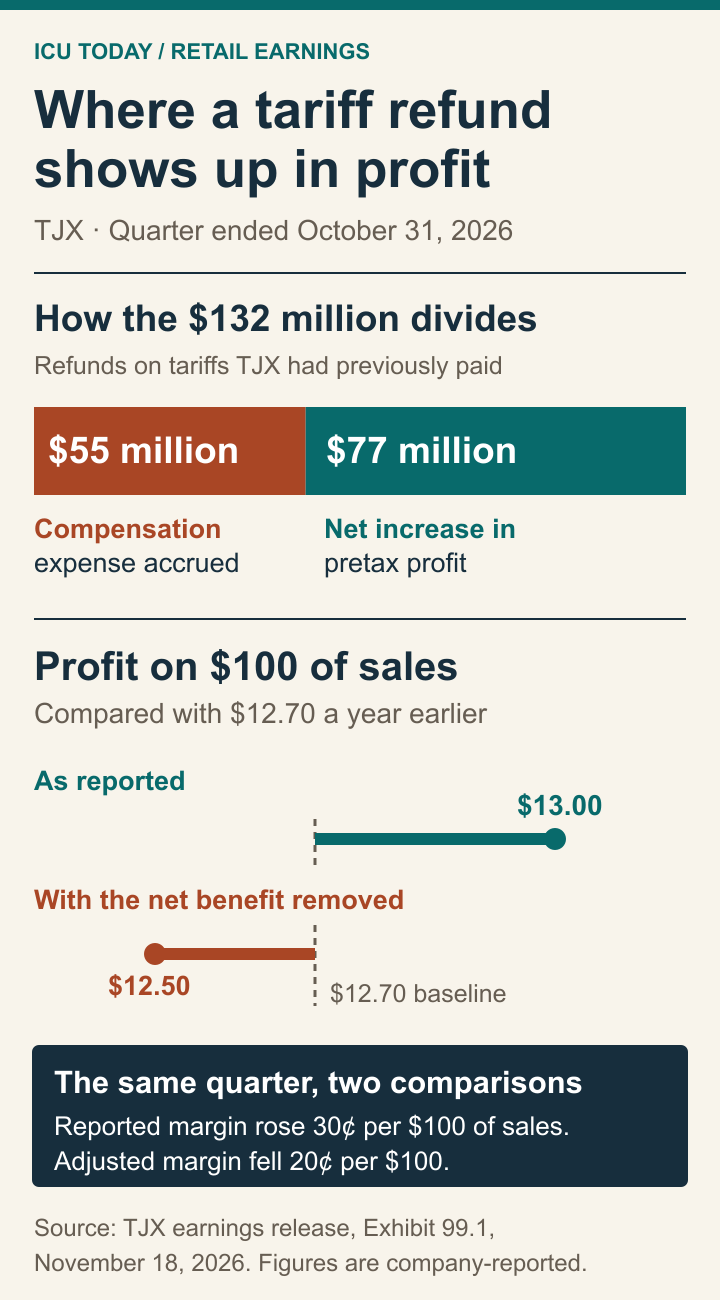
Where the $132 million went. For the quarter ended October 31, 2026, TJX reported $132 million in refunds on previously paid tariffs. The company accrued $55 million of incremental compensation expense. The remaining $77 million increased pretax profit. The compensation figure is an accrual, not a payment per worker.
Pretax profit per $100 of sales. Year-earlier quarter: $12.70. Current quarter as reported: $13.00, up 30 cents. Current quarter after removing the refund and the related compensation expense: $12.50, down 20 cents. Each comparison uses the same prior-year quarter.
Why the two margins moved in opposite directions. The refund after compensation added 50 cents of pretax profit per $100 of sales. Starting from the adjusted $12.50 and adding those 50 cents produces the reported $13.00. The prior-year comparison is $12.70 in both cases.
Graphic sources: U.S. Securities and Exchange Commission, EDGAR
The developing record.
Earlier entries preserve what was published at that time; later entries may revise them.
2026-11-19T05:03:41.561Z · Initial account of the TJX’s third-quarter sales, tariff refunds and related compensation expense.
Tariff refunds lifted TJX’s quarterly profit by $77 million before tax
The parent of TJ Maxx and Marshalls received $132 million back and booked $55 million in related compensation expense. Its earnings report shows how that changed the margin on every $100 of sales.
What happened
TJX, the parent of TJ Maxx and Marshalls, said it received $132 million in refunds on tariffs it had paid. In its November 18 earnings release, the retailer said it set aside $55 million for additional employee compensation tied to those refunds. That left a $77 million lift to pretax profit in the quarter ended October 31. The company reported $16 billion in sales, up 6% from a year earlier. [U.S. Securities and Exchange Commission, EDGAR]
Why it matters
Did TJX earn more profit on each dollar of sales? The answer depends on how the refund is counted. A year earlier, the company kept $12.70 in pretax profit for every $100 it sold. This quarter it reported $13.00. When TJX removed the refund and the related compensation expense, it calculated $12.50 on the same $100 of sales. On the reported measure its margin rose. On the adjusted measure its margin slipped. Both figures describe the same quarter. [U.S. Securities and Exchange Commission, EDGAR]
What remains unknown
The filing gives a total for the additional compensation expense. It covers year-end incentive pay and discretionary bonuses for eligible employees. That accrual records an expense in the quarter. It does not tell an individual employee how much they will receive. Nor does the refund figure show what shoppers paid for particular goods. The company’s sales and margin figures cover its business as a whole, including stores outside the United States. [U.S. Securities and Exchange Commission, EDGAR]
Read the infographic as text
Where the $132 million went. For the quarter ended October 31, 2026, TJX reported $132 million in refunds on previously paid tariffs. The company accrued $55 million of incremental compensation expense. The remaining $77 million increased pretax profit. The compensation figure is an accrual, not a payment per worker.
Pretax profit per $100 of sales. Year-earlier quarter: $12.70. Current quarter as reported: $13.00, up 30 cents. Current quarter after removing the refund and the related compensation expense: $12.50, down 20 cents. Each comparison uses the same prior-year quarter.
Why the two margins moved in opposite directions. The refund after compensation added 50 cents of pretax profit per $100 of sales. Starting from the adjusted $12.50 and adding those 50 cents produces the reported $13.00. The prior-year comparison is $12.70 in both cases.
Graphic sources: U.S. Securities and Exchange Commission, EDGAR
Original sources
The TJX Companies reports third-quarter fiscal 2027 results, Exhibit 99.1 · Issuer: The TJX Companies, Inc. · Published 2026-11-18
Corrections
No corrections recorded.