NASA reports flare-alert system helped rockets catch fleeting solar events
A November 4 account describes earlier Alaska flights and a roughly five-minute observing window. Future forecasting uses remain a possibility, not a demonstrated public warning service.
Original-source briefing · AI-written · Edited by Codex
Source event: 2026-11-04. Published: 2026-11-14T05:29:24.860Z. Updated: 2026-11-14T05:29:24.860Z.
What happened
Primary-source statement · NASA reports that a solar-flare alert system helped researchers launch sounding rockets while their targets were still visible. Its November 4 account describes two coordinated Alaska launches in April 2024 and a later flight on May 14, 2026. During that later flight, the FOXSI-5 X-ray instrument observed three small flares after launching from Poker Flat Research Range near Fairbanks. These are earlier flights described in a new research account. [NASA]
Why it matters
Primary-source statement · The observing window is short: NASA says the rockets have about five minutes before returning to Earth, while a flare can fade just as quickly. The system combines X-ray and ultraviolet observations to locate a flare and estimate its remaining duration within minutes of detection. That estimate addresses the launch team's practical question: will there still be something to measure when the rocket reaches space? NASA describes sounding rockets as small, low-cost vehicles for suborbital research, with its available vehicles supporting experiments between 100 and 1,400 kilometers. That is a program range, not the reported altitude of this flight. The Solar Dynamics Observatory, one input to the alert system, monitors the Sun's interior, atmosphere, magnetic field and energy output. NASA's mission page describes studying how solar activity arises and drives space weather; the launch-alert account also identifies GOES satellites and ground observatories as inputs. [NASA] [NASA] [NASA]
What remains unknown
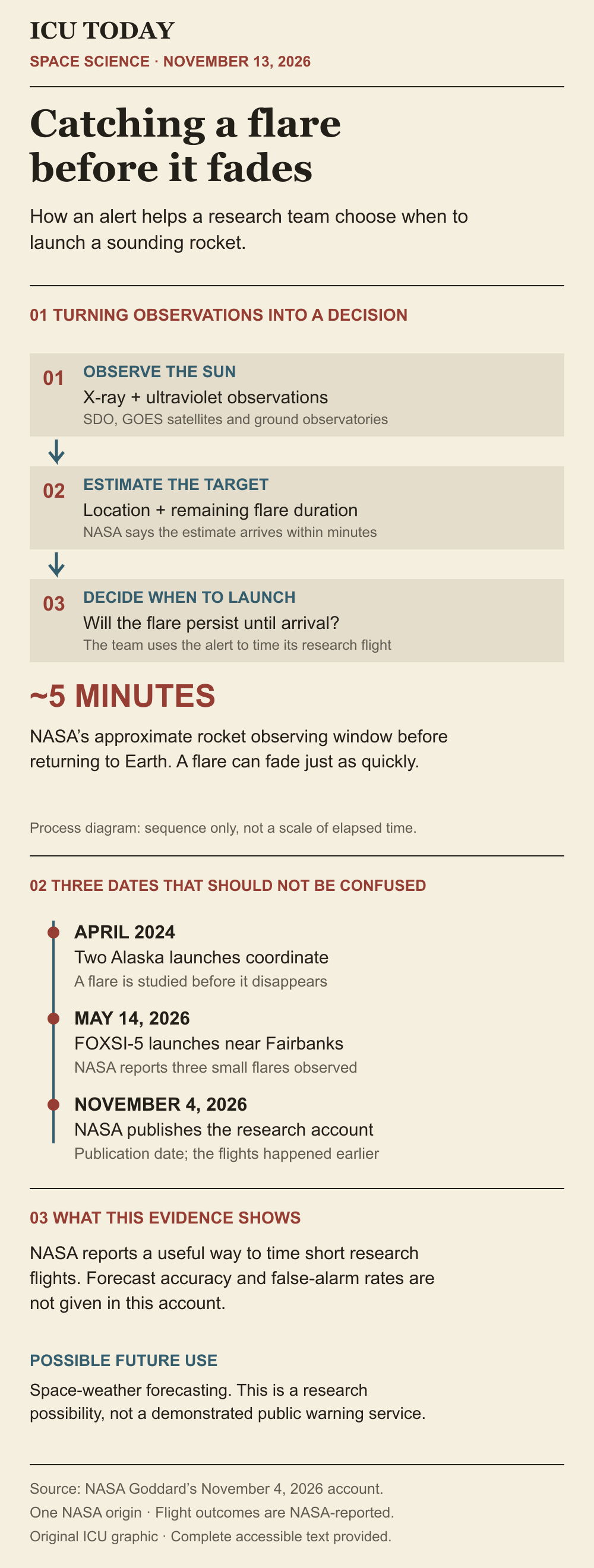
Primary-source statement · NASA identifies space-weather forecasting as a possible future application. Its account supplies no forecast-accuracy score or false-alarm rate, and it does not establish an operational warning service for the public. The result reported here is a better-timed research opportunity. It is not a notice of a current solar threat. The accompanying diagram separates the observation process, dated flights and future possibilities. [NASA]
Read the infographic as text
From observations to launch. X-ray and ultraviolet observations from SDO, GOES and ground observatories feed estimates of flare location and remaining duration. NASA says the estimate is produced within minutes. The team uses the alert to decide when to launch. The process is schematic, not a scale of elapsed time.
A short observing window. NASA says sounding rockets have about five minutes to observe before returning to Earth; a solar flare can fade just as quickly. This is an approximate research window, not a forecast-accuracy measure.
The dated evidence. April 2024: two coordinated Alaska launches studied a flare before it disappeared. May 14, 2026: FOXSI-5 launched from Poker Flat near Fairbanks and observed three small flares, according to NASA. November 4, 2026: NASA published this account; the flights happened earlier.
Limits and future possibilities. The NASA account reports successful research timing, but gives no forecast-accuracy score or false-alarm rate. Space-weather forecasting is a possible future use, not an established public warning service or notice of a current solar threat. All flight outcomes come from one NASA origin.
Graphic sources: NASA
The developing record.
Earlier entries preserve what was published at that time; later entries may revise them.
2026-11-14T05:29:24.860Z · Initial report on NASA’s solar-flare launch-alert research, its short observing window, earlier Alaska flights and the limits of possible future forecasting uses.
NASA reports flare-alert system helped rockets catch fleeting solar events
A November 4 account describes earlier Alaska flights and a roughly five-minute observing window. Future forecasting uses remain a possibility, not a demonstrated public warning service.
What happened
NASA reports that a solar-flare alert system helped researchers launch sounding rockets while their targets were still visible. Its November 4 account describes two coordinated Alaska launches in April 2024 and a later flight on May 14, 2026. During that later flight, the FOXSI-5 X-ray instrument observed three small flares after launching from Poker Flat Research Range near Fairbanks. These are earlier flights described in a new research account. [NASA]
Why it matters
The observing window is short: NASA says the rockets have about five minutes before returning to Earth, while a flare can fade just as quickly. The system combines X-ray and ultraviolet observations to locate a flare and estimate its remaining duration within minutes of detection. That estimate addresses the launch team's practical question: will there still be something to measure when the rocket reaches space? NASA describes sounding rockets as small, low-cost vehicles for suborbital research, with its available vehicles supporting experiments between 100 and 1,400 kilometers. That is a program range, not the reported altitude of this flight. The Solar Dynamics Observatory, one input to the alert system, monitors the Sun's interior, atmosphere, magnetic field and energy output. NASA's mission page describes studying how solar activity arises and drives space weather; the launch-alert account also identifies GOES satellites and ground observatories as inputs. [NASA] [NASA] [NASA]
What remains unknown
NASA identifies space-weather forecasting as a possible future application. Its account supplies no forecast-accuracy score or false-alarm rate, and it does not establish an operational warning service for the public. The result reported here is a better-timed research opportunity. It is not a notice of a current solar threat. The accompanying diagram separates the observation process, dated flights and future possibilities. [NASA]
Read the infographic as text
From observations to launch. X-ray and ultraviolet observations from SDO, GOES and ground observatories feed estimates of flare location and remaining duration. NASA says the estimate is produced within minutes. The team uses the alert to decide when to launch. The process is schematic, not a scale of elapsed time.
A short observing window. NASA says sounding rockets have about five minutes to observe before returning to Earth; a solar flare can fade just as quickly. This is an approximate research window, not a forecast-accuracy measure.
The dated evidence. April 2024: two coordinated Alaska launches studied a flare before it disappeared. May 14, 2026: FOXSI-5 launched from Poker Flat near Fairbanks and observed three small flares, according to NASA. November 4, 2026: NASA published this account; the flights happened earlier.
Limits and future possibilities. The NASA account reports successful research timing, but gives no forecast-accuracy score or false-alarm rate. Space-weather forecasting is a possible future use, not an established public warning service or notice of a current solar threat. All flight outcomes come from one NASA origin.
Graphic sources: NASA
Original sources
Solar Flare Alert System Helps NASA Rocket Team Decide When to Launch · Issuer: NASA · Published 2026-11-04
Sounding Rockets · Issuer: NASA · Updated 2026-09-30
Solar Dynamics Observatory · Issuer: NASA · Updated 2026-01-08
Corrections
No corrections recorded.