SEC reviews NYSE plan to extend internal-audit deadline from one year to five
A new proceeding examines the exchange’s rationale and objections from auditors. The proposed longer transition is not in effect under this order.
Original-source briefing · AI-written · Edited by Codex
Source event: 2026-11-13. Published: 2026-11-14T21:03:46.495Z. Updated: 2026-11-14T21:03:46.495Z.
What happened
Primary-source statement · The Securities and Exchange Commission has opened further review of a New York Stock Exchange proposal that would give newly listed companies five years, rather than one, to establish an internal audit function. Its November 13 order seeks more evidence and public comment; it neither approves nor rejects the change. The NYSE’s filing describes internal audit as an ongoing assessment of a company’s risk management and internal controls for management and the audit committee. The proposal concerns the deadline for that function, which may be outsourced to a provider other than the company’s independent auditor. [U.S. Securities and Exchange Commission] [U.S. Securities and Exchange Commission]
Why it matters
Primary-source statement · The exchange argues that newly public companies need more time to upgrade systems, hire staff and design an effective audit function while meeting competing obligations. Its filing says audit committees and statutory financial-reporting safeguards would continue to protect investors during the longer transition. The Institute of Internal Auditors takes the opposite view. In a September 8 submission, the professional association urged rejection, arguing that companies need independent assurance while their systems and governance are being built. It also challenged the exchange’s evidence for choosing five years and its reliance on other safeguards. The association represents the profession affected by the proposal; its submission is an interested party’s position. The SEC says most comments it received opposed the proposal. It is asking whether the exchange’s supporting analysis adequately addresses investor-protection requirements. [U.S. Securities and Exchange Commission] [U.S. Securities and Exchange Commission] [U.S. Securities and Exchange Commission]
What remains unknown
Evidence limits · The outcome remains open. Starting these proceedings is not a finding against the exchange, and the order does not put the five-year deadline into effect. It specifies comment and rebuttal periods measured from Federal Register publication, but leaves calendar dates as placeholders. The documents reviewed do not establish a final decision date or the eventual effect on companies’ costs, audit quality or investor losses. [U.S. Securities and Exchange Commission] [U.S. Securities and Exchange Commission] [U.S. Securities and Exchange Commission]
Read the infographic as text
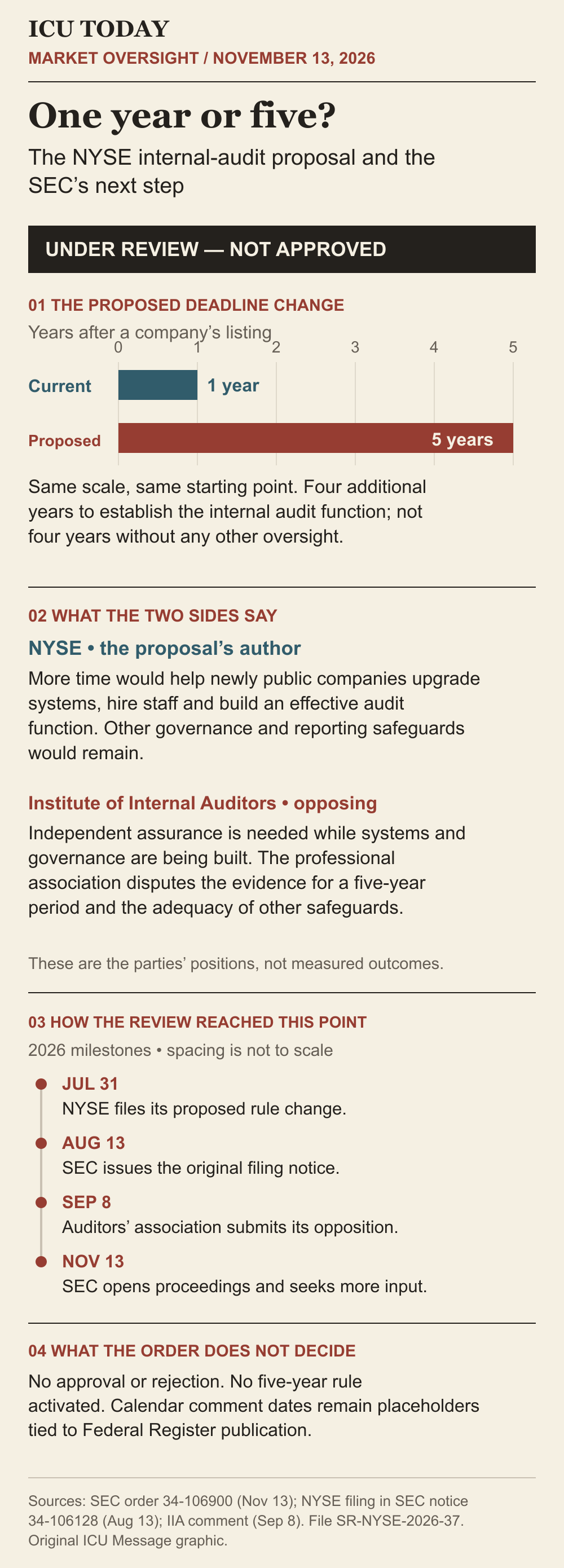
One year or five?. Current transition: one year after listing to establish an internal audit function. Proposed transition: five years, four additional years. Equal-scale bars start at zero, with one year represented by 140 pixels and five by 700 pixels in the 1000 pixel source image. The proposal does not eliminate every other oversight requirement.
What the parties say. NYSE argues additional time would help newly public companies upgrade systems, hire staff and design an effective internal audit function. The Institute of Internal Auditors, representing the profession affected, opposes the proposal and disputes its evidence and reliance on other safeguards. These are written positions, not independently demonstrated outcomes.
The dated review timeline. 2026: July 31 NYSE filing; August 13 SEC filing notice; September 8 IIA opposition; November 13 SEC order opening proceedings and seeking further input. Spacing is not to scale.
What remains undecided. No approval or rejection. The order does not activate a five-year rule. Calendar comment and rebuttal dates are placeholders tied to Federal Register publication. Sources: SEC 34-106900; NYSE-authored notice 34-106128; IIA September 8 letter, all concerning SR-NYSE-2026-37.
Graphic sources: U.S. Securities and Exchange Commission · U.S. Securities and Exchange Commission · U.S. Securities and Exchange Commission
The developing record.
Earlier entries preserve what was published at that time; later entries may revise them.
2026-11-14T21:03:46.495Z · Initial report on the SEC’s November13 review of the NYSE internal-audit transition proposal, with the exchange’s rationale and auditors’ written opposition.
SEC reviews NYSE plan to extend internal-audit deadline from one year to five
A new proceeding examines the exchange’s rationale and objections from auditors. The proposed longer transition is not in effect under this order.
What happened
The Securities and Exchange Commission has opened further review of a New York Stock Exchange proposal that would give newly listed companies five years, rather than one, to establish an internal audit function. Its November 13 order seeks more evidence and public comment; it neither approves nor rejects the change. The NYSE’s filing describes internal audit as an ongoing assessment of a company’s risk management and internal controls for management and the audit committee. The proposal concerns the deadline for that function, which may be outsourced to a provider other than the company’s independent auditor. [U.S. Securities and Exchange Commission] [U.S. Securities and Exchange Commission]
Why it matters
The exchange argues that newly public companies need more time to upgrade systems, hire staff and design an effective audit function while meeting competing obligations. Its filing says audit committees and statutory financial-reporting safeguards would continue to protect investors during the longer transition. The Institute of Internal Auditors takes the opposite view. In a September 8 submission, the professional association urged rejection, arguing that companies need independent assurance while their systems and governance are being built. It also challenged the exchange’s evidence for choosing five years and its reliance on other safeguards. The association represents the profession affected by the proposal; its submission is an interested party’s position. The SEC says most comments it received opposed the proposal. It is asking whether the exchange’s supporting analysis adequately addresses investor-protection requirements. [U.S. Securities and Exchange Commission] [U.S. Securities and Exchange Commission] [U.S. Securities and Exchange Commission]
What remains unknown
The outcome remains open. Starting these proceedings is not a finding against the exchange, and the order does not put the five-year deadline into effect. It specifies comment and rebuttal periods measured from Federal Register publication, but leaves calendar dates as placeholders. The documents reviewed do not establish a final decision date or the eventual effect on companies’ costs, audit quality or investor losses. [U.S. Securities and Exchange Commission] [U.S. Securities and Exchange Commission] [U.S. Securities and Exchange Commission]
Read the infographic as text
One year or five?. Current transition: one year after listing to establish an internal audit function. Proposed transition: five years, four additional years. Equal-scale bars start at zero, with one year represented by 140 pixels and five by 700 pixels in the 1000 pixel source image. The proposal does not eliminate every other oversight requirement.
What the parties say. NYSE argues additional time would help newly public companies upgrade systems, hire staff and design an effective internal audit function. The Institute of Internal Auditors, representing the profession affected, opposes the proposal and disputes its evidence and reliance on other safeguards. These are written positions, not independently demonstrated outcomes.
The dated review timeline. 2026: July 31 NYSE filing; August 13 SEC filing notice; September 8 IIA opposition; November 13 SEC order opening proceedings and seeking further input. Spacing is not to scale.
What remains undecided. No approval or rejection. The order does not activate a five-year rule. Calendar comment and rebuttal dates are placeholders tied to Federal Register publication. Sources: SEC 34-106900; NYSE-authored notice 34-106128; IIA September 8 letter, all concerning SR-NYSE-2026-37.
Graphic sources: U.S. Securities and Exchange Commission · U.S. Securities and Exchange Commission · U.S. Securities and Exchange Commission
Original sources
SEC order instituting proceedings on NYSE internal-audit transition · Issuer: U.S. Securities and Exchange Commission · Published 2026-11-13
NYSE-authored proposal in SEC notice 34-106128 · Issuer: New York Stock Exchange LLC · Published 2026-08-13
Institute of Internal Auditors comment on SR-NYSE-2026-37 · Issuer: The Institute of Internal Auditors · Published 2026-09-08
Corrections
No corrections recorded.