SEC bars penny-stock telemarketer after reviewing matched trades
The November 13 order adds industry restrictions after an earlier civil judgment. The SEC explains why that judgment alone did not settle the underlying facts.
Original-source briefing · AI-written · Edited by Codex
Source event: 2026-11-13. Published: 2026-11-16T02:48:21.847Z. Updated: 2026-11-16T02:48:21.847Z.
What happened
Primary-source statement · The Securities and Exchange Commission barred Christopher Byungin Lee from securities-industry associations and penny-stock offerings in a November 13 opinion and order. The commission found that he had worked as an unregistered broker, earned more than $1 million in commissions and helped coordinate matched trades. Its new administrative restrictions follow a July 2022 civil default judgment; they are not a new criminal conviction. [Securities and Exchange Commission]
Why it matters
Primary-source statement · The opinion describes a sales process that concealed the seller’s role from prospective buyers. Telemarketers solicited investors, then coordinated the same price and number of shares on opposing buy and sell orders, allowing existing shareholders to exit. The SEC’s reasoning also distinguishes a default judgment from proof of every underlying allegation. It required additional evidence before deciding that an industry ban served the public interest. The resulting order restricts industry associations and penny-stock promotion, while preserving otherwise lawful trading in Lee’s personal account. [Securities and Exchange Commission]
What remains unknown
Evidence limits · According to the commission, Lee requested a settlement in his March 2025 answer but did not respond to the later motions or supplemental briefing. This report relies on the SEC’s written findings, not an independently obtained response from Lee. The document does not establish any later appeal, recovery for investors or payment of the earlier $1.14 million civil penalty. It provides no basis for describing these administrative sanctions as a criminal sentence. [Securities and Exchange Commission]
This report describes SEC civil and administrative findings. It is not a criminal-charge report or personal investment or legal advice.
Read the infographic as text
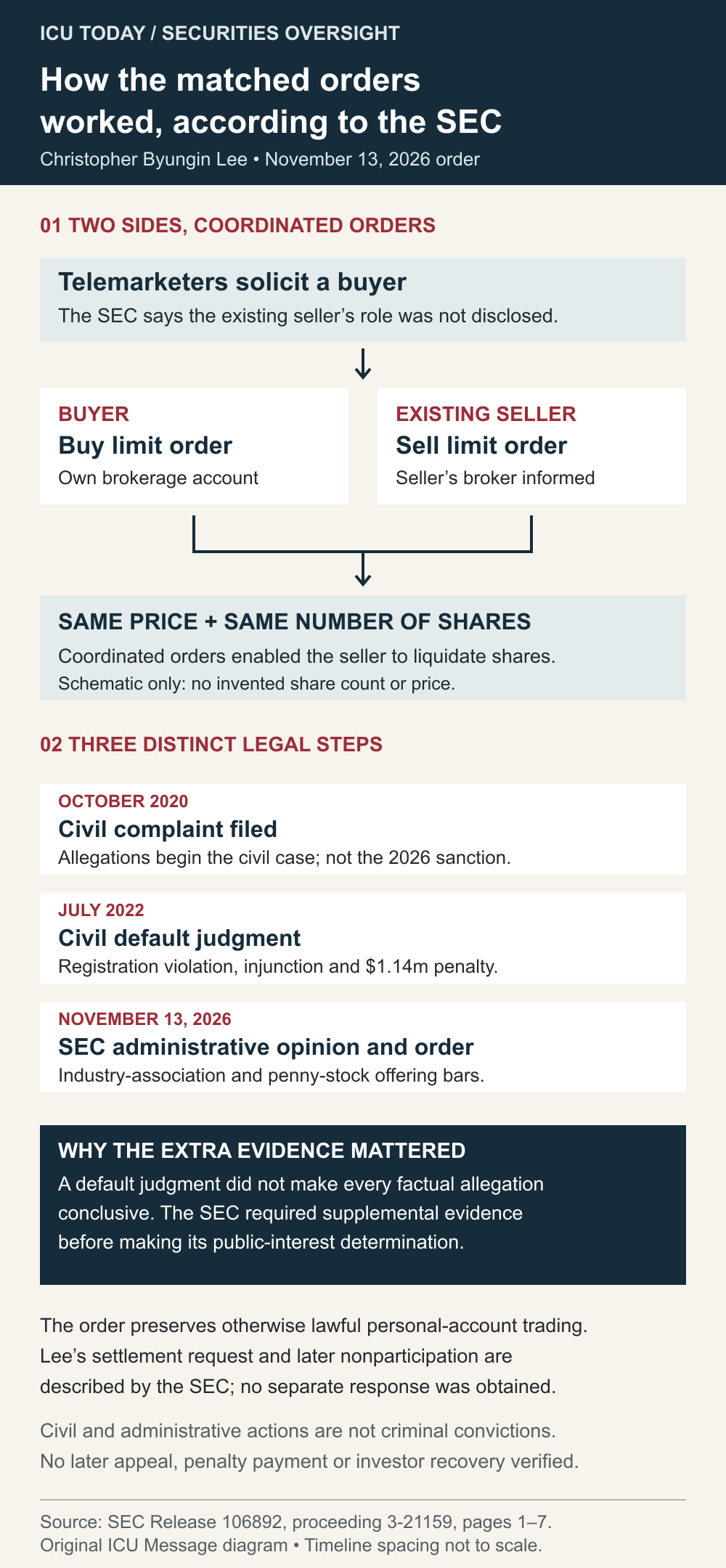
How the orders matched. According to the SEC, telemarketers solicited buyers without disclosing the existing seller’s role. The buyer placed a buy limit order in their own brokerage account. The seller’s broker received the same price and share quantity for a sell limit order, enabling the existing shareholder to liquidate shares. No sample price or quantity is invented.
Procedural timeline. October2020: SEC civil complaint. July2022: civil default judgment for a registration violation, injunction and $1,144,061.81 penalty. November13,2026: SEC administrative industry-association and penny-stock offering bars. A default judgment did not conclusively establish every factual allegation; the commission required supplemental evidence for its public-interest determination.
Limits and response. Otherwise lawful personal-account trading remains permitted. The SEC describes Lee’s March2025 settlement request and his later nonparticipation; this report obtained no separate response. No new criminal conviction, later appeal, penalty payment or investor recovery is established. One SEC agency origin; not independent verification of every underlying allegation.
Graphic sources: Securities and Exchange Commission
The developing record.
Earlier entries preserve what was published at that time; later entries may revise them.
2026-11-16T02:48:21.847Z · Initial report on the November13 SEC industry and penny-stock bars, with an explanatory matched-order diagram and procedural timeline.
SEC bars penny-stock telemarketer after reviewing matched trades
The November 13 order adds industry restrictions after an earlier civil judgment. The SEC explains why that judgment alone did not settle the underlying facts.
What happened
The Securities and Exchange Commission barred Christopher Byungin Lee from securities-industry associations and penny-stock offerings in a November 13 opinion and order. The commission found that he had worked as an unregistered broker, earned more than $1 million in commissions and helped coordinate matched trades. Its new administrative restrictions follow a July 2022 civil default judgment; they are not a new criminal conviction. [Securities and Exchange Commission]
Why it matters
The opinion describes a sales process that concealed the seller’s role from prospective buyers. Telemarketers solicited investors, then coordinated the same price and number of shares on opposing buy and sell orders, allowing existing shareholders to exit. The SEC’s reasoning also distinguishes a default judgment from proof of every underlying allegation. It required additional evidence before deciding that an industry ban served the public interest. The resulting order restricts industry associations and penny-stock promotion, while preserving otherwise lawful trading in Lee’s personal account. [Securities and Exchange Commission]
What remains unknown
According to the commission, Lee requested a settlement in his March 2025 answer but did not respond to the later motions or supplemental briefing. This report relies on the SEC’s written findings, not an independently obtained response from Lee. The document does not establish any later appeal, recovery for investors or payment of the earlier $1.14 million civil penalty. It provides no basis for describing these administrative sanctions as a criminal sentence. [Securities and Exchange Commission]
Read the infographic as text
How the orders matched. According to the SEC, telemarketers solicited buyers without disclosing the existing seller’s role. The buyer placed a buy limit order in their own brokerage account. The seller’s broker received the same price and share quantity for a sell limit order, enabling the existing shareholder to liquidate shares. No sample price or quantity is invented.
Procedural timeline. October2020: SEC civil complaint. July2022: civil default judgment for a registration violation, injunction and $1,144,061.81 penalty. November13,2026: SEC administrative industry-association and penny-stock offering bars. A default judgment did not conclusively establish every factual allegation; the commission required supplemental evidence for its public-interest determination.
Limits and response. Otherwise lawful personal-account trading remains permitted. The SEC describes Lee’s March2025 settlement request and his later nonparticipation; this report obtained no separate response. No new criminal conviction, later appeal, penalty payment or investor recovery is established. One SEC agency origin; not independent verification of every underlying allegation.
Graphic sources: Securities and Exchange Commission
Original sources
Opinion and order, Release106892, Christopher Byungin Lee, November13,2026 · Issuer: Securities and Exchange Commission · Published 2026-11-13
Corrections
No corrections recorded.