SEC proposes fewer named executives and a higher perks threshold in pay disclosures
The proposal would reorganize compensation tables, usually focus individual disclosures on two top officers and raise the minimum aggregate perks-reporting threshold. It is a proposal, not an adopted rule.
Original-source briefing · AI-written · Edited by Codex
Source event: 2026-11-13. Published: 2026-11-13T19:09:48.673Z. Updated: 2026-11-13T19:09:48.673Z.
What happened
Primary-source statement · The Securities and Exchange Commission proposed a broad rewrite of executive and director compensation disclosures on November 13. In its announcement, the agency described changes to the people covered, the tables companies present and the treatment of executive perks. The proposal concerns Item 402 of Regulation S-K. The SEC says it follows a review of compensation disclosure requirements, public comments and a roundtable with companies, investors and other participants. The announcement describes proposed amendments, not a final rule taking effect. [U.S. Securities and Exchange Commission]
Two officers, in most circumstances
Primary-source statement · According to the SEC’s comparison, current rules typically cover five or more named executive officers. The proposal would generally focus on the principal executive officer and principal financial officer, reducing that number to two in most circumstances. The agency also proposes replacing four primary compensation tables with three: an Earned Compensation Table, a Granted Compensation Table and a Status of Equity Awards Table, accompanied by explanatory narratives. Those names separate amounts earned, awards granted and the status of equity awards; they should not be read as three interchangeable totals. [U.S. Securities and Exchange Commission]
A different threshold for perks
Primary-source statement · The SEC says the minimum aggregate reporting threshold for perquisites would rise from $10,000 to $150,000. It also proposes a small-value tracking exclusion and more flexibility in deciding whether a benefit is a perquisite, provided the determination is reasonable and made in good faith. The dollar comparison describes a proposed disclosure threshold. It is not a measurement of what any executive received, and the announcement does not supply the details needed to decide how a particular benefit would be treated. [U.S. Securities and Exchange Commission]
Changes to pay comparisons
Primary-source statement · For pay-versus-performance reporting, the agency proposes fewer required performance measures and replacing the existing Compensation Actually Paid calculation with total compensation earned from the proposed Earned Compensation Table. It would also narrow the population used to identify the median employee for the pay-ratio rule to U.S. full-time employees, with that determination made every five years. That five-year interval refers to identifying the median employee; the announcement does not say companies would publish all compensation disclosures only once every five years. [U.S. Securities and Exchange Commission]
Why it matters
Primary-source statement · These proposed changes concern the information investors see when reading companies’ compensation disclosures. The SEC presents them as a way to reduce complexity and compliance burdens while retaining material information. Those are the agency’s stated aims, not demonstrated results of a rule already operating. Its announcement says the disclosure framework was last comprehensively reformed in 2006, placing the proposal within a longer review of how compensation information is presented. [U.S. Securities and Exchange Commission]
What remains unknown
Evidence limits · The announcement says comments will remain open for 60 days after the proposing release is published in the Federal Register. November 13 is the announcement date, not automatically the start of that clock. This account examines the SEC’s complete announcement text; the underlying proposing rule and fact sheet were not reviewed. Whether amendments will be adopted, their final wording and their eventual effects remain unresolved. The infographic compares selected existing requirements as described by the SEC with the proposed changes. [U.S. Securities and Exchange Commission]
Read the infographic as text
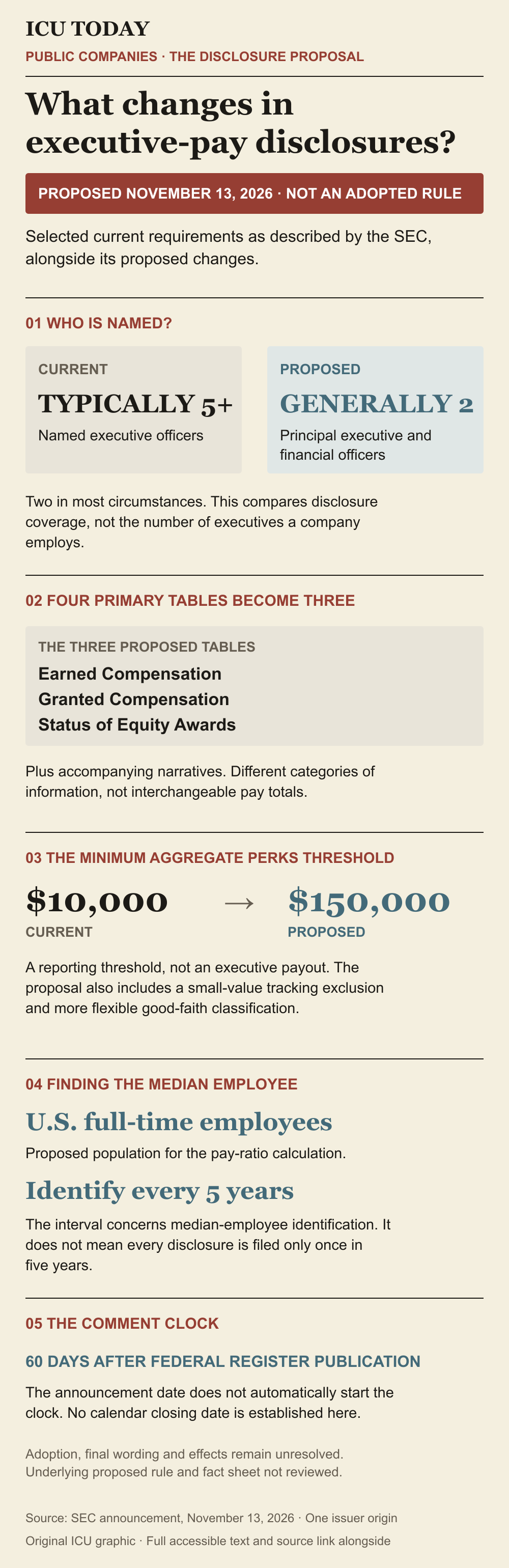
Who is individually covered. Current requirements, as described by the SEC: typically five or more named executive officers. Proposed: the principal executive officer and principal financial officer, two in most circumstances. This is a disclosure-population comparison, not a count of executives employed by a company.
How the pay tables change. The SEC proposes replacing four primary compensation tables with three: Earned Compensation Table, Granted Compensation Table and Status of Equity Awards Table, plus accompanying narratives. These are different categories of information, not interchangeable amounts.
The proposed perks threshold. The minimum aggregate perquisite reporting threshold would rise from $10,000 to $150,000. These amounts describe a disclosure threshold, not executive payouts. The proposal also includes a small-value tracking exclusion and more flexible classification subject to reasonable, good-faith determinations. Particular benefits and exceptions require the underlying rule text, not this overview.
The median-employee calculation. Proposed: use U.S. full-time employees to identify the median employee under the pay-ratio rule, and make that determination every five years. The five-year interval concerns median-employee identification; it is not a statement that all compensation reporting becomes five-yearly.
The comment clock and unresolved outcome. November 13, 2026: SEC announces the proposal. Federal Register publication of the proposing release starts the 60-day comment period. That publication date and a calendar closing date are not established here. Adoption, final wording and effects remain unresolved. One SEC announcement is reviewed; the underlying proposed rule and fact sheet were not reviewed.
Graphic sources: U.S. Securities and Exchange Commission
The developing record.
Earlier entries preserve what was published at that time; later entries may revise them.
2026-11-13T19:09:48.673Z · Initial SEC-attributed report of the proposed compensation-disclosure changes, with a detailed current-versus-proposed infographic and an event-triggered comment-period explanation.
SEC proposes fewer named executives and a higher perks threshold in pay disclosures
The proposal would reorganize compensation tables, usually focus individual disclosures on two top officers and raise the minimum aggregate perks-reporting threshold. It is a proposal, not an adopted rule.
What happened
The Securities and Exchange Commission proposed a broad rewrite of executive and director compensation disclosures on November 13. In its announcement, the agency described changes to the people covered, the tables companies present and the treatment of executive perks. The proposal concerns Item 402 of Regulation S-K. The SEC says it follows a review of compensation disclosure requirements, public comments and a roundtable with companies, investors and other participants. The announcement describes proposed amendments, not a final rule taking effect. [U.S. Securities and Exchange Commission]
Two officers, in most circumstances
According to the SEC’s comparison, current rules typically cover five or more named executive officers. The proposal would generally focus on the principal executive officer and principal financial officer, reducing that number to two in most circumstances. The agency also proposes replacing four primary compensation tables with three: an Earned Compensation Table, a Granted Compensation Table and a Status of Equity Awards Table, accompanied by explanatory narratives. Those names separate amounts earned, awards granted and the status of equity awards; they should not be read as three interchangeable totals. [U.S. Securities and Exchange Commission]
A different threshold for perks
The SEC says the minimum aggregate reporting threshold for perquisites would rise from $10,000 to $150,000. It also proposes a small-value tracking exclusion and more flexibility in deciding whether a benefit is a perquisite, provided the determination is reasonable and made in good faith. The dollar comparison describes a proposed disclosure threshold. It is not a measurement of what any executive received, and the announcement does not supply the details needed to decide how a particular benefit would be treated. [U.S. Securities and Exchange Commission]
Changes to pay comparisons
For pay-versus-performance reporting, the agency proposes fewer required performance measures and replacing the existing Compensation Actually Paid calculation with total compensation earned from the proposed Earned Compensation Table. It would also narrow the population used to identify the median employee for the pay-ratio rule to U.S. full-time employees, with that determination made every five years. That five-year interval refers to identifying the median employee; the announcement does not say companies would publish all compensation disclosures only once every five years. [U.S. Securities and Exchange Commission]
Why it matters
These proposed changes concern the information investors see when reading companies’ compensation disclosures. The SEC presents them as a way to reduce complexity and compliance burdens while retaining material information. Those are the agency’s stated aims, not demonstrated results of a rule already operating. Its announcement says the disclosure framework was last comprehensively reformed in 2006, placing the proposal within a longer review of how compensation information is presented. [U.S. Securities and Exchange Commission]
What remains unknown
The announcement says comments will remain open for 60 days after the proposing release is published in the Federal Register. November 13 is the announcement date, not automatically the start of that clock. This account examines the SEC’s complete announcement text; the underlying proposing rule and fact sheet were not reviewed. Whether amendments will be adopted, their final wording and their eventual effects remain unresolved. The infographic compares selected existing requirements as described by the SEC with the proposed changes. [U.S. Securities and Exchange Commission]
Read the infographic as text
Who is individually covered. Current requirements, as described by the SEC: typically five or more named executive officers. Proposed: the principal executive officer and principal financial officer, two in most circumstances. This is a disclosure-population comparison, not a count of executives employed by a company.
How the pay tables change. The SEC proposes replacing four primary compensation tables with three: Earned Compensation Table, Granted Compensation Table and Status of Equity Awards Table, plus accompanying narratives. These are different categories of information, not interchangeable amounts.
The proposed perks threshold. The minimum aggregate perquisite reporting threshold would rise from $10,000 to $150,000. These amounts describe a disclosure threshold, not executive payouts. The proposal also includes a small-value tracking exclusion and more flexible classification subject to reasonable, good-faith determinations. Particular benefits and exceptions require the underlying rule text, not this overview.
The median-employee calculation. Proposed: use U.S. full-time employees to identify the median employee under the pay-ratio rule, and make that determination every five years. The five-year interval concerns median-employee identification; it is not a statement that all compensation reporting becomes five-yearly.
The comment clock and unresolved outcome. November 13, 2026: SEC announces the proposal. Federal Register publication of the proposing release starts the 60-day comment period. That publication date and a calendar closing date are not established here. Adoption, final wording and effects remain unresolved. One SEC announcement is reviewed; the underlying proposed rule and fact sheet were not reviewed.
Graphic sources: U.S. Securities and Exchange Commission
Original sources
SEC Proposes Executive and Director Compensation Disclosure Reforms · Issuer: U.S. Securities and Exchange Commission · Published 2026-11-13T16:57:00.000Z
Corrections
No corrections recorded.