SEC proposes taking direct control of the stock market’s audit trail
Exchanges and brokers would keep reporting much the same trading data. The proposed change is who receives it and how the SEC would pay for the system.
Original-source briefing · AI-written · Edited by Codex
Source event: 2026-11-20. Published: 2026-11-20T22:58:37.317Z. Updated: 2026-11-20T22:58:37.317Z.
What happened
Primary-source statement · The Securities and Exchange Commission proposed on November 20 that exchanges and broker-dealers send their trading records directly to the agency or to an operator it designates. Today those records go to the Consolidated Audit Trail, a system administered by participants in a national market plan. Regulators use the trail to enforce securities laws. Under the proposal, firms would continue to report much the same information. What would change is who runs the system that receives it. [U.S. Securities and Exchange Commission]
Why it matters
Primary-source statement · Responsibility for running the audit trail also raises a question about who pays the bill. Under the current rule, national securities exchanges and securities associations must establish and maintain the system. The SEC says it intends to use money appropriated by Congress to cover the agency’s costs of operating it under the proposed rule. In April, the agency asked for public comment on funding, governance and privacy. At that point it said earlier changes had already lowered projected annual operating costs by more than $100 million. That estimate predates Friday’s proposal. [U.S. Securities and Exchange Commission] [U.S. Securities and Exchange Commission]
What remains unknown
Primary-source statement · The rules in force have yet to change. The public will have 60 days to comment once the proposal appears in the Federal Register. The SEC’s announcement gives no date for a transfer of responsibility and does not identify an operator to receive reports on its behalf. The eventual choice of operator and the amount Congress might provide therefore remain open. [U.S. Securities and Exchange Commission]
Read the infographic as text
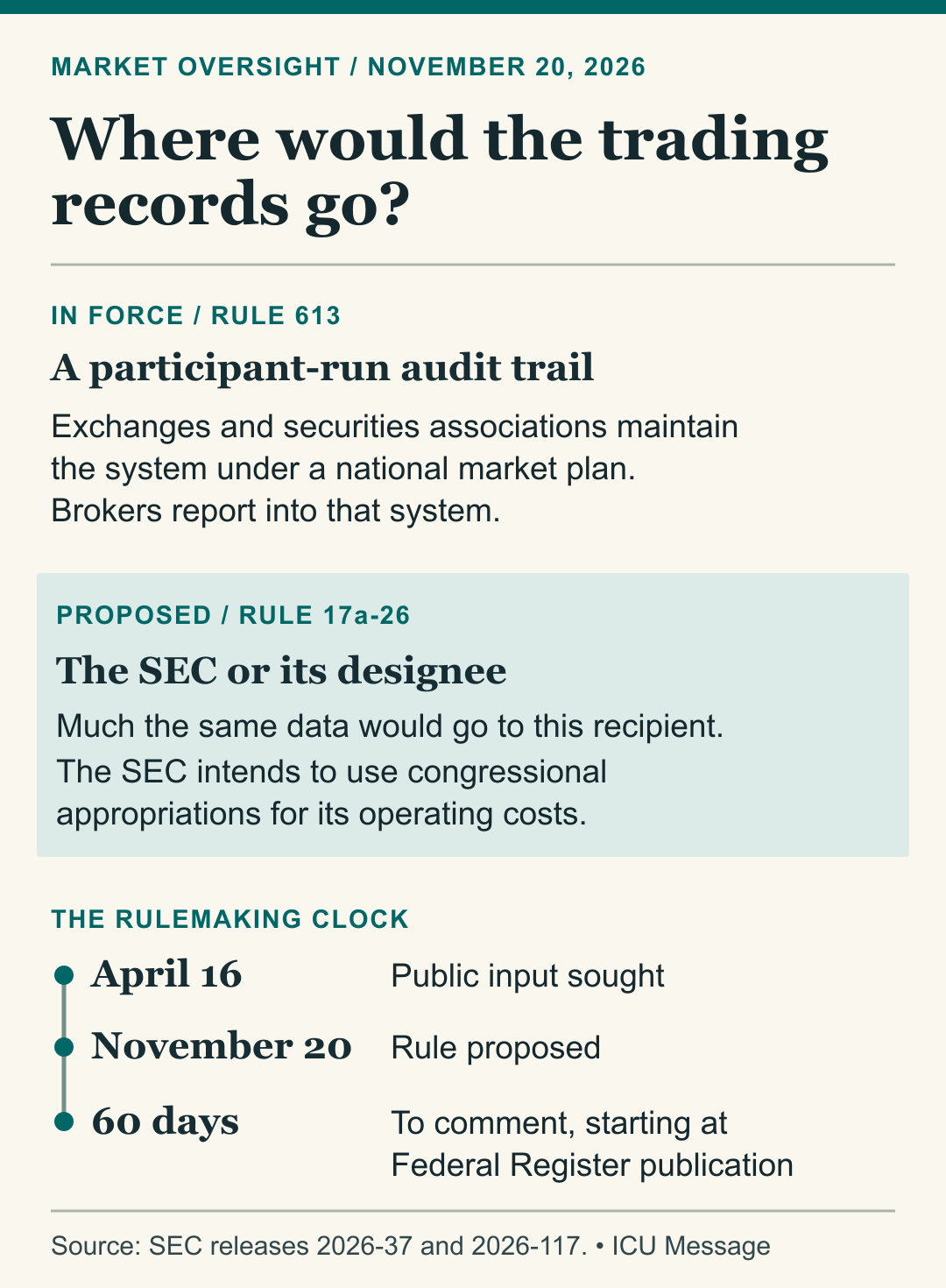
Current rule · 613. National exchanges and securities associations maintain the Consolidated Audit Trail under a national market system plan. Brokers report into the participant-run system.
Proposed rule · 17a-26. Exchanges, associations and brokers would report much the same data to the SEC or its designee. The SEC intends to use congressional appropriations for its costs.
How the proposal advances. April 16: the SEC requested public input. November 20: the SEC proposed a rule. Federal Register publication starts a 60-day comment period. A date for transfer has yet to be set.
Graphic sources: U.S. Securities and Exchange Commission · U.S. Securities and Exchange Commission
The developing record.
Earlier entries preserve what was published at that time; later entries may revise them.
2026-11-20T22:58:37.317Z · The SEC proposed moving the Consolidated Audit Trail under its direct control and opened a path to public comment.
SEC proposes taking direct control of the stock market’s audit trail
Exchanges and brokers would keep reporting much the same trading data. The proposed change is who receives it and how the SEC would pay for the system.
What happened
The Securities and Exchange Commission proposed on November 20 that exchanges and broker-dealers send their trading records directly to the agency or to an operator it designates. Today those records go to the Consolidated Audit Trail, a system administered by participants in a national market plan. Regulators use the trail to enforce securities laws. Under the proposal, firms would continue to report much the same information. What would change is who runs the system that receives it. [U.S. Securities and Exchange Commission]
Why it matters
Responsibility for running the audit trail also raises a question about who pays the bill. Under the current rule, national securities exchanges and securities associations must establish and maintain the system. The SEC says it intends to use money appropriated by Congress to cover the agency’s costs of operating it under the proposed rule. In April, the agency asked for public comment on funding, governance and privacy. At that point it said earlier changes had already lowered projected annual operating costs by more than $100 million. That estimate predates Friday’s proposal. [U.S. Securities and Exchange Commission] [U.S. Securities and Exchange Commission]
What remains unknown
The rules in force have yet to change. The public will have 60 days to comment once the proposal appears in the Federal Register. The SEC’s announcement gives no date for a transfer of responsibility and does not identify an operator to receive reports on its behalf. The eventual choice of operator and the amount Congress might provide therefore remain open. [U.S. Securities and Exchange Commission]
Read the infographic as text
Current rule · 613. National exchanges and securities associations maintain the Consolidated Audit Trail under a national market system plan. Brokers report into the participant-run system.
Proposed rule · 17a-26. Exchanges, associations and brokers would report much the same data to the SEC or its designee. The SEC intends to use congressional appropriations for its costs.
How the proposal advances. April 16: the SEC requested public input. November 20: the SEC proposed a rule. Federal Register publication starts a 60-day comment period. A date for transfer has yet to be set.
Graphic sources: U.S. Securities and Exchange Commission · U.S. Securities and Exchange Commission
Original sources
SEC proposes restructuring the Consolidated Audit Trail · Issuer: U.S. Securities and Exchange Commission · Published 2026-11-20
SEC opens its review of market audit trails · Issuer: U.S. Securities and Exchange Commission · Published 2026-04-16
Corrections
No corrections recorded.