SEC censures Cannon instead of imposing the industry bar staff sought
The November 13 decision separates proven registration violations from the question of how severely to restrict a securities professional.
Original-source briefing · AI-written · Edited by Codex
Source event: 2026-11-13. Published: 2026-11-16T04:47:12.096Z. Updated: 2026-11-16T04:47:12.096Z.
What happened
Primary-source statement · The Securities and Exchange Commission censured Eric Christopher Cannon on November 13, declining its enforcement division’s request for securities-industry and penny-stock bars. The commission’s opinion describes an earlier federal court judgment against Cannon for selling unregistered securities and acting as an unregistered broker while working as a Pacific West Capital Group sales agent. According to the opinion, the court imposed a permanent injunction, a $15,000 civil penalty and $219,333.33 in disgorgement; the Ninth Circuit later affirmed the judgment and remedies. [U.S. Securities and Exchange Commission]
Why it matters
Primary-source statement · The new decision addresses the administrative sanction following that court case. The SEC called Cannon’s repeated conduct serious and said his wish to continue working in the industry created opportunities for future violations. But it also cited the court’s finding that he could reasonably have believed the interests were exempt from registration because the legal question was close. The commission said it could not conclude that Cannon knowingly crossed the registration boundary or even acted negligently. It credited his assurances against future violations and recognition of wrongdoing when choosing censure. [U.S. Securities and Exchange Commission]
What remains unknown
Evidence limits · Cannon’s objections are described in the SEC opinion, which rejected his requests to dismiss the proceeding. This report does not include a separately obtained response from him or his counsel after the decision. The order establishes the commission’s censure; it does not establish whether Cannon will seek further review or how any later proceeding would conclude. [U.S. Securities and Exchange Commission]
Read the infographic as text
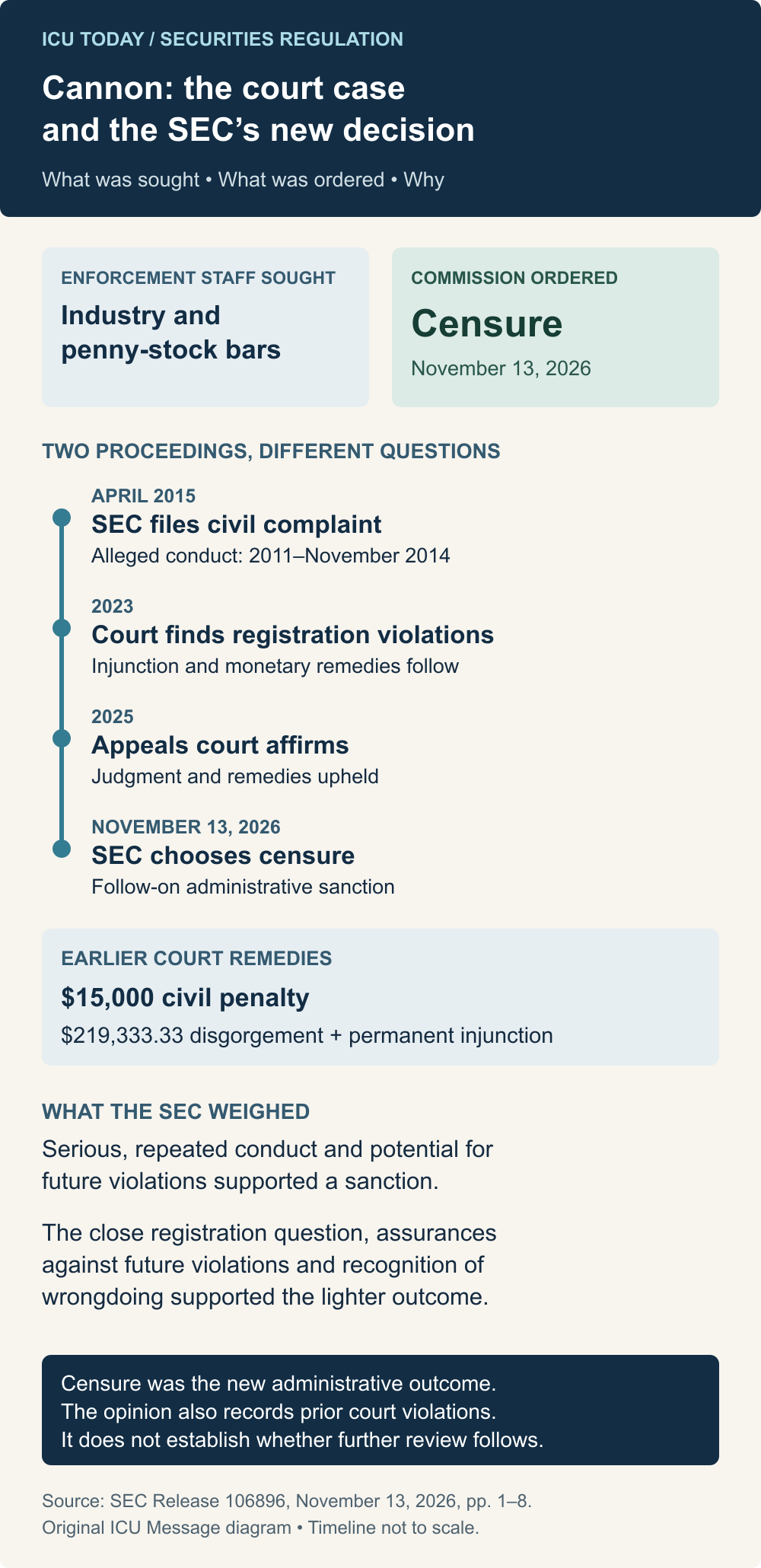
Requested and ordered. Enforcement staff sought securities-industry and penny-stock bars. The Commission ordered censure on November 13, 2026.
Case timeline. April 2015: SEC files civil complaint concerning 2011 through November 2014 conduct. 2023: court finds registration violations, followed by an injunction and monetary remedies. 2025: Ninth Circuit affirms the judgment and remedies. November 13, 2026: SEC chooses censure in the follow-on administrative proceeding.
Court remedies and SEC reasoning. The SEC opinion records a $15,000 civil penalty, $219,333.33 disgorgement and a permanent injunction. Serious repeated conduct and opportunities for future violations supported a sanction. The close registration question, assurances against future violations and recognition of wrongfulness supported censure rather than the requested bars. Whether further review will follow is not established.
Graphic sources: U.S. Securities and Exchange Commission
The developing record.
Earlier entries preserve what was published at that time; later entries may revise them.
2026-11-16T04:47:12.096Z · Initial report on the SEC’s November 13 Cannon censure, with a timeline separating the earlier court judgment from the administrative sanction.
SEC censures Cannon instead of imposing the industry bar staff sought
The November 13 decision separates proven registration violations from the question of how severely to restrict a securities professional.
What happened
The Securities and Exchange Commission censured Eric Christopher Cannon on November 13, declining its enforcement division’s request for securities-industry and penny-stock bars. The commission’s opinion describes an earlier federal court judgment against Cannon for selling unregistered securities and acting as an unregistered broker while working as a Pacific West Capital Group sales agent. According to the opinion, the court imposed a permanent injunction, a $15,000 civil penalty and $219,333.33 in disgorgement; the Ninth Circuit later affirmed the judgment and remedies. [U.S. Securities and Exchange Commission]
Why it matters
The new decision addresses the administrative sanction following that court case. The SEC called Cannon’s repeated conduct serious and said his wish to continue working in the industry created opportunities for future violations. But it also cited the court’s finding that he could reasonably have believed the interests were exempt from registration because the legal question was close. The commission said it could not conclude that Cannon knowingly crossed the registration boundary or even acted negligently. It credited his assurances against future violations and recognition of wrongdoing when choosing censure. [U.S. Securities and Exchange Commission]
What remains unknown
Cannon’s objections are described in the SEC opinion, which rejected his requests to dismiss the proceeding. This report does not include a separately obtained response from him or his counsel after the decision. The order establishes the commission’s censure; it does not establish whether Cannon will seek further review or how any later proceeding would conclude. [U.S. Securities and Exchange Commission]
Read the infographic as text
Requested and ordered. Enforcement staff sought securities-industry and penny-stock bars. The Commission ordered censure on November 13, 2026.
Case timeline. April 2015: SEC files civil complaint concerning 2011 through November 2014 conduct. 2023: court finds registration violations, followed by an injunction and monetary remedies. 2025: Ninth Circuit affirms the judgment and remedies. November 13, 2026: SEC chooses censure in the follow-on administrative proceeding.
Court remedies and SEC reasoning. The SEC opinion records a $15,000 civil penalty, $219,333.33 disgorgement and a permanent injunction. Serious repeated conduct and opportunities for future violations supported a sanction. The close registration question, assurances against future violations and recognition of wrongfulness supported censure rather than the requested bars. Whether further review will follow is not established.
Graphic sources: U.S. Securities and Exchange Commission
Original sources
SEC opinion and order, Eric Christopher Cannon, Release 106896, November 13, 2026 · Issuer: U.S. Securities and Exchange Commission · Published 2026-11-13
Corrections
No corrections recorded.