SEC alleges false filings helped draw $130 million into crypto scheme
The October 29 civil complaint against BG Wealth and DSJ Exchange describes a gap between public paperwork, promised returns and investors’ access to their money.
Original-source briefing · AI-written · Edited by Codex
Source event: 2026-10-29. Published: 2026-11-15T02:19:47.837Z. Updated: 2026-11-15T02:19:47.837Z.
What happened
Primary-source statement · The Securities and Exchange Commission sued BG Wealth Sharing Ltd and DSJ Exchange Pty Ltd on October 29, alleging that they raised more than $130 million from tens of thousands of investors through a fraudulent crypto investment program. The two Colorado-incorporated entities were operated from abroad, the agency says. The civil case was filed in the Northern District of California; the allegations are not court findings. The SEC says the companies used publicly visible Form ADV and Form D filings, along with fabricated certificates bearing its seal, to suggest government approval. Its litigation notice says neither entity was registered with the agency and that the filings contained false information. [U.S. Securities and Exchange Commission] [U.S. Securities and Exchange Commission]
Why it matters
Primary-source statement · The complaint describes promises of at least 60% monthly returns and doubling investors’ principal in 40 days through purported AI trading signals. According to the SEC, the platform displayed invented trades and profits rather than investing the deposits as represented. Some early payments helped build confidence; withdrawals later became unavailable, and demands for additional payments did not restore access. The distinction between a filing and an endorsement is central to the case. The SEC says an exempt reporting adviser’s Form ADV and a Form D offering notice are not licenses or evidence that it approved the filer or investment. Its announcement says the two disputed filings have been removed from its website. The accompanying graphic follows the alleged sequence from paperwork and promises to deposits and withdrawal barriers. [U.S. Securities and Exchange Commission] [U.S. Securities and Exchange Commission]
What remains unknown
Evidence limits · The SEC seeks injunctions, repayment of allegedly ill-gotten gains with interest, and civil penalties. Those are requested remedies, not awards established by the records reviewed. This report examines the October filing and agency notices, checked November 14 Central. ICU Message has not obtained a defendant response or verified a later court outcome, and cannot establish how much investors will recover. [U.S. Securities and Exchange Commission] [U.S. Securities and Exchange Commission]
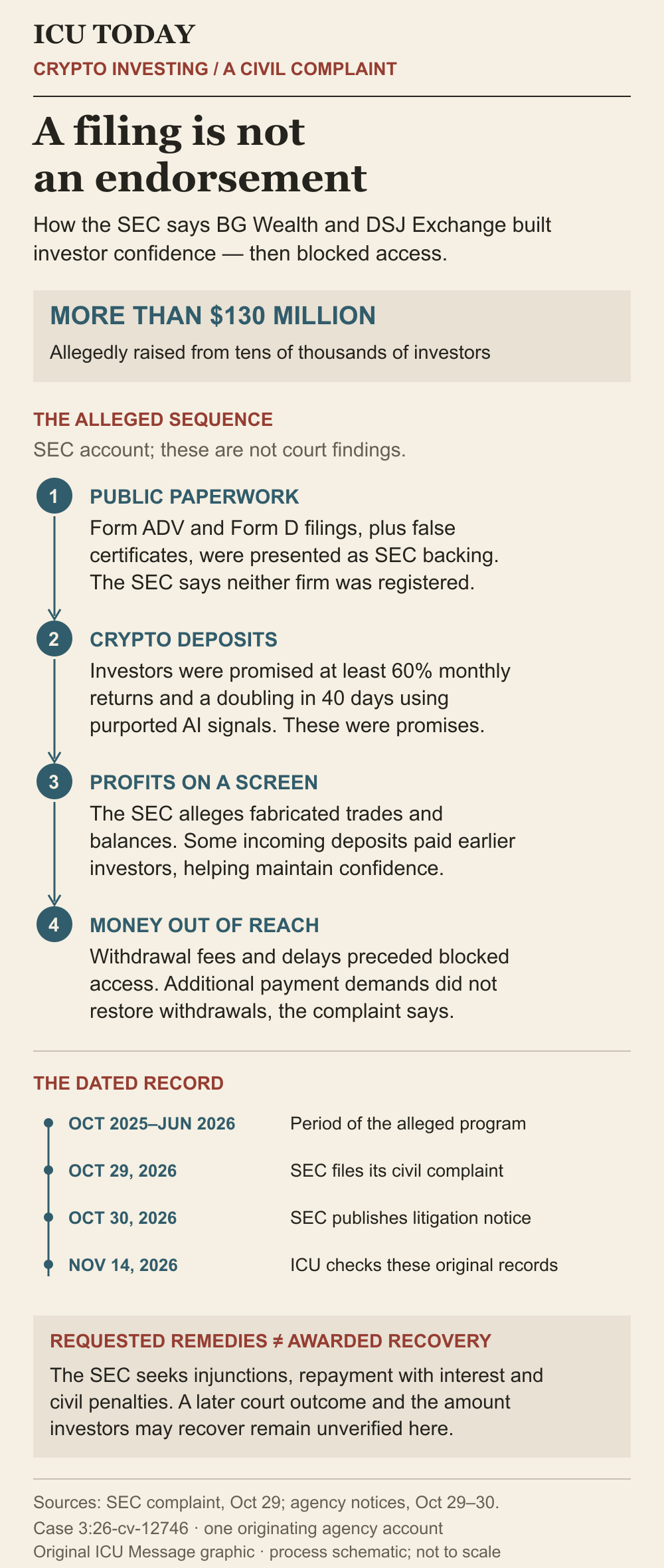
Read the infographic as text
Alleged scale. The SEC alleges more than 130 million dollars was raised from tens of thousands of investors. This is the agency’s account, not an independently audited total.
From credentials to deposits. The SEC says public Form ADV and Form D filings and fabricated certificates were presented as government backing, although neither firm was registered. Investors were promised at least 60 percent monthly returns and doubling in 40 days using purported AI signals. Those were promises, not verified performance.
From displayed profits to blocked access. The complaint alleges fabricated trades and balances, with some incoming deposits used to pay earlier investors and build confidence. Withdrawal fees and delays preceded blocked access; additional payment demands did not restore withdrawals.
Dated record. October 2025 through June 2026: period of the alleged program. October 29, 2026: SEC files its civil complaint in case 3:26-cv-12746. October 30: agency litigation notice. November 14 Central: ICU checked these original records. The process diagram and dates are schematic, not to scale.
Remedies and limits. The SEC seeks injunctions, repayment of allegedly ill-gotten gains with interest, and civil penalties. These requested remedies are not established awards. A later court outcome, a defendant response and the amount investors may recover were not verified in this review.
Graphic sources: U.S. Securities and Exchange Commission · U.S. Securities and Exchange Commission · U.S. Securities and Exchange Commission
The developing record.
Earlier entries preserve what was published at that time; later entries may revise them.
2026-11-15T02:19:47.837Z · Initial report on the SEC’s civil fraud allegations, public-filing claims, investment promises and uncertain recovery, with explanatory process and timeline graphic.
SEC alleges false filings helped draw $130 million into crypto scheme
The October 29 civil complaint against BG Wealth and DSJ Exchange describes a gap between public paperwork, promised returns and investors’ access to their money.
What happened
The Securities and Exchange Commission sued BG Wealth Sharing Ltd and DSJ Exchange Pty Ltd on October 29, alleging that they raised more than $130 million from tens of thousands of investors through a fraudulent crypto investment program. The two Colorado-incorporated entities were operated from abroad, the agency says. The civil case was filed in the Northern District of California; the allegations are not court findings. The SEC says the companies used publicly visible Form ADV and Form D filings, along with fabricated certificates bearing its seal, to suggest government approval. Its litigation notice says neither entity was registered with the agency and that the filings contained false information. [U.S. Securities and Exchange Commission] [U.S. Securities and Exchange Commission]
Why it matters
The complaint describes promises of at least 60% monthly returns and doubling investors’ principal in 40 days through purported AI trading signals. According to the SEC, the platform displayed invented trades and profits rather than investing the deposits as represented. Some early payments helped build confidence; withdrawals later became unavailable, and demands for additional payments did not restore access. The distinction between a filing and an endorsement is central to the case. The SEC says an exempt reporting adviser’s Form ADV and a Form D offering notice are not licenses or evidence that it approved the filer or investment. Its announcement says the two disputed filings have been removed from its website. The accompanying graphic follows the alleged sequence from paperwork and promises to deposits and withdrawal barriers. [U.S. Securities and Exchange Commission] [U.S. Securities and Exchange Commission]
What remains unknown
The SEC seeks injunctions, repayment of allegedly ill-gotten gains with interest, and civil penalties. Those are requested remedies, not awards established by the records reviewed. This report examines the October filing and agency notices, checked November 14 Central. ICU Message has not obtained a defendant response or verified a later court outcome, and cannot establish how much investors will recover. [U.S. Securities and Exchange Commission] [U.S. Securities and Exchange Commission]
Read the infographic as text
Alleged scale. The SEC alleges more than 130 million dollars was raised from tens of thousands of investors. This is the agency’s account, not an independently audited total.
From credentials to deposits. The SEC says public Form ADV and Form D filings and fabricated certificates were presented as government backing, although neither firm was registered. Investors were promised at least 60 percent monthly returns and doubling in 40 days using purported AI signals. Those were promises, not verified performance.
From displayed profits to blocked access. The complaint alleges fabricated trades and balances, with some incoming deposits used to pay earlier investors and build confidence. Withdrawal fees and delays preceded blocked access; additional payment demands did not restore withdrawals.
Dated record. October 2025 through June 2026: period of the alleged program. October 29, 2026: SEC files its civil complaint in case 3:26-cv-12746. October 30: agency litigation notice. November 14 Central: ICU checked these original records. The process diagram and dates are schematic, not to scale.
Remedies and limits. The SEC seeks injunctions, repayment of allegedly ill-gotten gains with interest, and civil penalties. These requested remedies are not established awards. A later court outcome, a defendant response and the amount investors may recover were not verified in this review.
Graphic sources: U.S. Securities and Exchange Commission · U.S. Securities and Exchange Commission · U.S. Securities and Exchange Commission
Original sources
SEC October 29 announcement of the BG Wealth and DSJ Exchange case · Issuer: U.S. Securities and Exchange Commission · Published 2026-10-29
SEC Litigation Release 26679: BG Wealth Sharing and DSJ Exchange · Issuer: U.S. Securities and Exchange Commission · Published 2026-10-30
SEC v. BG Wealth Sharing and DSJ Exchange, complaint Document 1 · Issuer: U.S. Securities and Exchange Commission · Published 2026-10-29
Corrections
No corrections recorded.