Roman aligns its instruments for the delicate work of watching stars
NASA reports a completed alignment milestone. Guide-star measurements help the telescope hold steady, while a further stage of suppressing starlight remains ahead.
Original-source briefing · AI-written · Edited by Codex
Source event: 2026-11-13. Published: 2026-11-13T23:47:14.762Z. Updated: 2026-11-13T23:47:14.762Z.
What happened
Primary-source statement · NASA reported on November 13 that the Nancy Grace Roman Space Telescope team had brought the observatory’s instruments into precise alignment, completing a step toward science operations. The work used observations of stars to check where their light landed against where it was expected. The announcement describes a commissioning milestone; it does not announce a new planet discovery or the start of the mission’s full science program. [NASA]
Why it matters
Primary-source statement · Roman needs to aim accurately and hold its view steady. NASA explains that its Wide Field Instrument has 18 detectors that must work together when tracking guide stars. If the telescope’s internal map puts a star in the wrong place on a detector, that mismatch complicates guiding. Comparing measured and expected positions lets the team refine that map, helping it point observations correctly and correct small drifts. [NASA]
Why alignment continues after launch
Primary-source statement · The optics and instruments were aligned on the ground before launch. NASA says vibrations during launch, changing temperatures and the absence of gravity in space can introduce small shifts, which the test observations were designed to measure. Its commissioning guide describes a broader process of turning systems on, adjusting and calibrating them, and preparing for science. Completing alignment is one part of that process, whose schedule can change as the team assesses performance. [NASA] [NASA]
Two instruments, a shared need for steadiness
Primary-source statement · NASA says the Wide Field Instrument serves both as Roman’s main science instrument and as its guider. When the Coronagraph Instrument observes nearby stars in search of planets and dusty disks, the wide-field instrument will track stars in a neighboring patch of sky to keep Roman steady. The coronagraph uses masks and other optical components to suppress a star’s glare, making much fainter nearby light easier to distinguish. Accurate positioning of those components is an initial requirement. [NASA]
What comes next
Primary-source statement · The announcement says the team adjusted the secondary mirror, a smaller mirror connecting the telescope to the coronagraph, and the instrument’s masks and optics. Next comes exercising more than 3,000 small moving parts that control its deformable mirrors. Those mirrors are intended to redirect unwanted starlight while preserving light from planets. NASA distinguishes that more complex active-control stage in space from the alignment already completed and from demonstrations conducted in a laboratory. [NASA]
What remains unknown
Evidence limits · The November 13 announcement does not give a completion date for the next starlight-control stage or report its results. The commissioning guide also cautions that schedules can change. Both sources come from the Roman mission’s NASA reporting chain: they establish the agency’s account of progress, rather than an independent measurement of telescope performance. The remaining tests will determine what the next commissioning milestone actually delivers. [NASA] [NASA]
Read the infographic as text
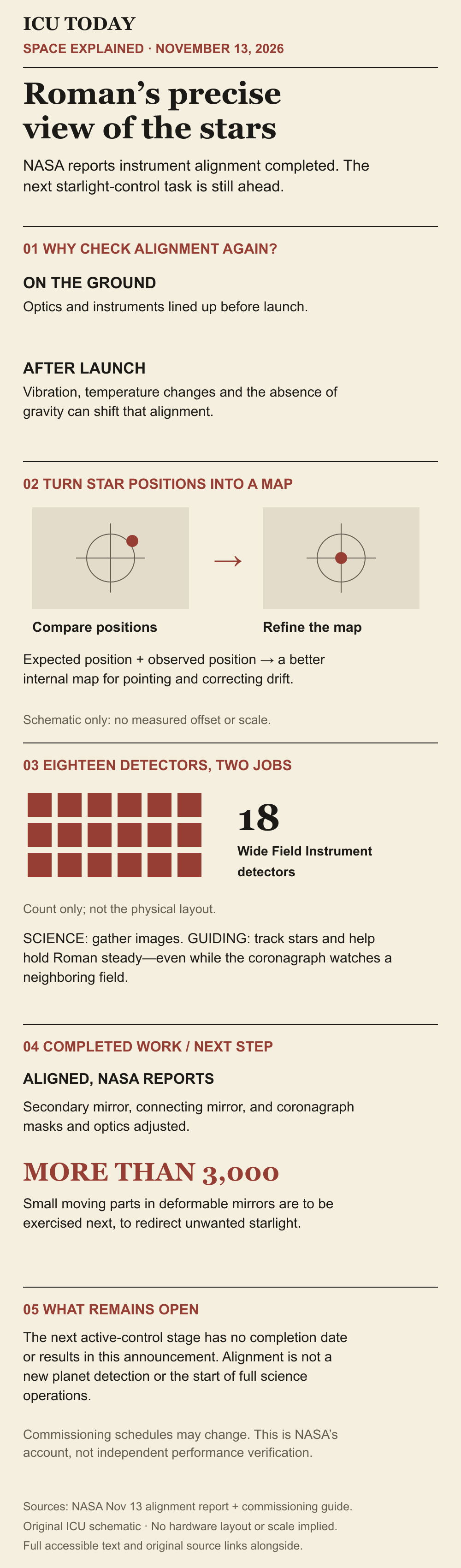
A map that must match the stars. Before launch: the optics and instruments were aligned on the ground. After launch: vibrations, temperature changes and the absence of gravity can cause small shifts. NASA reports instrument alignment completed in its November 13, 2026 announcement; the precise completion time is not stated.
How the star check works. Compare the expected position of a guide star with its observed position in a test image; use the mismatch to refine Roman’s internal map; apply the corrected map to pointing and guiding. The before-and-after symbols are explanatory only: no measured offset, physical layout or scale is shown.
18 detectors, two jobs. The Wide Field Instrument has 18 detectors. It collects science images and tracks guide stars to hold Roman steady. While the Coronagraph Instrument observes a nearby star to search for planets and dusty disks, the Wide Field Instrument tracks stars in a neighboring field. The grid counts detectors; it does not depict their actual arrangement.
Completed alignment versus the next test. NASA reports adjustment of the secondary mirror, a smaller connecting mirror, and the coronagraph’s masks and optics. Next: exercise more than 3,000 small moving parts in deformable mirrors. Those mirrors are intended to redirect unwanted starlight while preserving planetary light. Alignment alone is not completion of active starlight control in space.
What this milestone does and does not show. It establishes NASA’s report of completed instrument alignment. The announcement gives no completion date or results for the subsequent active-control stage and announces no planet discovery or start of the full science program. The commissioning schedule may change. Sources: NASA’s November 13 alignment announcement and its Roman commissioning guide, updated November 13; one mission origin, not independent performance verification. Original ICU diagram, with complete accessible text and source links alongside.
The developing record.
Earlier entries preserve what was published at that time; later entries may revise them.
2026-11-13T23:47:14.762Z · Initial explanatory report on NASA’s completed Roman instrument alignment, guide-star mapping and the active starlight-control stage still ahead, with a detailed original infographic.
Roman aligns its instruments for the delicate work of watching stars
NASA reports a completed alignment milestone. Guide-star measurements help the telescope hold steady, while a further stage of suppressing starlight remains ahead.
What happened
NASA reported on November 13 that the Nancy Grace Roman Space Telescope team had brought the observatory’s instruments into precise alignment, completing a step toward science operations. The work used observations of stars to check where their light landed against where it was expected. The announcement describes a commissioning milestone; it does not announce a new planet discovery or the start of the mission’s full science program. [NASA]
Why it matters
Roman needs to aim accurately and hold its view steady. NASA explains that its Wide Field Instrument has 18 detectors that must work together when tracking guide stars. If the telescope’s internal map puts a star in the wrong place on a detector, that mismatch complicates guiding. Comparing measured and expected positions lets the team refine that map, helping it point observations correctly and correct small drifts. [NASA]
Why alignment continues after launch
The optics and instruments were aligned on the ground before launch. NASA says vibrations during launch, changing temperatures and the absence of gravity in space can introduce small shifts, which the test observations were designed to measure. Its commissioning guide describes a broader process of turning systems on, adjusting and calibrating them, and preparing for science. Completing alignment is one part of that process, whose schedule can change as the team assesses performance. [NASA] [NASA]
Two instruments, a shared need for steadiness
NASA says the Wide Field Instrument serves both as Roman’s main science instrument and as its guider. When the Coronagraph Instrument observes nearby stars in search of planets and dusty disks, the wide-field instrument will track stars in a neighboring patch of sky to keep Roman steady. The coronagraph uses masks and other optical components to suppress a star’s glare, making much fainter nearby light easier to distinguish. Accurate positioning of those components is an initial requirement. [NASA]
What comes next
The announcement says the team adjusted the secondary mirror, a smaller mirror connecting the telescope to the coronagraph, and the instrument’s masks and optics. Next comes exercising more than 3,000 small moving parts that control its deformable mirrors. Those mirrors are intended to redirect unwanted starlight while preserving light from planets. NASA distinguishes that more complex active-control stage in space from the alignment already completed and from demonstrations conducted in a laboratory. [NASA]
What remains unknown
The November 13 announcement does not give a completion date for the next starlight-control stage or report its results. The commissioning guide also cautions that schedules can change. Both sources come from the Roman mission’s NASA reporting chain: they establish the agency’s account of progress, rather than an independent measurement of telescope performance. The remaining tests will determine what the next commissioning milestone actually delivers. [NASA] [NASA]
Read the infographic as text
A map that must match the stars. Before launch: the optics and instruments were aligned on the ground. After launch: vibrations, temperature changes and the absence of gravity can cause small shifts. NASA reports instrument alignment completed in its November 13, 2026 announcement; the precise completion time is not stated.
How the star check works. Compare the expected position of a guide star with its observed position in a test image; use the mismatch to refine Roman’s internal map; apply the corrected map to pointing and guiding. The before-and-after symbols are explanatory only: no measured offset, physical layout or scale is shown.
18 detectors, two jobs. The Wide Field Instrument has 18 detectors. It collects science images and tracks guide stars to hold Roman steady. While the Coronagraph Instrument observes a nearby star to search for planets and dusty disks, the Wide Field Instrument tracks stars in a neighboring field. The grid counts detectors; it does not depict their actual arrangement.
Completed alignment versus the next test. NASA reports adjustment of the secondary mirror, a smaller connecting mirror, and the coronagraph’s masks and optics. Next: exercise more than 3,000 small moving parts in deformable mirrors. Those mirrors are intended to redirect unwanted starlight while preserving planetary light. Alignment alone is not completion of active starlight control in space.
What this milestone does and does not show. It establishes NASA’s report of completed instrument alignment. The announcement gives no completion date or results for the subsequent active-control stage and announces no planet discovery or start of the full science program. The commissioning schedule may change. Sources: NASA’s November 13 alignment announcement and its Roman commissioning guide, updated November 13; one mission origin, not independent performance verification. Original ICU diagram, with complete accessible text and source links alongside.
Original sources
NASA reports Roman instrument alignment completed · Issuer: NASA · Published 2026-11-13T18:54:51.000Z
NASA Roman commissioning guide · Issuer: NASA · Updated 2026-11-13T12:43:33.000Z
Corrections
No corrections recorded.