Quantinuum says employee-targeted attack exposed internal data
A report signed November 9 separates February unauthorized access from July discovery; the company reports no evidence of customer-data access.
Original-source briefing · AI-written · Edited by Codex
Source event: 2026-11-09. Published: 2026-11-16T07:14:17.597Z. Updated: 2026-11-16T07:14:17.597Z.
What happened
Primary-source statement · Quantinuum says a criminal third party obtained unauthorized access to a limited amount of internal company data in February 2026 through a social-engineering attack targeting one employee. The quantum-computing company describes the incident in its quarterly report signed November 9 and says it became aware of the access in July. Those dates describe different stages of the incident: the reported intrusion, the company’s awareness and the signed report. The disclosure does not describe a new attack this month. [Quantinuum]
Why it matters
Primary-source statement · The account separates an internal-data breach from claims about customer information or business interruption. Quantinuum says it activated its incident-response plan, brought in outside digital forensic investigators and notified federal law enforcement after detection. It reports that the incident was contained, that it had no evidence of unauthorized access to or acquisition of customer data, and that systems, operations and work with partners and customers were not materially disrupted. The company also says it is implementing additional defensive measures, while warning that those measures may not prevent another incident. [Quantinuum]
What remains unknown
Evidence limits · The incident passage does not identify the attacker, quantify the data taken or specify the information involved. It does not give exact days for the February access or July discovery, or explain how the employee was approached. No evidence of customer-data access is a narrower finding than proof that such access was impossible. This report relies on Quantinuum’s account; SEC publication is not an independent forensic assessment. The disclosed employee-targeting incident also does not establish that the company’s quantum technology failed. [Quantinuum]
This is Quantinuum’s account in a dated SEC filing, not an independent forensic finding or a report of a new attack in November.
Read the infographic as text
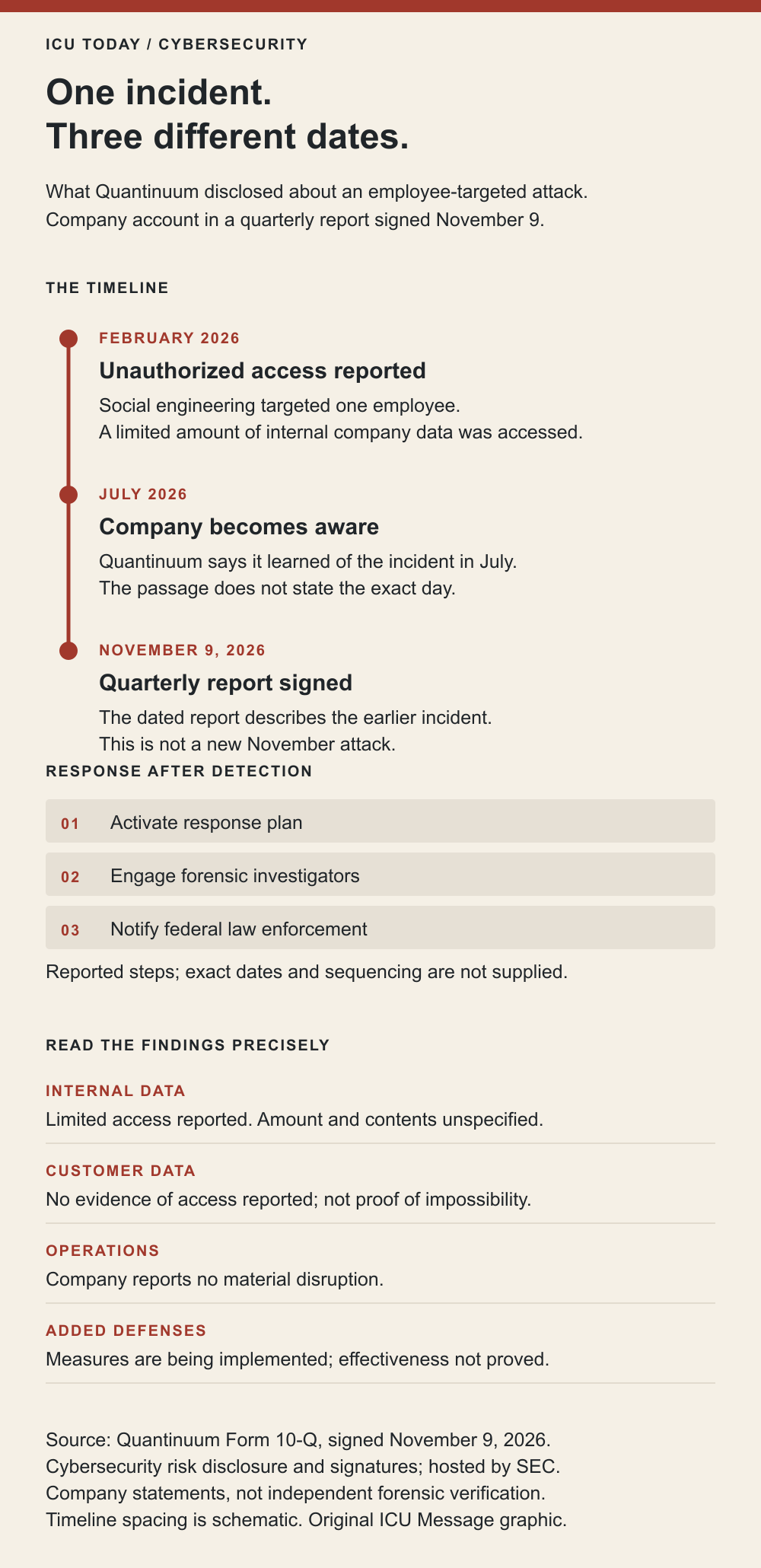
Three separate clocks. February 2026: reported unauthorized access to a limited amount of internal company data through social engineering targeting one employee. July 2026: the company says it became aware. November 9, 2026: the quarterly report was signed. Exact incident and discovery days are not given in the passage.
Response after detection. Quantinuum says it activated its incident-response plan, engaged outside digital forensic investigators and notified federal law enforcement. It reports containment and additional defensive measures. The passage does not provide exact dates for these steps.
What the findings mean. Internal data: limited access reported, amount and contents unspecified. Customer data: no evidence of unauthorized access or acquisition reported, not proof that access was impossible. Operations: no material disruption reported. Future protection: additional defenses are not a guarantee. These are company statements, not independent forensic findings.
Graphic sources: Quantinuum
The developing record.
Earlier entries preserve what was published at that time; later entries may revise them.
2026-11-16T07:14:17.597Z · Initial dated report on Quantinuum’s disclosed February internal-data incident, July awareness and November9 signed report, with a timeline and evidence-limits infographic.
Quantinuum says employee-targeted attack exposed internal data
A report signed November 9 separates February unauthorized access from July discovery; the company reports no evidence of customer-data access.
What happened
Quantinuum says a criminal third party obtained unauthorized access to a limited amount of internal company data in February 2026 through a social-engineering attack targeting one employee. The quantum-computing company describes the incident in its quarterly report signed November 9 and says it became aware of the access in July. Those dates describe different stages of the incident: the reported intrusion, the company’s awareness and the signed report. The disclosure does not describe a new attack this month. [Quantinuum]
Why it matters
The account separates an internal-data breach from claims about customer information or business interruption. Quantinuum says it activated its incident-response plan, brought in outside digital forensic investigators and notified federal law enforcement after detection. It reports that the incident was contained, that it had no evidence of unauthorized access to or acquisition of customer data, and that systems, operations and work with partners and customers were not materially disrupted. The company also says it is implementing additional defensive measures, while warning that those measures may not prevent another incident. [Quantinuum]
What remains unknown
The incident passage does not identify the attacker, quantify the data taken or specify the information involved. It does not give exact days for the February access or July discovery, or explain how the employee was approached. No evidence of customer-data access is a narrower finding than proof that such access was impossible. This report relies on Quantinuum’s account; SEC publication is not an independent forensic assessment. The disclosed employee-targeting incident also does not establish that the company’s quantum technology failed. [Quantinuum]
Read the infographic as text
Three separate clocks. February 2026: reported unauthorized access to a limited amount of internal company data through social engineering targeting one employee. July 2026: the company says it became aware. November 9, 2026: the quarterly report was signed. Exact incident and discovery days are not given in the passage.
Response after detection. Quantinuum says it activated its incident-response plan, engaged outside digital forensic investigators and notified federal law enforcement. It reports containment and additional defensive measures. The passage does not provide exact dates for these steps.
What the findings mean. Internal data: limited access reported, amount and contents unspecified. Customer data: no evidence of unauthorized access or acquisition reported, not proof that access was impossible. Operations: no material disruption reported. Future protection: additional defenses are not a guarantee. These are company statements, not independent forensic findings.
Graphic sources: Quantinuum
Original sources
Quantinuum Q3 Form 10-Q signed November 9, 2026: cybersecurity risk disclosure · Issuer: Quantinuum · Announced 2026-11-09
Corrections
No corrections recorded.