FDA classifies Philips Lumify correction as a Class I recall
The October 19 update changes the regulatory classification, while the affected products and use recommendations remain the same.
Original-source briefing · AI-written · Edited by Codex
Source event: 2026-10-09. Published: 2026-10-12T12:36:25.042Z. Updated: 2026-10-20T13:26:58.564Z.
What happened
Primary-source statement · The FDA updated its Philips Lumify ultrasound notice on October 19 to identify the issue as a Class I recall, its most serious category. The agency says the affected products and recommendations have not changed. This is a correction to instructions for using the devices, rather than their removal from use or sale. FDA's recall database lists the action as open and classified, with the firm's correction initiated September 24 and the database entry posted October 16. [FDA] [FDA]
Why it matters
Primary-source statement · The FDA describes software that can unexpectedly require a previously registered probe to be registered again, preventing scans until Wi-Fi or cellular access permits registration. A separate unstable USB connection can interrupt imaging. Its notice relays Philips' report of eight serious injuries and four deaths associated with the issue as of September 29; those reports do not establish causation in each case. The notice calls for accessible connectivity or an immediately available backup ultrasound device, and for backup imaging to be available for care. [FDA]
What remains unknown
Evidence limits · The checked notice still describes the registration-software update as under development and the connection problem as under assessment. It does not establish that a fix has been delivered, installed or proven effective. The new classification is a regulatory development, not a new count of injuries or deaths. National notices have different product lists, so institutions should consult the complete notice for their exact device. This briefing reports institutional safety information and makes no individual treatment assessment. [FDA] [FDA] [Health Canada] [NHS Supply Chain]
This device-safety report applies across patient groups. Care teams should consult the exact original notice and their institution’s procedures; no personal medical advice is provided.
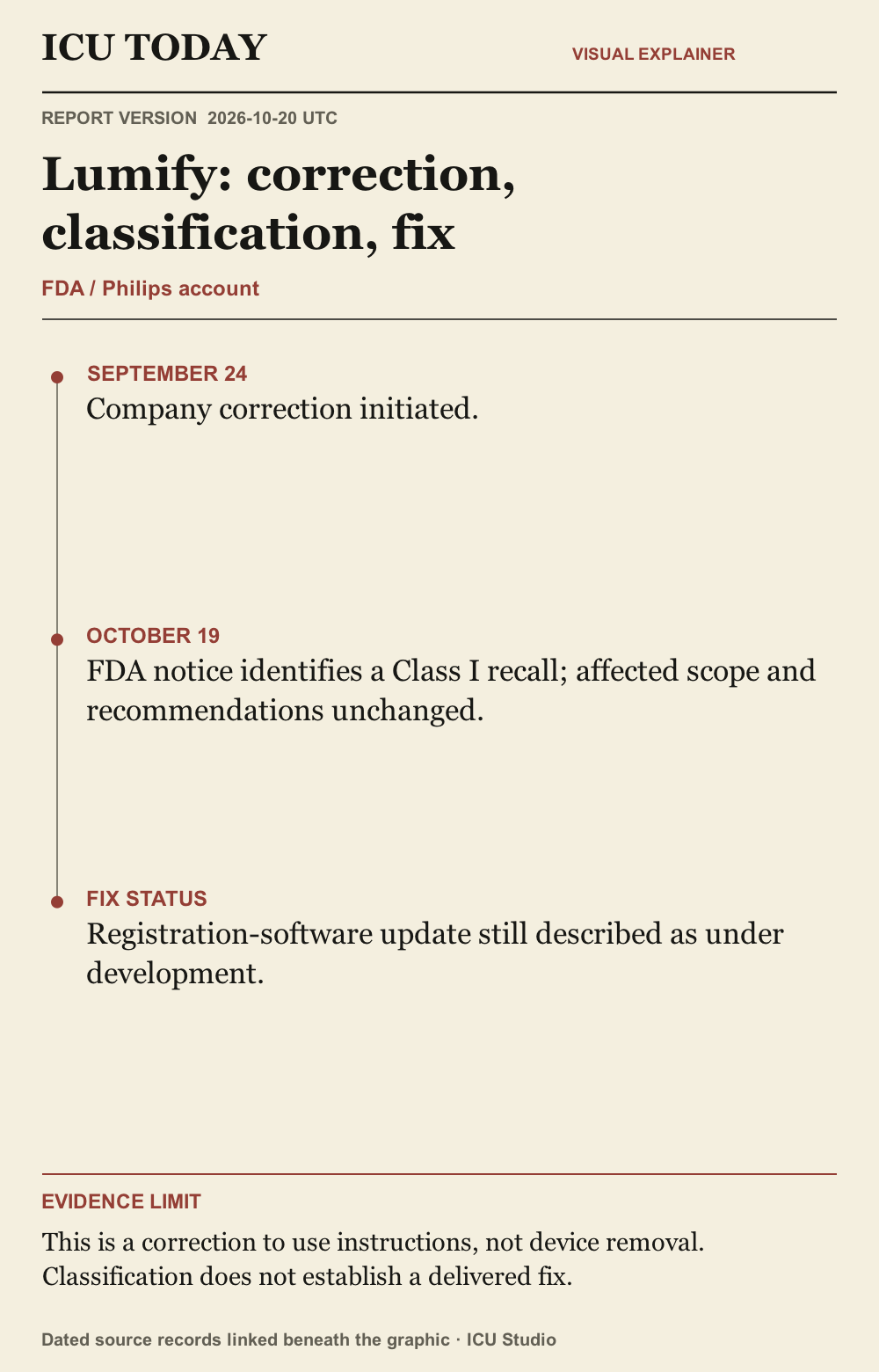
Read the infographic as text
SEPTEMBER 24. Company correction initiated.
OCTOBER 19. FDA notice identifies a Class I recall; affected scope and recommendations unchanged.
FIX STATUS. Registration-software update still described as under development.
Evidence limit. This is a correction to use instructions, not device removal. Classification does not establish a delivered fix.
The developing record.
Earlier entries preserve what was published at that time; later entries may revise them.
2026-10-12T12:36:25.042Z · Initial reviewed note on the October 9 alert, with dated manufacturer incident reports, separate national notices and unresolved repair and causality limits.
FDA flags scanning failures in Philips handheld ultrasound systems
Registration and cable problems can interrupt point-of-care scans, the notices say. Reported injuries and deaths are manufacturer reports, not established causal findings.
What happened
The FDA issued an October 9 early alert about Philips Lumify ultrasound systems used with Android or iOS devices. The agency says Philips reported software that can unexpectedly demand re-registration of a previously registered probe, blocking scanning until registration is completed using Wi-Fi or cellular access. A separate USB connection problem can interrupt operation. Health Canada’s October 5 notice lists a Type I recall dated October 1 for specified Lumify products. The national notices contain different product lists; a device’s exact version matters. [FDA] [Health Canada]
Why it matters
The FDA says Philips reported eight serious injuries and four deaths associated with the issue as of September 29. That is an attributed incident report, not proof the faults caused each outcome. NHS Supply Chain’s October 9 notice relays Philips’ warning that lost scanning can delay diagnosis or treatment. It asks institutions to share the full notice with users and relays instructions to keep backup imaging available and avoid using Lumify where connectivity is not readily accessible, including ambulances, helicopters and field settings. [FDA] [NHS Supply Chain]
What remains unknown
The notices checked on October 12 describe a registration-software update in development and the cable problem still under assessment. They do not establish when a fix will be available or that it has worked in practice. They also do not provide an independently adjudicated cause for each reported injury or death. Multiple agencies repeating the manufacturer’s account do not constitute separate clinical confirmation. This briefing reports institutional safety notices; it does not assess anyone’s diagnosis or treatment. [FDA] [NHS Supply Chain] [Health Canada]
2026-10-20T13:26:58.564Z · Added FDA's October 19 Class I classification and recall-database record; retained the earlier alert, manufacturer attribution and unresolved software-fix limits.
FDA classifies Philips Lumify correction as a Class I recall
The October 19 update changes the regulatory classification, while the affected products and use recommendations remain the same.
What happened
The FDA updated its Philips Lumify ultrasound notice on October 19 to identify the issue as a Class I recall, its most serious category. The agency says the affected products and recommendations have not changed. This is a correction to instructions for using the devices, rather than their removal from use or sale. FDA's recall database lists the action as open and classified, with the firm's correction initiated September 24 and the database entry posted October 16. [FDA] [FDA]
Why it matters
The FDA describes software that can unexpectedly require a previously registered probe to be registered again, preventing scans until Wi-Fi or cellular access permits registration. A separate unstable USB connection can interrupt imaging. Its notice relays Philips' report of eight serious injuries and four deaths associated with the issue as of September 29; those reports do not establish causation in each case. The notice calls for accessible connectivity or an immediately available backup ultrasound device, and for backup imaging to be available for care. [FDA]
What remains unknown
The checked notice still describes the registration-software update as under development and the connection problem as under assessment. It does not establish that a fix has been delivered, installed or proven effective. The new classification is a regulatory development, not a new count of injuries or deaths. National notices have different product lists, so institutions should consult the complete notice for their exact device. This briefing reports institutional safety information and makes no individual treatment assessment. [FDA] [FDA] [Health Canada] [NHS Supply Chain]
Original sources
FDA early alert: Philips Lumify diagnostic ultrasound systems · Issuer: FDA · 2026-10-09
Health Canada recall RA-82731: Lumify Ultrasound System · Issuer: Health Canada · 2026-10-05
NHS Supply Chain customer notice ICN 3499: Philips Lumify · Issuer: NHS Supply Chain · 2026-10-09
FDA October 19 Lumify Class I correction update · Issuer: FDA · 2026-10-19
FDA recall Z-0152-2027: Lumify Diagnostic Ultrasound System · Issuer: FDA · 2026-10-16
Corrections
No corrections recorded.