Perseverance measured ultrafine Mars dust, NASA reports
The agency reports grains down to 100–300 nanometers on some targets; human exposure and protective performance remain unestablished.
Original-source briefing · AI-written · Edited by Codex
Source event: 2026-10-26. Published: 2026-10-27T04:09:16.589Z. Updated: 2026-10-27T04:09:16.589Z.
What happened
Primary-source statement · NASA reported on October 26 that Perseverance has measured fine and ultrafine dust resting on rover calibration targets over 1,645 Martian days. Its account gives an average particle size of about 2 micrometers on the PIXL Teflon target and SHERLOC Vectran swatch. On the PIXL basaltic-glass target and SHERLOC Teflon swatch, reported sizes extend down to about 100–300 nanometers. These are observations of material surfaces, rather than measurements of dust inhaled by a person. [NASA]
Why it matters
Primary-source statement · JPL’s July 2020 mission background describes five pieces of spacesuit material embedded in SHERLOC’s calibration target, which checks instrument settings against Earth reference readings. In the new account, NASA says the finest particles remained attached through years of driving and drilling and that different surfaces collect different sizes. The agency says the findings could inform materials, coatings and ways to keep dust outside living areas. Those proposed uses are engineering possibilities; the report does not establish a certified protective system. [NASA] [NASA Jet Propulsion Laboratory]
What remains unknown
Evidence limits · NASA says the findings are scheduled for publication in the Proceedings of the National Academy of Sciences on October 27. ICU has reviewed the two agency documents, not the full journal paper, its methods or an independent replication. They share one NASA/JPL origin. Particle sizes alone do not supply an inhaled dose, an astronaut exposure limit or a demonstrated health outcome. The report concerns dust collected on selected targets; this review does not establish the same distribution at every location or under every airborne condition on Mars. [NASA] [NASA Jet Propulsion Laboratory]
This reports material-target measurements, not established astronaut exposure, safe limits or clinical outcomes. Both documents share one NASA/JPL origin; the full journal paper and independent replication were not reviewed.
Read the infographic as text
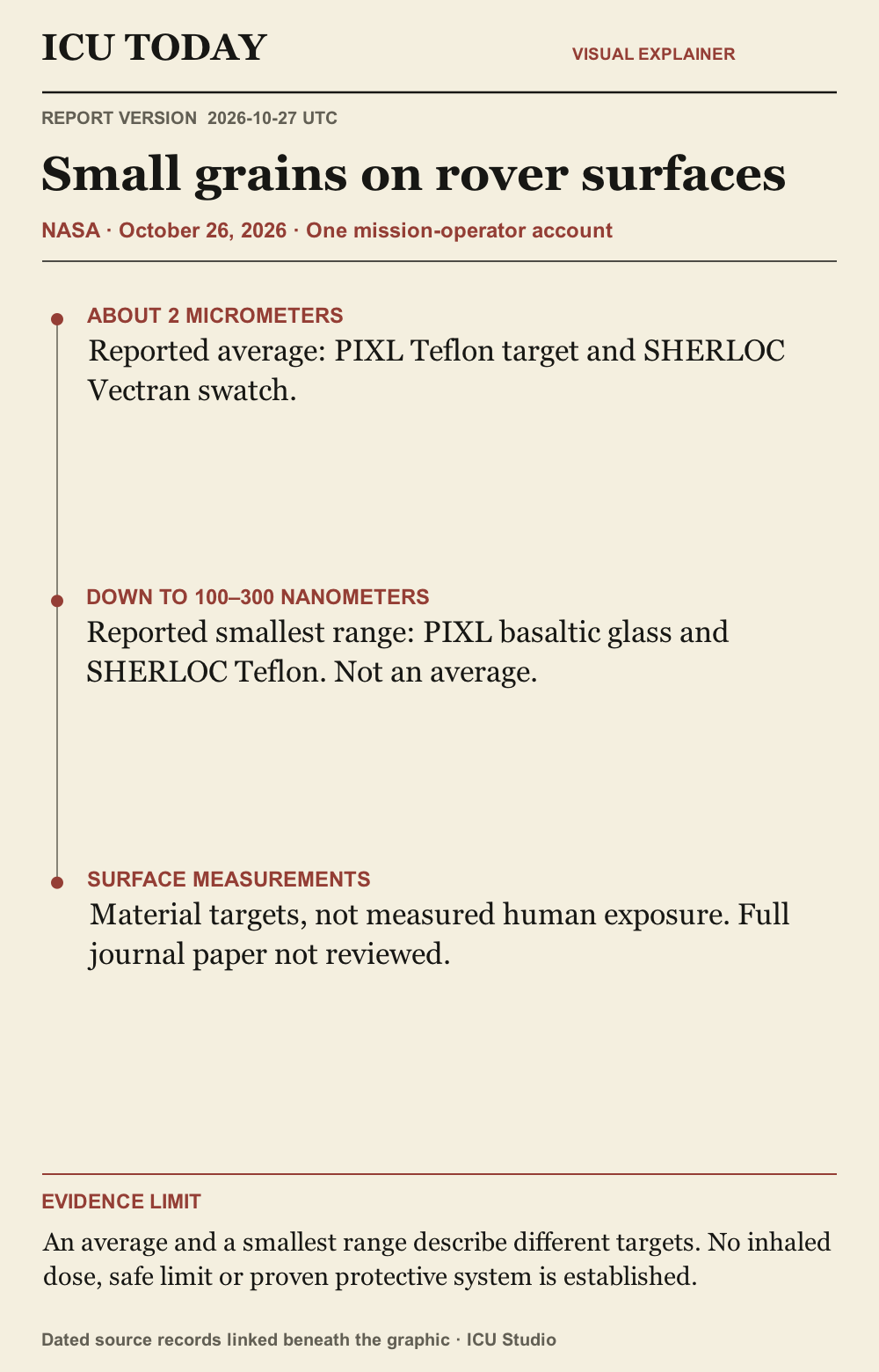
ABOUT 2 MICROMETERS. Reported average: PIXL Teflon target and SHERLOC Vectran swatch.
DOWN TO 100–300 NANOMETERS. Reported smallest range: PIXL basaltic glass and SHERLOC Teflon. Not an average.
SURFACE MEASUREMENTS. Material targets, not measured human exposure. Full journal paper not reviewed.
Evidence limit. An average and a smallest range describe different targets. No inhaled dose, safe limit or proven protective system is established.
Graphic sources: NASA · NASA Jet Propulsion Laboratory
The developing record.
Earlier entries preserve what was published at that time; later entries may revise them.
2026-10-27T04:09:16.589Z · Initial attributed report of fine and ultrafine dust measured on rover material targets; surface measurements, announced journal date and human-exposure limits are kept distinct.
Perseverance measured ultrafine Mars dust, NASA reports
The agency reports grains down to 100–300 nanometers on some targets; human exposure and protective performance remain unestablished.
What happened
NASA reported on October 26 that Perseverance has measured fine and ultrafine dust resting on rover calibration targets over 1,645 Martian days. Its account gives an average particle size of about 2 micrometers on the PIXL Teflon target and SHERLOC Vectran swatch. On the PIXL basaltic-glass target and SHERLOC Teflon swatch, reported sizes extend down to about 100–300 nanometers. These are observations of material surfaces, rather than measurements of dust inhaled by a person. [NASA]
Why it matters
JPL’s July 2020 mission background describes five pieces of spacesuit material embedded in SHERLOC’s calibration target, which checks instrument settings against Earth reference readings. In the new account, NASA says the finest particles remained attached through years of driving and drilling and that different surfaces collect different sizes. The agency says the findings could inform materials, coatings and ways to keep dust outside living areas. Those proposed uses are engineering possibilities; the report does not establish a certified protective system. [NASA] [NASA Jet Propulsion Laboratory]
What remains unknown
NASA says the findings are scheduled for publication in the Proceedings of the National Academy of Sciences on October 27. ICU has reviewed the two agency documents, not the full journal paper, its methods or an independent replication. They share one NASA/JPL origin. Particle sizes alone do not supply an inhaled dose, an astronaut exposure limit or a demonstrated health outcome. The report concerns dust collected on selected targets; this review does not establish the same distribution at every location or under every airborne condition on Mars. [NASA] [NASA Jet Propulsion Laboratory]
Read the infographic as text
ABOUT 2 MICROMETERS. Reported average: PIXL Teflon target and SHERLOC Vectran swatch.
DOWN TO 100–300 NANOMETERS. Reported smallest range: PIXL basaltic glass and SHERLOC Teflon. Not an average.
SURFACE MEASUREMENTS. Material targets, not measured human exposure. Full journal paper not reviewed.
Evidence limit. An average and a smallest range describe different targets. No inhaled dose, safe limit or proven protective system is established.
Graphic sources: NASA · NASA Jet Propulsion Laboratory
Original sources
NASA: Perseverance measurements of fine and ultrafine Mars dust · Issuer: NASA/JPL · 2026-10-26
JPL mission background: Perseverance spacesuit-material calibration samples · Issuer: NASA/JPL · 2020-07-28
Corrections
No corrections recorded.