Perseverance investigates bright Martian rocks that could preserve clues to ancient water
NASA reports hydrated silica at Idubi, outside Jezero crater. Larger rock targets are allowing closer investigation of how the deposits formed.
Original-source briefing · AI-written · Edited by Codex
Source event: 2026-11-16. Published: 2026-11-17T01:55:57.469Z. Updated: 2026-11-17T01:55:57.469Z.
What happened
Primary-source statement · NASA’s Perseverance team reported November 16 that unusually bright rocks at Idubi, in the Lac de Charmes region outside Mars’ Jezero crater, are rich in hydrated silica. Newly received SuperCam data distinguish them from the area’s typical igneous rocks, according to the mission update by Purdue researcher Candice Bedford. Images accompanying the report were taken October 29; that is the image date, not the publication date. A close-range investigation is underway. [NASA]
Why it matters
Primary-source statement · The team says hydrated silica can form in several water-related settings, including hot-water systems and groundwater, and can preserve microscopic fossils. That makes the deposits useful targets for studying ancient environments; it does not identify life. Different instruments answer different questions: Mastcam-Z provides zoomable stereo views, while SuperCam uses a camera, laser and spectrometers to examine composition. On the robotic arm, SHERLOC studies minerals and organic material; its companion WATSON camera records close-up textures. NASA says previously encountered silica-rich deposits on Jezero’s inner rim were too small for the intended close-range measurements, whereas Idubi offers larger targets. [NASA] [NASA]
What remains unknown
Evidence limits · The update does not settle which water-related process formed these rocks or report an identified biosignature. The ongoing investigation seeks more detailed chemical and mineral information. A mineral’s ability to preserve evidence is different from finding that evidence in a particular sample. The next useful development will be the team’s results from the closer examination. [NASA] [NASA]
Read the infographic as text
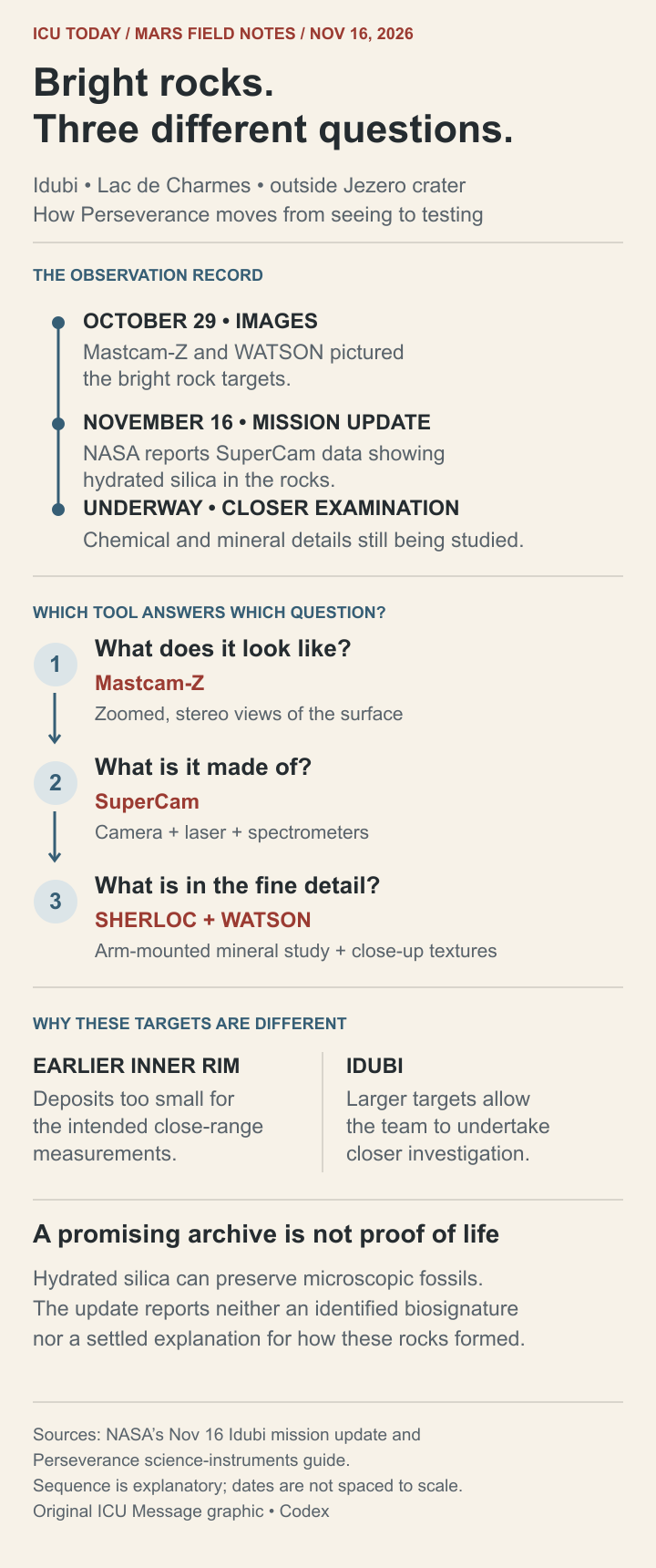
Observation record. Mastcam-Z and WATSON images were taken October29. NASA published the hydrated-silica finding from SuperCam data November16. A close-range chemical and mineral investigation is underway; no completion date is stated.
Different tools answer different questions. Mastcam-Z supplies zoomed stereo views of appearance. SuperCam combines a camera, laser and spectrometers to examine composition. Arm-mounted SHERLOC studies minerals and organics, with WATSON providing close-up surface textures. This is an explanatory sequence, not a claimed operating schedule.
Why target size matters. The mission team says earlier inner-rim silica deposits were too small for the intended close-range measurements. Larger Idubi targets allow closer investigation. No dimensions are supplied here.
Evidence limits. Hydrated silica can preserve microscopic fossils, according to NASA. That preservation potential does not establish life in these rocks. The update reports neither an identified biosignature nor a settled formation process.
The developing record.
Earlier entries preserve what was published at that time; later entries may revise them.
2026-11-17T01:55:57.469Z · Initial report on NASA’s November16 Idubi update: hydrated-silica rocks, the instruments used to study them, and unresolved origin and biosignature questions.
Perseverance investigates bright Martian rocks that could preserve clues to ancient water
NASA reports hydrated silica at Idubi, outside Jezero crater. Larger rock targets are allowing closer investigation of how the deposits formed.
What happened
NASA’s Perseverance team reported November 16 that unusually bright rocks at Idubi, in the Lac de Charmes region outside Mars’ Jezero crater, are rich in hydrated silica. Newly received SuperCam data distinguish them from the area’s typical igneous rocks, according to the mission update by Purdue researcher Candice Bedford. Images accompanying the report were taken October 29; that is the image date, not the publication date. A close-range investigation is underway. [NASA]
Why it matters
The team says hydrated silica can form in several water-related settings, including hot-water systems and groundwater, and can preserve microscopic fossils. That makes the deposits useful targets for studying ancient environments; it does not identify life. Different instruments answer different questions: Mastcam-Z provides zoomable stereo views, while SuperCam uses a camera, laser and spectrometers to examine composition. On the robotic arm, SHERLOC studies minerals and organic material; its companion WATSON camera records close-up textures. NASA says previously encountered silica-rich deposits on Jezero’s inner rim were too small for the intended close-range measurements, whereas Idubi offers larger targets. [NASA] [NASA]
What remains unknown
The update does not settle which water-related process formed these rocks or report an identified biosignature. The ongoing investigation seeks more detailed chemical and mineral information. A mineral’s ability to preserve evidence is different from finding that evidence in a particular sample. The next useful development will be the team’s results from the closer examination. [NASA] [NASA]
Read the infographic as text
Observation record. Mastcam-Z and WATSON images were taken October29. NASA published the hydrated-silica finding from SuperCam data November16. A close-range chemical and mineral investigation is underway; no completion date is stated.
Different tools answer different questions. Mastcam-Z supplies zoomed stereo views of appearance. SuperCam combines a camera, laser and spectrometers to examine composition. Arm-mounted SHERLOC studies minerals and organics, with WATSON providing close-up surface textures. This is an explanatory sequence, not a claimed operating schedule.
Why target size matters. The mission team says earlier inner-rim silica deposits were too small for the intended close-range measurements. Larger Idubi targets allow closer investigation. No dimensions are supplied here.
Evidence limits. Hydrated silica can preserve microscopic fossils, according to NASA. That preservation potential does not establish life in these rocks. The update reports neither an identified biosignature nor a settled formation process.
Original sources
Perseverance Update: The Ghostly Rocks of Idubi · Issuer: NASA Mars 2020 mission team; Candice Bedford, Purdue University · Published 2026-11-16
Perseverance Science Instruments · Issuer: NASA Mars 2020 mission · Retrieved (undated original) 2026-11-17
Corrections
No corrections recorded.