Gap between one-month and 10-year Treasury yields narrows to 84 basis points
In the Federal Reserve’s November 20 release, the shortest Treasury benchmark rose as the 10-year yield fell. Just over half the narrowing came on the final day shown.
Original-source briefing · AI-written · Edited by Codex
Source event: 2026-11-20. Published: 2026-11-22T12:53:19.390Z. Updated: 2026-11-22T12:53:19.390Z.
What happened
Primary-source statement · The gap between one-month and 10-year U.S. Treasury yields narrowed from 1.05 percentage points on November 13 to 0.84 on November 19, according to the Federal Reserve’s November 20 interest-rate release. The two yields moved toward each other. The one-month rate climbed from 4.10% to 4.20%, while the 10-year rate fell from 5.15% to 5.04%. The longer maturity still carried the higher yield on each of the five business days shown. [Federal Reserve Board]
Why it matters
Primary-source statement · The daily figures show what a comparison of the 10-year rate alone would miss. On Wednesday, November 18, the gap stood at 97 basis points. On Thursday it fell to 84. Of that 13-basis-point move, 10 came from the increase in the one-month yield and three from the decline in the 10-year yield. A basis point is one hundredth of a percentage point. Together, those two daily moves accounted for 13 of the 21 basis points by which the gap narrowed over the five observations. [Federal Reserve Board]
What remains unknown
Evidence limits · The Fed publishes this series on business days except holidays. The November 20 release ends with Thursday’s figures. Treasury derives these benchmark yields from a curve based on closing market bid yields, so it can report a 10-year rate even when no outstanding security has exactly 10 years left. The table gives no reason for the changes and does not identify who bought or sold Treasury securities. [Federal Reserve Board] [Federal Reserve Board]
Read the infographic as text
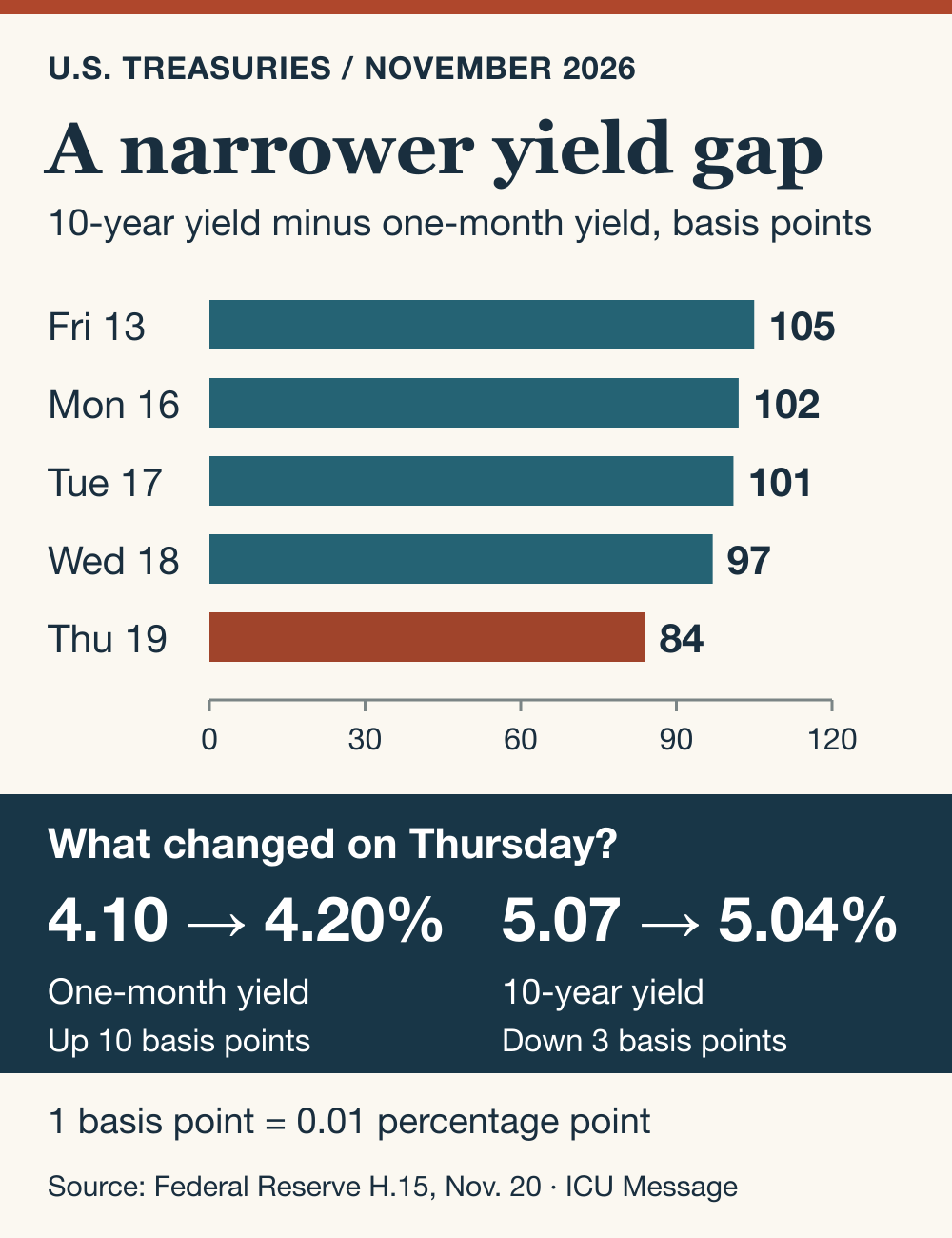
Five daily observations. The gap was 105 basis points on November 13, 102 on November 16, 101 on November 17, 97 on November 18 and 84 on November 19. The release lists business days.
What changed on November 19. The one-month yield rose 10 basis points to 4.20%. The 10-year yield fell three basis points to 5.04%. Together they narrowed the gap by 13 basis points that day.
How to read the gap. Subtract the one-month yield from the 10-year yield. On November 19, 5.04% minus 4.20% was 0.84 percentage point, or 84 basis points. These are benchmark yields derived from a market curve.
Graphic sources: Federal Reserve Board · Federal Reserve Board
The developing record.
Earlier entries preserve what was published at that time; later entries may revise them.
2026-11-22T12:53:19.390Z · The Federal Reserve published the five observations used to compare the one-month and 10-year nominal Treasury benchmarks.
Gap between one-month and 10-year Treasury yields narrows to 84 basis points
In the Federal Reserve’s November 20 release, the shortest Treasury benchmark rose as the 10-year yield fell. Just over half the narrowing came on the final day shown.
What happened
The gap between one-month and 10-year U.S. Treasury yields narrowed from 1.05 percentage points on November 13 to 0.84 on November 19, according to the Federal Reserve’s November 20 interest-rate release. The two yields moved toward each other. The one-month rate climbed from 4.10% to 4.20%, while the 10-year rate fell from 5.15% to 5.04%. The longer maturity still carried the higher yield on each of the five business days shown. [Federal Reserve Board]
Why it matters
The daily figures show what a comparison of the 10-year rate alone would miss. On Wednesday, November 18, the gap stood at 97 basis points. On Thursday it fell to 84. Of that 13-basis-point move, 10 came from the increase in the one-month yield and three from the decline in the 10-year yield. A basis point is one hundredth of a percentage point. Together, those two daily moves accounted for 13 of the 21 basis points by which the gap narrowed over the five observations. [Federal Reserve Board]
What remains unknown
The Fed publishes this series on business days except holidays. The November 20 release ends with Thursday’s figures. Treasury derives these benchmark yields from a curve based on closing market bid yields, so it can report a 10-year rate even when no outstanding security has exactly 10 years left. The table gives no reason for the changes and does not identify who bought or sold Treasury securities. [Federal Reserve Board] [Federal Reserve Board]
Read the infographic as text
Five daily observations. The gap was 105 basis points on November 13, 102 on November 16, 101 on November 17, 97 on November 18 and 84 on November 19. The release lists business days.
What changed on November 19. The one-month yield rose 10 basis points to 4.20%. The 10-year yield fell three basis points to 5.04%. Together they narrowed the gap by 13 basis points that day.
How to read the gap. Subtract the one-month yield from the 10-year yield. On November 19, 5.04% minus 4.20% was 0.84 percentage point, or 84 basis points. These are benchmark yields derived from a market curve.
Graphic sources: Federal Reserve Board · Federal Reserve Board
Original sources
Selected Interest Rates (Daily), November 20, 2026 · Issuer: Board of Governors of the Federal Reserve System · Published 2026-11-20
About the H.15 release · Issuer: Board of Governors of the Federal Reserve System · Updated 2017-01-03
Corrections
No corrections recorded.