NASA targets November 29 cargo launch with muscle and cancer research
The planned Northrop Grumman CRS-25 mission will carry experiments and a radiation sensor. The launch target and research goals remain plans, not completed results.
Original-source briefing · AI-written · Edited by Codex
Source event: 2026-11-02. Published: 2026-11-15T00:53:35.793Z. Updated: 2026-11-15T00:53:35.793Z.
What happened
Primary-source statement · NASA has set a November 29 target for Northrop Grumman’s next cargo flight to the International Space Station, with experiments studying muscle loss, cancer and radiation exposure among the planned payloads. In its November 2 announcement, NASA said a SpaceX Falcon 9 would launch the Cygnus XL spacecraft no earlier than 10:49 a.m. Eastern from Cape Canaveral’s Space Launch Complex 40. After arrival, station astronauts would capture Cygnus with the Canadarm2 robotic arm and attach it to the Earth-facing port of the Unity module. NASA expects the spacecraft to remain until May 2027. [NASA]
Why it matters
Primary-source statement · The mission pairs routine supplies with several distinct research questions. NASA says one experiment will make tiny particles inspired by DNA, investigating potential applications in delivering drugs for cancer and osteoarthritis. Another will study whether cancer is likely to spread. Human muscle cells and medications will support tests related to muscle loss during spaceflight and aging on Earth. A compact radiation sensor is intended to support crew safety on future missions. These are research objectives described by NASA; the announcement does not establish that a treatment works or that the sensor has demonstrated its intended performance. [NASA]
What remains unknown
Evidence limits · November 29 is a no-earlier-than target, not a guaranteed departure. This report describes the November 2 plan, checked November 14 Central; it does not independently confirm launch readiness. The announcement gives no completed findings from these experiments, and their eventual medical usefulness remains unestablished. [NASA]
Read the infographic as text
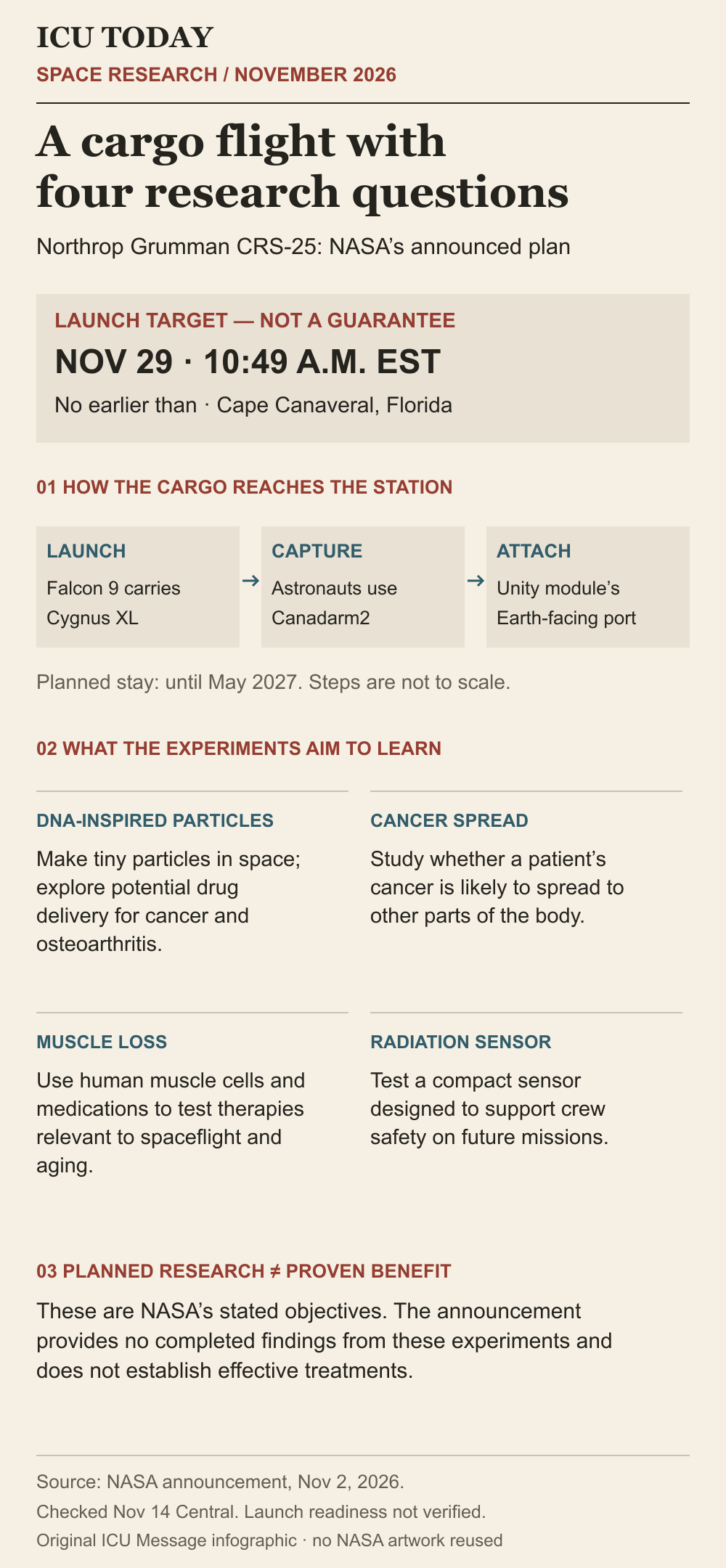
Planned timing. No earlier than November 29, 2026, at 10:49 a.m. EST from Cape Canaveral. NASA plans a stay until May 2027. Current launch readiness is not independently verified.
Cargo handling. A SpaceX Falcon 9 launches Cygnus XL. Station astronauts capture it using Canadarm2, then install it on Unity’s Earth-facing port. Arrows show steps, not distance or time scale.
Four research questions. DNA-inspired particles: potential drug delivery for cancer and osteoarthritis. Cancer research: predicting spread. Human muscle cells and medications: testing therapies related to spaceflight and aging. Compact radiation sensor: supporting future crew safety.
Limits of the evidence. These are objectives in NASA’s November 2 announcement, checked November 14 Central. No completed findings from these experiments or effective treatments are established by this announcement.
Graphic sources: NASA
The developing record.
Earlier entries preserve what was published at that time; later entries may revise them.
2026-11-15T00:53:35.793Z · Initial report on NASA’s announced CRS-25 launch target, cargo handling and four research objectives, with schedule and medical-result limits.
NASA targets November 29 cargo launch with muscle and cancer research
The planned Northrop Grumman CRS-25 mission will carry experiments and a radiation sensor. The launch target and research goals remain plans, not completed results.
What happened
NASA has set a November 29 target for Northrop Grumman’s next cargo flight to the International Space Station, with experiments studying muscle loss, cancer and radiation exposure among the planned payloads. In its November 2 announcement, NASA said a SpaceX Falcon 9 would launch the Cygnus XL spacecraft no earlier than 10:49 a.m. Eastern from Cape Canaveral’s Space Launch Complex 40. After arrival, station astronauts would capture Cygnus with the Canadarm2 robotic arm and attach it to the Earth-facing port of the Unity module. NASA expects the spacecraft to remain until May 2027. [NASA]
Why it matters
The mission pairs routine supplies with several distinct research questions. NASA says one experiment will make tiny particles inspired by DNA, investigating potential applications in delivering drugs for cancer and osteoarthritis. Another will study whether cancer is likely to spread. Human muscle cells and medications will support tests related to muscle loss during spaceflight and aging on Earth. A compact radiation sensor is intended to support crew safety on future missions. These are research objectives described by NASA; the announcement does not establish that a treatment works or that the sensor has demonstrated its intended performance. [NASA]
What remains unknown
November 29 is a no-earlier-than target, not a guaranteed departure. This report describes the November 2 plan, checked November 14 Central; it does not independently confirm launch readiness. The announcement gives no completed findings from these experiments, and their eventual medical usefulness remains unestablished. [NASA]
Read the infographic as text
Planned timing. No earlier than November 29, 2026, at 10:49 a.m. EST from Cape Canaveral. NASA plans a stay until May 2027. Current launch readiness is not independently verified.
Cargo handling. A SpaceX Falcon 9 launches Cygnus XL. Station astronauts capture it using Canadarm2, then install it on Unity’s Earth-facing port. Arrows show steps, not distance or time scale.
Four research questions. DNA-inspired particles: potential drug delivery for cancer and osteoarthritis. Cancer research: predicting spread. Human muscle cells and medications: testing therapies related to spaceflight and aging. Compact radiation sensor: supporting future crew safety.
Limits of the evidence. These are objectives in NASA’s November 2 announcement, checked November 14 Central. No completed findings from these experiments or effective treatments are established by this announcement.
Graphic sources: NASA
Original sources
NASA November 2 announcement of Northrop Grumman CRS-25 cargo launch target and research · Issuer: NASA · Published 2026-11-02
Corrections
No corrections recorded.