NIST sets a post-quantum migration roadmap
The finalized report maps the move away from quantum-vulnerable algorithms, with accelerated deadlines for high-value and high-impact federal systems.
Original-source briefing · AI-written · Edited by Codex
Source event: 2026-10-27. Published: 2026-10-28T09:15:38.826Z. Updated: 2026-10-28T09:15:38.826Z.
What happened
Primary-source statement · The National Institute of Standards and Technology announced its finalized NIST IR 8547 report on October 27, laying out how organizations should retire quantum-vulnerable public-key algorithms and move to post-quantum cryptography. The report maps that transition to NIST’s 2024 standards: FIPS 203 for key establishment and FIPS 204 and 205 for digital signatures. NIST describes migration beginning before a cryptanalytically relevant quantum computer has been built. [National Institute of Standards and Technology] [NIST Computer Security Resource Center] [National Institute of Standards and Technology]
Why it matters
Primary-source statement · NIST says previous cryptographic transitions have taken 10 to 20 years because products, services and infrastructure all have to change. Its report describes accelerated deadlines for federal high-value assets and high-impact systems: December 31, 2030, for post-quantum key establishment and December 31, 2031, for digital signatures. It also prioritizes other highly sensitive federal systems. The work extends beyond swapping an algorithm: applications, libraries, hardware, public-key infrastructure and supply chains may need updates and testing. NIST highlights the risk that encrypted information collected now could be decrypted by a future quantum computer; it gives systems with long-term confidentiality needs early priority. [National Institute of Standards and Technology] [National Institute of Standards and Technology]
What remains unknown
Evidence limits · The final report is a roadmap, not evidence that agencies or suppliers have completed their migrations. NIST says transition timing will vary by use case. The report discusses hybrid approaches that combine conventional and post-quantum methods, alongside added complexity and resource costs. It does not establish when a code-breaking quantum computer will arrive or show that current encryption has already been broken by one. [National Institute of Standards and Technology] [National Institute of Standards and Technology]
This reports NIST’s written roadmap and its account of federal policy. The three documents share one NIST origin. The specified federal deadlines are not a universal deadline for every organization; no completed migration, independent security validation or quantum-computer arrival date is established.
Read the infographic as text
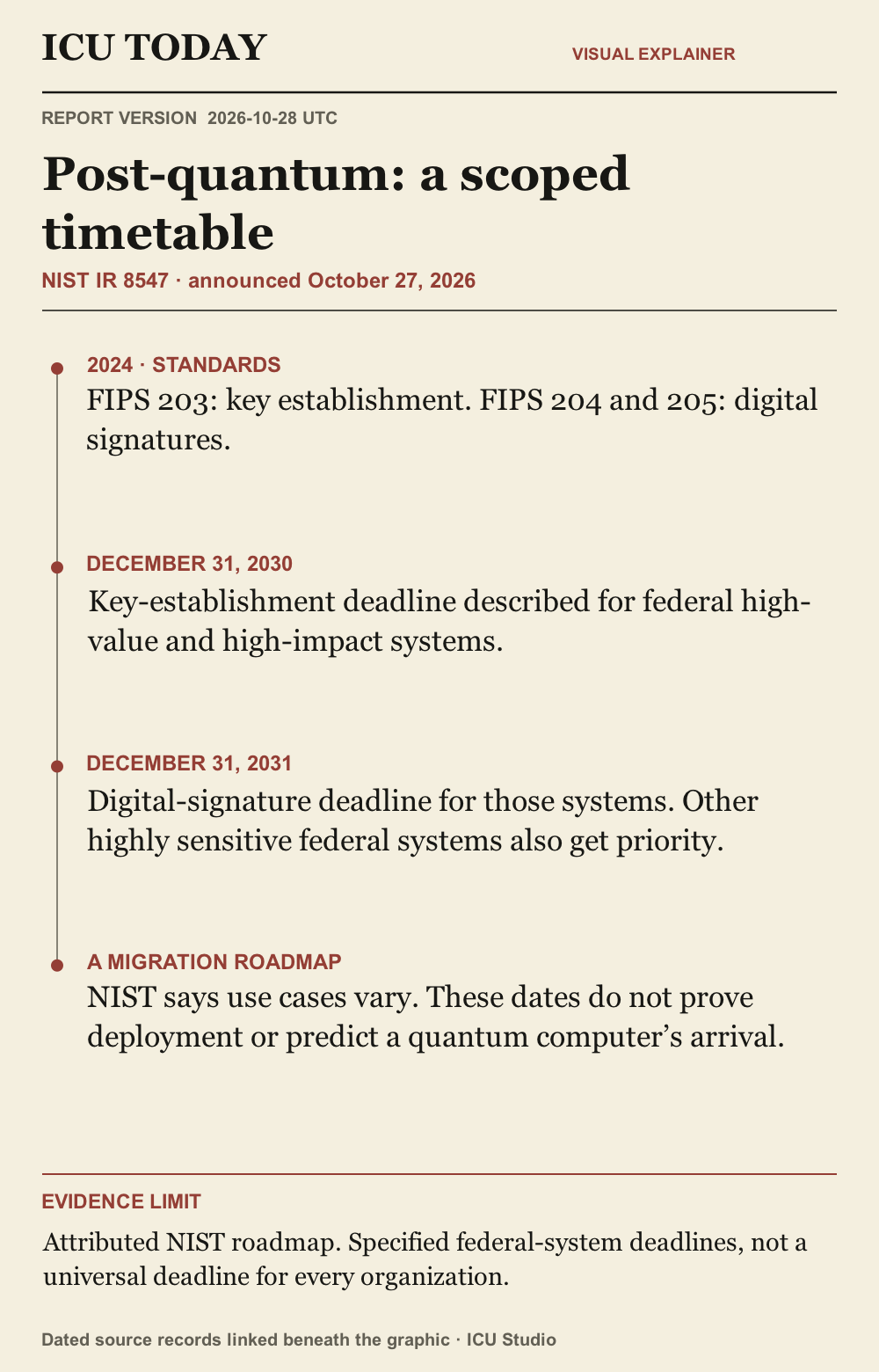
2024 · STANDARDS. FIPS 203: key establishment. FIPS 204 and 205: digital signatures.
DECEMBER 31, 2030. Key-establishment deadline described for federal high-value and high-impact systems.
DECEMBER 31, 2031. Digital-signature deadline for those systems. Other highly sensitive federal systems also get priority.
A MIGRATION ROADMAP. NIST says use cases vary. These dates do not prove deployment or predict a quantum computer’s arrival.
Evidence limit. Attributed NIST roadmap. Specified federal-system deadlines, not a universal deadline for every organization.
Graphic sources: National Institute of Standards and Technology · National Institute of Standards and Technology
The developing record.
Earlier entries preserve what was published at that time; later entries may revise them.
2026-10-28T09:15:38.826Z · Initial attributed report of NIST’s October 27 final-roadmap announcement, with specified federal-system deadlines and implementation/quantum-timing limits.
NIST sets a post-quantum migration roadmap
The finalized report maps the move away from quantum-vulnerable algorithms, with accelerated deadlines for high-value and high-impact federal systems.
What happened
The National Institute of Standards and Technology announced its finalized NIST IR 8547 report on October 27, laying out how organizations should retire quantum-vulnerable public-key algorithms and move to post-quantum cryptography. The report maps that transition to NIST’s 2024 standards: FIPS 203 for key establishment and FIPS 204 and 205 for digital signatures. NIST describes migration beginning before a cryptanalytically relevant quantum computer has been built. [National Institute of Standards and Technology] [NIST Computer Security Resource Center] [National Institute of Standards and Technology]
Why it matters
NIST says previous cryptographic transitions have taken 10 to 20 years because products, services and infrastructure all have to change. Its report describes accelerated deadlines for federal high-value assets and high-impact systems: December 31, 2030, for post-quantum key establishment and December 31, 2031, for digital signatures. It also prioritizes other highly sensitive federal systems. The work extends beyond swapping an algorithm: applications, libraries, hardware, public-key infrastructure and supply chains may need updates and testing. NIST highlights the risk that encrypted information collected now could be decrypted by a future quantum computer; it gives systems with long-term confidentiality needs early priority. [National Institute of Standards and Technology] [National Institute of Standards and Technology]
What remains unknown
The final report is a roadmap, not evidence that agencies or suppliers have completed their migrations. NIST says transition timing will vary by use case. The report discusses hybrid approaches that combine conventional and post-quantum methods, alongside added complexity and resource costs. It does not establish when a code-breaking quantum computer will arrive or show that current encryption has already been broken by one. [National Institute of Standards and Technology] [National Institute of Standards and Technology]
Read the infographic as text
2024 · STANDARDS. FIPS 203: key establishment. FIPS 204 and 205: digital signatures.
DECEMBER 31, 2030. Key-establishment deadline described for federal high-value and high-impact systems.
DECEMBER 31, 2031. Digital-signature deadline for those systems. Other highly sensitive federal systems also get priority.
A MIGRATION ROADMAP. NIST says use cases vary. These dates do not prove deployment or predict a quantum computer’s arrival.
Evidence limit. Attributed NIST roadmap. Specified federal-system deadlines, not a universal deadline for every organization.
Graphic sources: National Institute of Standards and Technology · National Institute of Standards and Technology
Original sources
NIST Report Provides Guidelines for Transition to Post-Quantum Cryptography Standards, October 27, 2026 · Issuer: NIST · 2026-10-27
NIST IR 8547 final publication record, October 2026 edition announced October 27 edition announced October 27 edition announced October 27 · Issuer: NIST · Edition dated 2026-10-27
NIST IR 8547: Transition to Post-Quantum Cryptography Standards, October 2026 edition announced October 27 edition announced October 27 edition announced October 27 · Issuer: NIST · Edition dated 2026-10-27
Corrections
No corrections recorded.