FDA grants accelerated approval to neladalkib for some previously treated lung cancers
In two groups of patients with advanced ALK-positive lung cancer, independent reviewers confirmed tumor responses in 49% and 32%. The trial did not compare neladalkib with another treatment.
Original-source briefing · AI-written · Edited by Codex
Source event: 2026-11-17. Published: 2026-11-18T20:52:58.247Z. Updated: 2026-11-18T20:52:58.247Z.
What happened
Primary-source statement · The U.S. Food and Drug Administration granted accelerated approval on November 17 to neladalkib, sold as Nelkarmi, for adults with locally advanced or metastatic ALK-positive non-small cell lung cancer. Which medicines a patient has already received matters. The FDA lists two treatment histories in the setting of unresectable locally advanced or metastatic disease. One is a single prior ALK inhibitor, alectinib. The other is at least two prior ALK inhibitors plus platinum-based chemotherapy. [U.S. Food and Drug Administration] [U.S. Food and Drug Administration]
Why it matters
Primary-source statement · The FDA reported two different measures from a trial called ALKOVE-1. First, how many patients had a confirmed tumor response? Independent reviewers found a response in 49% of the 67 patients in the alectinib group and 32% of the 155 patients in the more heavily treated group. Second, how long did those responses last? Among patients whose tumors responded, 52% in the first group and 51% in the second had a response lasting at least a year. Those one-year figures describe only the people who responded. [U.S. Food and Drug Administration]
What remains unknown
Evidence limits · Everyone in these trial groups received neladalkib, and their treatment histories differed. The figures cannot show whether one group benefits more from the drug, whether it works better than another treatment, or whether patients live longer. The FDA also listed prescribing warnings, including risks to the liver, kidneys and eyes. Its approval notice gives no estimate of a survival benefit. [U.S. Food and Drug Administration]
Read the infographic as text
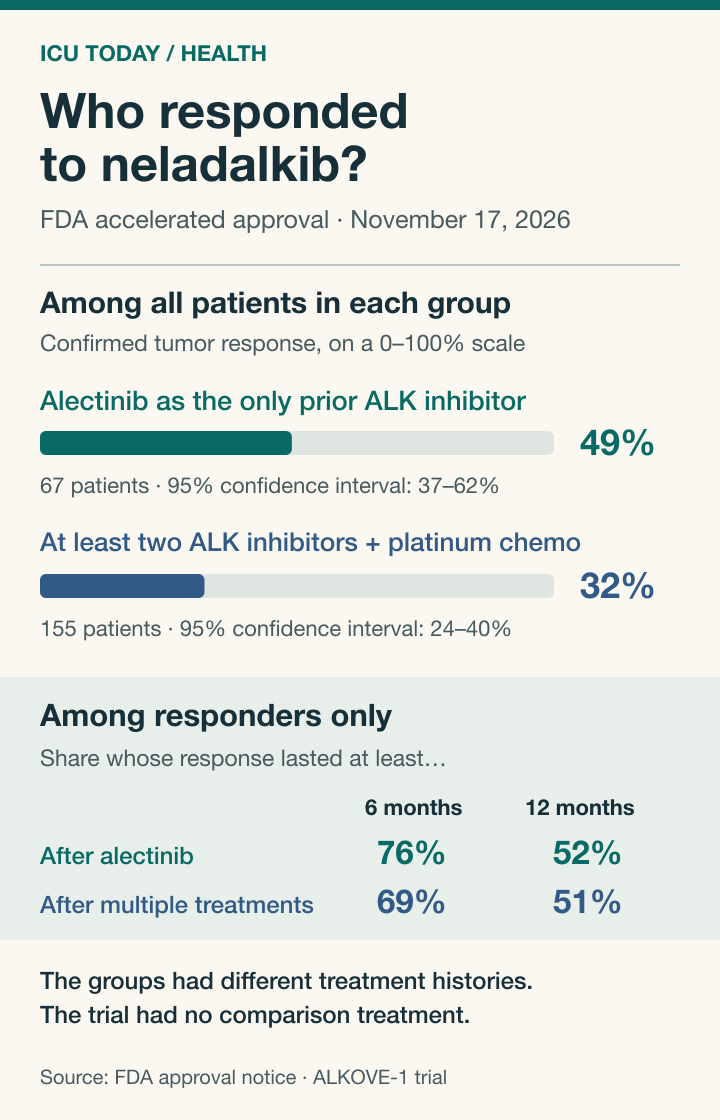
All enrolled patients. Confirmed responses occurred in 49% of 67 patients after alectinib (95% confidence interval 37% to 62%), and 32% of 155 patients after at least two ALK inhibitors and platinum chemotherapy (24% to 40%).
Responders only. At six months, 76% and 69% of responders, respectively, had a response lasting at least that long. At twelve months, the figures were 52% and 51%.
What the figures can tell us. An independent review assessed tumor response. The single-arm trial had no comparison treatment, and the two groups had different treatment histories. These data do not establish a survival advantage.
Graphic sources: U.S. Food and Drug Administration
The developing record.
Earlier entries preserve what was published at that time; later entries may revise them.
2026-11-18T20:52:58.247Z · Initial report on the FDA approval, eligible treatment histories and what the trial measured in each group.
FDA grants accelerated approval to neladalkib for some previously treated lung cancers
In two groups of patients with advanced ALK-positive lung cancer, independent reviewers confirmed tumor responses in 49% and 32%. The trial did not compare neladalkib with another treatment.
What happened
The U.S. Food and Drug Administration granted accelerated approval on November 17 to neladalkib, sold as Nelkarmi, for adults with locally advanced or metastatic ALK-positive non-small cell lung cancer. Which medicines a patient has already received matters. The FDA lists two treatment histories in the setting of unresectable locally advanced or metastatic disease. One is a single prior ALK inhibitor, alectinib. The other is at least two prior ALK inhibitors plus platinum-based chemotherapy. [U.S. Food and Drug Administration] [U.S. Food and Drug Administration]
Why it matters
The FDA reported two different measures from a trial called ALKOVE-1. First, how many patients had a confirmed tumor response? Independent reviewers found a response in 49% of the 67 patients in the alectinib group and 32% of the 155 patients in the more heavily treated group. Second, how long did those responses last? Among patients whose tumors responded, 52% in the first group and 51% in the second had a response lasting at least a year. Those one-year figures describe only the people who responded. [U.S. Food and Drug Administration]
What remains unknown
Everyone in these trial groups received neladalkib, and their treatment histories differed. The figures cannot show whether one group benefits more from the drug, whether it works better than another treatment, or whether patients live longer. The FDA also listed prescribing warnings, including risks to the liver, kidneys and eyes. Its approval notice gives no estimate of a survival benefit. [U.S. Food and Drug Administration]
Read the infographic as text
All enrolled patients. Confirmed responses occurred in 49% of 67 patients after alectinib (95% confidence interval 37% to 62%), and 32% of 155 patients after at least two ALK inhibitors and platinum chemotherapy (24% to 40%).
Responders only. At six months, 76% and 69% of responders, respectively, had a response lasting at least that long. At twelve months, the figures were 52% and 51%.
What the figures can tell us. An independent review assessed tumor response. The single-arm trial had no comparison treatment, and the two groups had different treatment histories. These data do not establish a survival advantage.
Graphic sources: U.S. Food and Drug Administration
Original sources
FDA accelerated approval of neladalkib for previously treated ALK-positive non-small cell lung cancer · Issuer: U.S. Food and Drug Administration · Published 2026-11-17
FDA oncology approval notifications: November 17 neladalkib entry · Issuer: U.S. Food and Drug Administration · Published 2026-11-17
Corrections
No corrections recorded.