NASA will end science observations from its Terra satellite on December 1
Terra was built for six years and worked for nearly 27. NASA plans to lower its orbit before a January shutdown. Its record of Earth will remain free to the public.
Original-source briefing · AI-written · Edited by Codex
Source event: 2026-11-17. Published: 2026-11-18T10:52:36.061Z. Updated: 2026-11-18T10:52:36.061Z.
What happened
Primary-source statement · NASA says its Terra satellite will stop gathering science data on December 1. Launched in December 1999 for a six-year mission, Terra has spent nearly 27 years observing Earth. The agency cited aging spacecraft systems and a drifting orbit in its November 17 announcement. Even before this decision, the team had switched off its MOPITT pollution-monitoring instrument and parts of two other instruments to conserve power. [NASA Science]
Why it matters
Primary-source statement · Terra gave people working on the ground a way to see changes that stretched well beyond any one observer’s field of view. Take California’s Sierra Nevada this month. On November 12, one of Terra’s instruments picked up snow along the highest ridges. Two days later, through a break between storms, it recorded snow across much of the range. Those two images will remain available for someone studying the storm years from now. What ends in December is the ability to add a fresh observation from Terra to a sequence like that. Researchers have also used its record to track changes in ice cover and follow smoke and dust across large areas. [NASA Science] [NASA Science]
What remains unknown
Evidence limits · Ending science collection and turning off the spacecraft are separate steps. NASA plans to use the remaining fuel to lower Terra’s orbit before shutting down all spacecraft systems in January 2027. The agency gave no exact day for that shutdown or date for atmospheric reentry. It said the data already collected will remain free to the public. [NASA Science]
Read the infographic as text
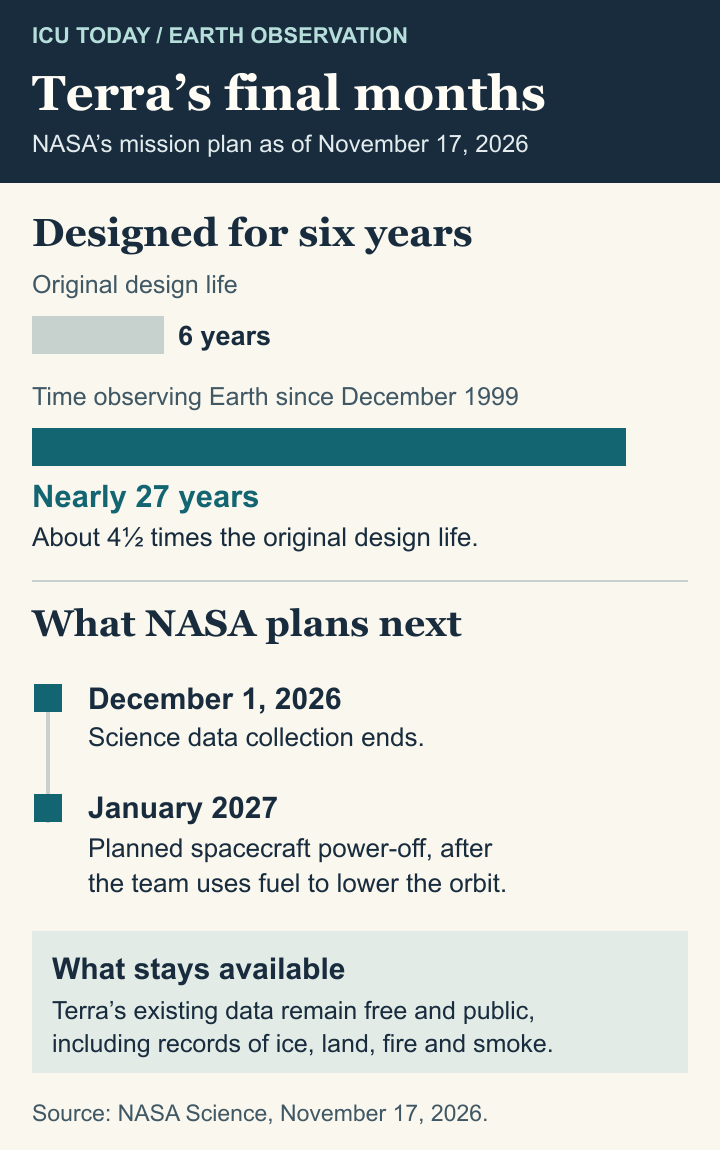
A six-year design that lasted nearly 27. Terra launched in December 1999. NASA describes a science mission lasting about four and a half times its original six-year design life.
Two different shutdown milestones. December 1, 2026 is the scheduled end of science data collection. The team plans to use the remaining fuel to lower the orbit before powering off all spacecraft systems in January 2027. NASA gave no precise power-off or reentry date.
The archive after shutdown. Previously collected data will remain free and public. The record includes observations of ice cover, land use, wildfires and smoke.
Graphic sources: NASA Science
The developing record.
Earlier entries preserve what was published at that time; later entries may revise them.
2026-11-18T10:52:36.061Z · Initial report on NASA’s plans to end Terra science collection December 1, lower its orbit and power off the spacecraft in January 2027.
NASA will end science observations from its Terra satellite on December 1
Terra was built for six years and worked for nearly 27. NASA plans to lower its orbit before a January shutdown. Its record of Earth will remain free to the public.
What happened
NASA says its Terra satellite will stop gathering science data on December 1. Launched in December 1999 for a six-year mission, Terra has spent nearly 27 years observing Earth. The agency cited aging spacecraft systems and a drifting orbit in its November 17 announcement. Even before this decision, the team had switched off its MOPITT pollution-monitoring instrument and parts of two other instruments to conserve power. [NASA Science]
Why it matters
Terra gave people working on the ground a way to see changes that stretched well beyond any one observer’s field of view. Take California’s Sierra Nevada this month. On November 12, one of Terra’s instruments picked up snow along the highest ridges. Two days later, through a break between storms, it recorded snow across much of the range. Those two images will remain available for someone studying the storm years from now. What ends in December is the ability to add a fresh observation from Terra to a sequence like that. Researchers have also used its record to track changes in ice cover and follow smoke and dust across large areas. [NASA Science] [NASA Science]
What remains unknown
Ending science collection and turning off the spacecraft are separate steps. NASA plans to use the remaining fuel to lower Terra’s orbit before shutting down all spacecraft systems in January 2027. The agency gave no exact day for that shutdown or date for atmospheric reentry. It said the data already collected will remain free to the public. [NASA Science]
Read the infographic as text
A six-year design that lasted nearly 27. Terra launched in December 1999. NASA describes a science mission lasting about four and a half times its original six-year design life.
Two different shutdown milestones. December 1, 2026 is the scheduled end of science data collection. The team plans to use the remaining fuel to lower the orbit before powering off all spacecraft systems in January 2027. NASA gave no precise power-off or reentry date.
The archive after shutdown. Previously collected data will remain free and public. The record includes observations of ice cover, land use, wildfires and smoke.
Graphic sources: NASA Science
Original sources
NASA’s Terra Mission to End · Issuer: NASA Science · Published 2026-11-17
Sierra Snow Season Spins Up · Issuer: NASA Earth Observatory · Published 2026-11-18
Corrections
No corrections recorded.