NASA asks students to draw a Moon base and explain their role in it
U.S. students in kindergarten through 12th grade have until March 1 to enter. One winner in each of three grade groups will earn a trip for two to NASA Glenn in Cleveland.
Original-source briefing · AI-written · Edited by Codex
Source event: 2026-11-17. Published: 2026-11-17T23:04:29.703Z. Updated: 2026-11-17T23:04:29.703Z.
What happened
Primary-source statement · NASA opened its Power to Explore challenge on November 17 to students in kindergarten through 12th grade across the United States. Students have until March 1, 2027, to submit two pieces of original work about the same imagined mission. In a 200-word essay, each student describes a personal strength and how it would help the mission succeed. In an illustration, the student shows what a lunar base powered by nuclear energy would let people and robots do on the Moon. [NASA]
Why it matters
Primary-source statement · Some of the places scientists want to explore on the Moon are also the hardest to keep powered. A crater near the south pole can stay in shadow even when the Sun is up elsewhere. NASA asks students to show how a base could use both radioisotope and fission power for exploration. That gives the drawing a job of its own. A student might show where a robot could go or what an instrument could study through a lunar night. The essay is where the student explains what they would bring to that work. [NASA]
What remains unknown
Primary-source statement · The winners are still to be chosen. Entries will be judged in three groups, covering kindergarten through fourth grade, fifth through eighth grade and ninth through 12th grade. NASA says one winner in each group will receive a trip for two to its Glenn Research Center in Cleveland. Every entrant is due a digital certificate and an invitation to a virtual event with NASA experts. The November 17 announcement gives the entry deadline but leaves the date of that event open. [NASA]
Read the infographic as text
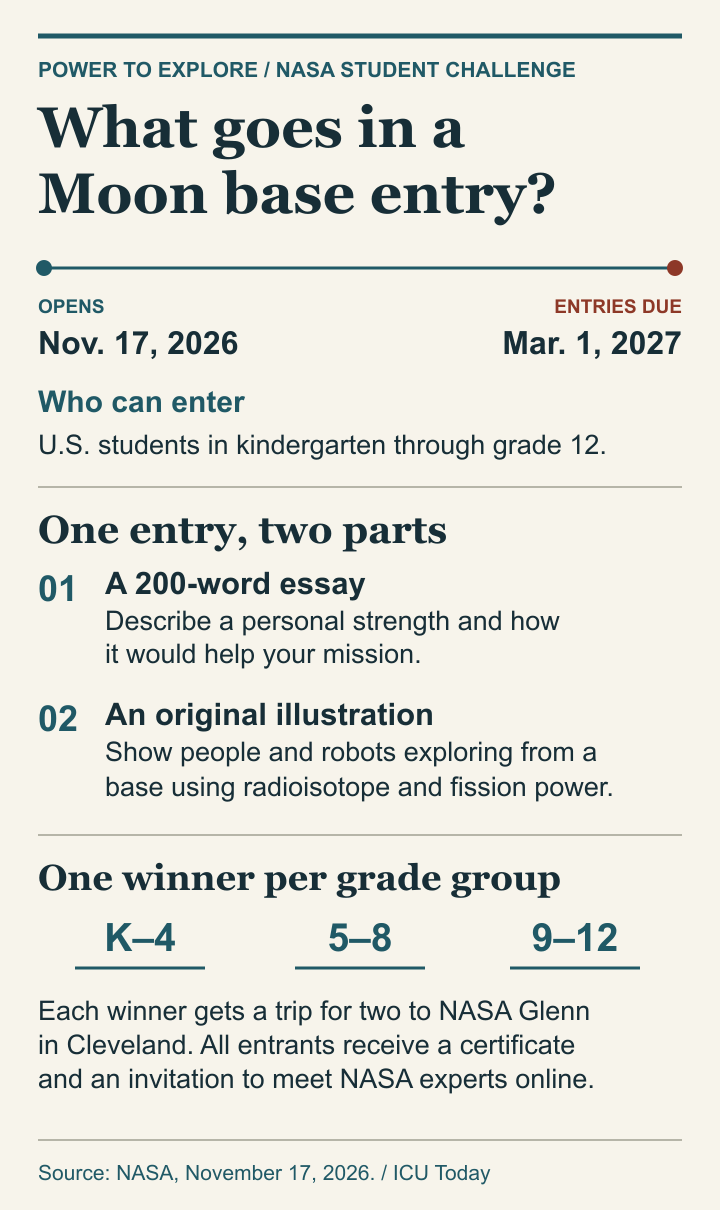
Entry window. The challenge opened November 17, 2026. U.S. students in kindergarten through 12th grade can enter by March 1, 2027.
Two pieces in one entry. Write a 200-word essay about a personal strength and its role in the mission. Draw an original lunar base that uses both radioisotope and fission power to support people and robots exploring the Moon.
Three grade groups. Judges select one winner each in grades K–4, 5–8 and 9–12. Each winner receives a trip for two to NASA Glenn in Cleveland. Every entrant receives a digital certificate and an invitation to a virtual event with NASA experts.
Graphic sources: NASA
The developing record.
Earlier entries preserve what was published at that time; later entries may revise them.
2026-11-17T23:04:29.703Z · Initial report on the November 17 student challenge, March 1 deadline and grade-group awards.
NASA asks students to draw a Moon base and explain their role in it
U.S. students in kindergarten through 12th grade have until March 1 to enter. One winner in each of three grade groups will earn a trip for two to NASA Glenn in Cleveland.
What happened
NASA opened its Power to Explore challenge on November 17 to students in kindergarten through 12th grade across the United States. Students have until March 1, 2027, to submit two pieces of original work about the same imagined mission. In a 200-word essay, each student describes a personal strength and how it would help the mission succeed. In an illustration, the student shows what a lunar base powered by nuclear energy would let people and robots do on the Moon. [NASA]
Why it matters
Some of the places scientists want to explore on the Moon are also the hardest to keep powered. A crater near the south pole can stay in shadow even when the Sun is up elsewhere. NASA asks students to show how a base could use both radioisotope and fission power for exploration. That gives the drawing a job of its own. A student might show where a robot could go or what an instrument could study through a lunar night. The essay is where the student explains what they would bring to that work. [NASA]
What remains unknown
The winners are still to be chosen. Entries will be judged in three groups, covering kindergarten through fourth grade, fifth through eighth grade and ninth through 12th grade. NASA says one winner in each group will receive a trip for two to its Glenn Research Center in Cleveland. Every entrant is due a digital certificate and an invitation to a virtual event with NASA experts. The November 17 announcement gives the entry deadline but leaves the date of that event open. [NASA]
Read the infographic as text
Entry window. The challenge opened November 17, 2026. U.S. students in kindergarten through 12th grade can enter by March 1, 2027.
Two pieces in one entry. Write a 200-word essay about a personal strength and its role in the mission. Draw an original lunar base that uses both radioisotope and fission power to support people and robots exploring the Moon.
Three grade groups. Judges select one winner each in grades K–4, 5–8 and 9–12. Each winner receives a trip for two to NASA Glenn in Cleveland. Every entrant receives a digital certificate and an invitation to a virtual event with NASA experts.
Graphic sources: NASA
Original sources
NASA Launches Nuclear Power Systems Student Contest · Issuer: NASA · Published 2026-11-17
Corrections
No corrections recorded.