NASA reports CRS-35 docking and the start of cargo unloading
Dragon reached the station October 15. Unloading has begun; solar-array installation and research outcomes remain separate milestones.
Original-source briefing · AI-written · Edited by Codex
Source event: 2026-10-13T10:33:00.000Z. Published: 2026-10-13T12:12:51.022Z. Updated: 2026-10-20T13:26:58.583Z.
What happened
Primary-source statement · NASA reports that SpaceX's CRS-35 Dragon docked at the International Space Station on October 15 at 10:27 a.m. Eastern Daylight Time. Its written docking report identifies the space-facing port of the Harmony module and more than 6,300 pounds of food, supplies and equipment. That supplies the arrival evidence missing from our launch briefing. NASA's October 16 station update says the crew opened the hatch, began unloading Dragon and transferred scientific samples into station freezers and research equipment. [NASA] [NASA]
Why it matters
Primary-source statement · The cargo includes the final pair of roll-out solar arrays intended to increase station power. NASA's October 16 account says the arrays remain in Dragon's unpressurized trunk for retrieval by the station's robotic arm, with installation during spacewalks scheduled for October 29 and November 5. The agency also describes preparations for experiments involving artificial retinas, heart tissue, protein crystals and plants. Arrival and sample transfer are operational milestones; the proposed medical and agricultural benefits remain research aims. [NASA] [NASA] [NASA]
What remains unknown
Evidence limits · These NASA accounts do not establish completed array installation, successful experiment results or benefits for patients on Earth. They come from the same mission operator and do not provide independent confirmation of the projected applications. The docking report schedules Dragon's return for mid-November with research and cargo; that remains a plan. Later installation, experiment and return reports will be checked as separate developments, without replacing the preserved account of the October 13 launch. [NASA] [NASA] [NASA]
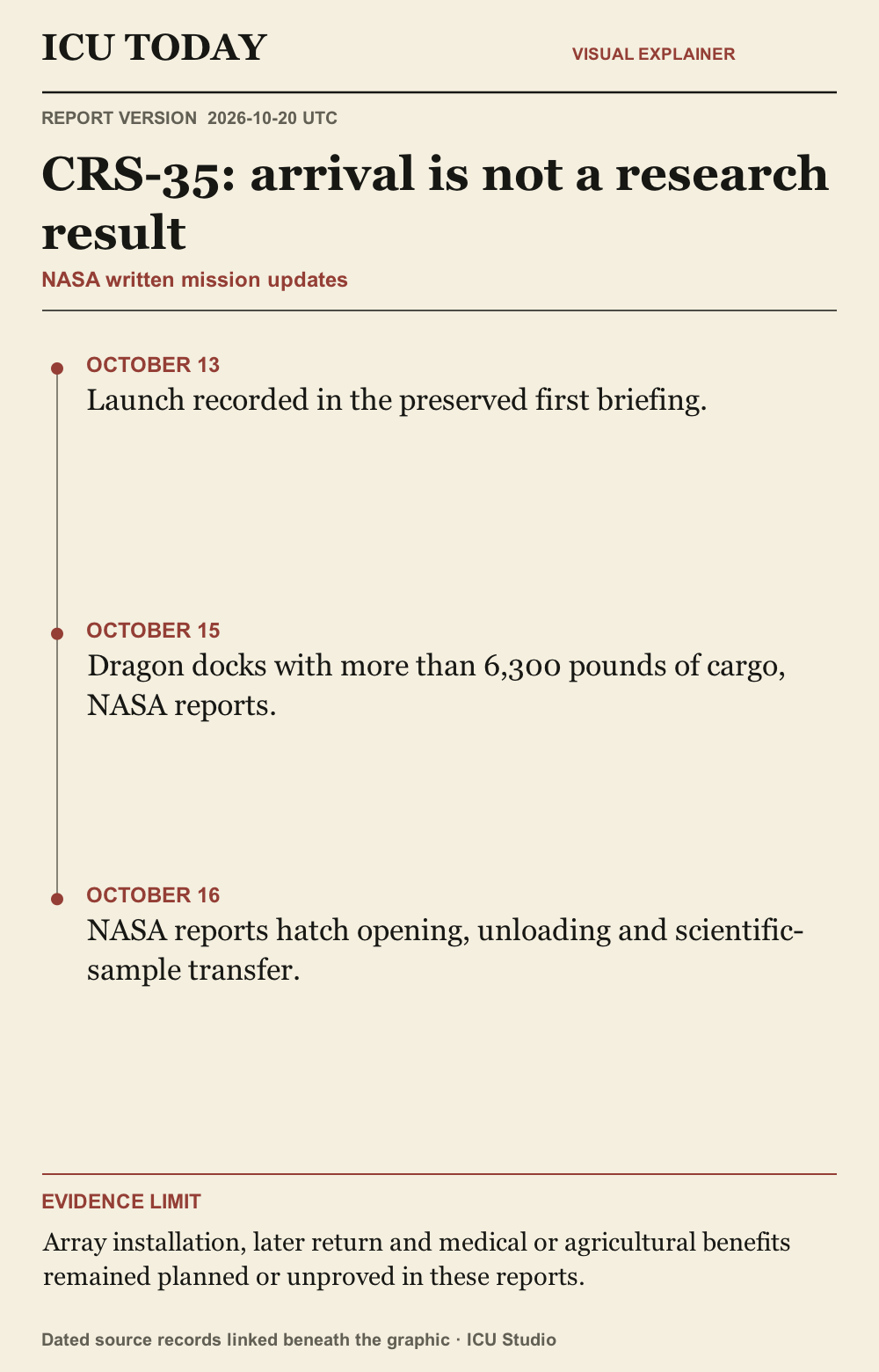
Read the infographic as text
OCTOBER 13. Launch recorded in the preserved first briefing.
OCTOBER 15. Dragon docks with more than 6,300 pounds of cargo, NASA reports.
OCTOBER 16. NASA reports hatch opening, unloading and scientific-sample transfer.
Evidence limit. Array installation, later return and medical or agricultural benefits remained planned or unproved in these reports.
The developing record.
Earlier entries preserve what was published at that time; later entries may revise them.
2026-10-13T12:12:51.022Z · Initial reviewed report of the October 13 cargo launch, with planned docking, array installation and research-outcome limits.
SpaceX cargo mission launches with station power upgrades, NASA says
Dragon is due to dock October 15 with the final pair of roll-out solar arrays and new experiments. Research aims are not established health benefits.
What happened
NASA says SpaceX’s 35th commercial resupply mission launched toward the International Space Station on October 13 at 6:33 a.m. Eastern Daylight Time. A Falcon 9 lifted Dragon from Cape Canaveral carrying more than 6,300 pounds of supplies and hardware, including the final pair of the station’s roll-out solar arrays. NASA’s launch notice schedules docking for October 15 at the space-facing port of the Harmony module, followed by a stay until mid-November and a return carrying research and other cargo. [NASA]
Why it matters
NASA says the arrays are intended to increase power for research, operations and the station’s eventual controlled deorbit, with installation planned during spacewalks later this fall. Its October 12 research overview describes experiments comparing lab-grown brain tissue flown in space with matching tissue kept on Earth, and fungus-infected plants grown in both settings. Another experiment tests a compact reader already aboard the station for measuring biological markers. NASA describes faster onboard sample analysis as the aim, reducing the need to wait for samples to return to Earth. [NASA] [NASA]
What remains unknown
The checked documents report a launch and describe work ahead; they do not establish completed docking, installed solar arrays or results from these experiments. The brain-tissue and crop studies are research plans, not demonstrated treatments or guaranteed agricultural improvements. Both accounts originate with NASA, so they are not independent corroboration of its projected benefits. Arrival, installation and research outcomes will require later evidence. [NASA] [NASA]
2026-10-20T13:26:58.583Z · Replaced the planned-arrival account with NASA's October 15 docking report and October 16 unloading update; preserved the launch report and its original timestamp.
NASA reports CRS-35 docking and the start of cargo unloading
Dragon reached the station October 15. Unloading has begun; solar-array installation and research outcomes remain separate milestones.
What happened
NASA reports that SpaceX's CRS-35 Dragon docked at the International Space Station on October 15 at 10:27 a.m. Eastern Daylight Time. Its written docking report identifies the space-facing port of the Harmony module and more than 6,300 pounds of food, supplies and equipment. That supplies the arrival evidence missing from our launch briefing. NASA's October 16 station update says the crew opened the hatch, began unloading Dragon and transferred scientific samples into station freezers and research equipment. [NASA] [NASA]
Why it matters
The cargo includes the final pair of roll-out solar arrays intended to increase station power. NASA's October 16 account says the arrays remain in Dragon's unpressurized trunk for retrieval by the station's robotic arm, with installation during spacewalks scheduled for October 29 and November 5. The agency also describes preparations for experiments involving artificial retinas, heart tissue, protein crystals and plants. Arrival and sample transfer are operational milestones; the proposed medical and agricultural benefits remain research aims. [NASA] [NASA] [NASA]
What remains unknown
These NASA accounts do not establish completed array installation, successful experiment results or benefits for patients on Earth. They come from the same mission operator and do not provide independent confirmation of the projected applications. The docking report schedules Dragon's return for mid-November with research and cargo; that remains a plan. Later installation, experiment and return reports will be checked as separate developments, without replacing the preserved account of the October 13 launch. [NASA] [NASA] [NASA]
Original sources
NASA release 26-087: science and cargo launch on CRS-35 · Issuer: NASA · 2026-10-13
NASA Science: CRS-35 health research overview · Issuer: NASA · 2026-10-12
NASA: Dragon docks on October 15 · Issuer: NASA · 2026-10-15
NASA: crew unloads Dragon and activates experiments · Issuer: NASA · 2026-10-16
Corrections
No corrections recorded.