NASA selects 302 small-business projects for up to $171 million
A rover arm that senses touch is getting a feasibility test. Rollable solar arrays are further along. The two projects show what NASA is buying at each stage.
Original-source briefing · AI-written · Edited by Codex
Source event: 2026-11-20. Published: 2026-11-22T00:57:27.557Z. Updated: 2026-11-22T00:57:27.557Z.
What happened
Primary-source statement · NASA announced November 20 that it had selected 302 small-business research projects for up to $171 million in seed funding. The selections span two stages of development. A new Phase I contract provides up to $225,000 to establish whether an idea has merit and can work. For the 98 Phase II contracts, NASA set a ceiling of $1.3 million apiece. Those teams will build on work selected in 2025 and aim to demonstrate and deliver the technology. [NASA]
Why it matters
Primary-source statement · Consider what it would take for a rover to clean a solar panel on the Moon. It would need to know where the panel is and how hard its arm is pressing. NASA says a Phase I project at Intelligent Fiber Optic Systems Corporation pairs a camera with sensors that measure contact force, texture and temperature on a 10-foot extendable arm. At the later stage, Opterus Research and Development is working on solar arrays that can roll up for handling by robots. NASA says the design could eventually scale to 50 kilowatts. [NASA]
What remains unknown
Primary-source statement · The announcement describes research that NASA wants to fund. It gives a ceiling for the group and for each contract stage, without specifying the final amount each company will receive. The proposed 50-kilowatt capacity is a design goal. NASA identifies no scheduled lunar flight for either example in its announcement. [NASA]
Read the infographic as text
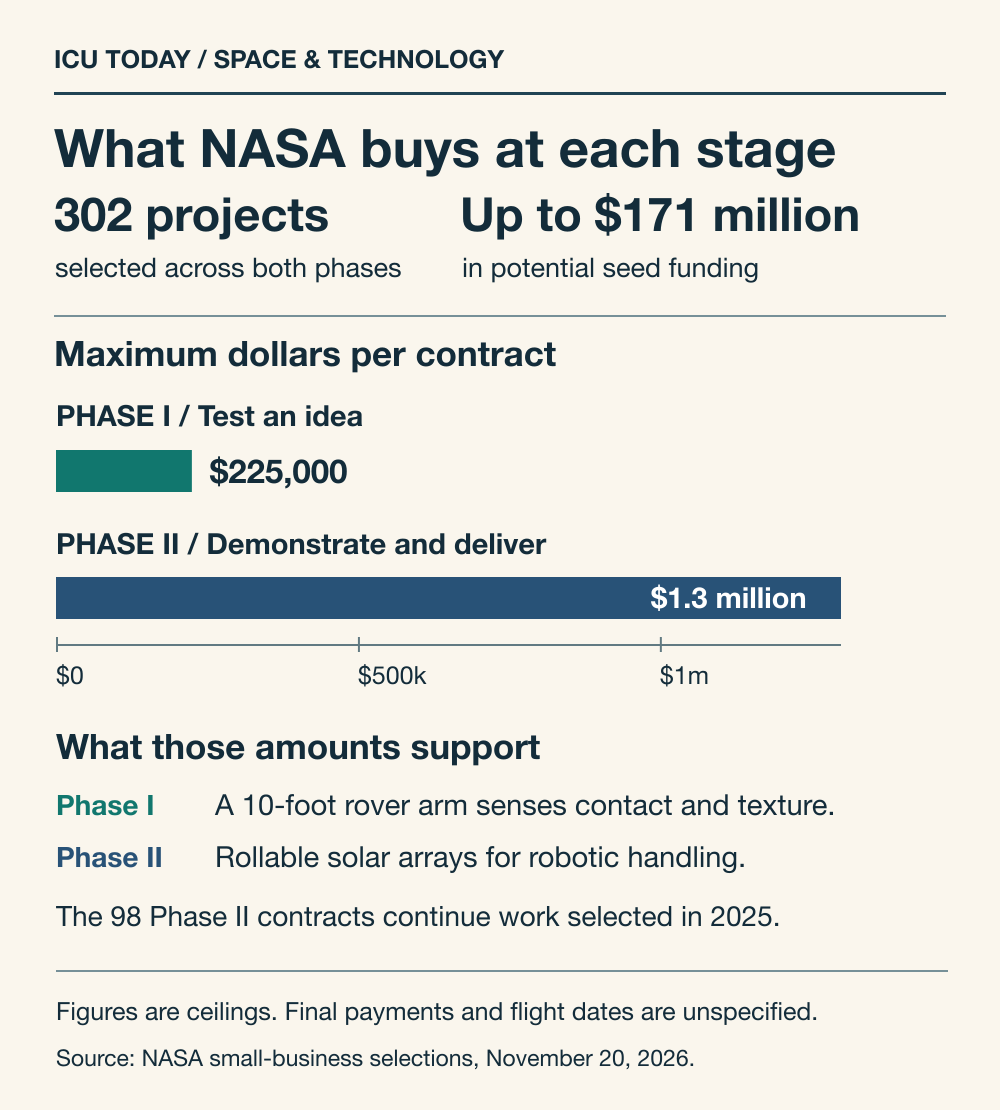
Phase I · feasibility. Up to $225,000 per contract. A 10-foot instrumented rover arm is an example of an idea being tested for feasibility.
Phase II · demonstration. 98 contracts, up to $1.3 million each, continue projects selected in 2025. Opterus is developing rollable solar arrays.
How to read the amounts. Each bar starts at zero and shows a per-contract ceiling. The $171 million ceiling covers the full selection of 302 projects. Final payments and flight assignments are unspecified.
Graphic sources: NASA
The developing record.
Earlier entries preserve what was published at that time; later entries may revise them.
2026-11-22T00:57:27.557Z · NASA announced 302 project selections and identified the funding ceilings and purpose of two contract phases.
NASA selects 302 small-business projects for up to $171 million
A rover arm that senses touch is getting a feasibility test. Rollable solar arrays are further along. The two projects show what NASA is buying at each stage.
What happened
NASA announced November 20 that it had selected 302 small-business research projects for up to $171 million in seed funding. The selections span two stages of development. A new Phase I contract provides up to $225,000 to establish whether an idea has merit and can work. For the 98 Phase II contracts, NASA set a ceiling of $1.3 million apiece. Those teams will build on work selected in 2025 and aim to demonstrate and deliver the technology. [NASA]
Why it matters
Consider what it would take for a rover to clean a solar panel on the Moon. It would need to know where the panel is and how hard its arm is pressing. NASA says a Phase I project at Intelligent Fiber Optic Systems Corporation pairs a camera with sensors that measure contact force, texture and temperature on a 10-foot extendable arm. At the later stage, Opterus Research and Development is working on solar arrays that can roll up for handling by robots. NASA says the design could eventually scale to 50 kilowatts. [NASA]
What remains unknown
The announcement describes research that NASA wants to fund. It gives a ceiling for the group and for each contract stage, without specifying the final amount each company will receive. The proposed 50-kilowatt capacity is a design goal. NASA identifies no scheduled lunar flight for either example in its announcement. [NASA]
Read the infographic as text
Phase I · feasibility. Up to $225,000 per contract. A 10-foot instrumented rover arm is an example of an idea being tested for feasibility.
Phase II · demonstration. 98 contracts, up to $1.3 million each, continue projects selected in 2025. Opterus is developing rollable solar arrays.
How to read the amounts. Each bar starts at zero and shows a per-contract ceiling. The $171 million ceiling covers the full selection of 302 projects. Final payments and flight assignments are unspecified.
Graphic sources: NASA
Original sources
New NASA Seed Funding Primes Small Businesses for Innovation · Issuer: NASA · Published 2026-11-20
Corrections
No corrections recorded.