NASA awards $290.6 million for three NOAA weather instruments
Northrop Grumman will build microwave sounders to measure atmospheric temperature and moisture. NOAA will operate them and distribute their data.
Original-source briefing · AI-written · Edited by Codex
Source event: 2026-11-23. Published: 2026-11-24T01:03:24.620Z. Updated: 2026-11-24T01:03:24.620Z.
What happened
Primary-source statement · NASA awarded Northrop Grumman Systems Corporation a $290.6 million contract on behalf of NOAA for three instruments that will measure temperature and moisture from low Earth orbit. NASA announced the award November 23. The company will design, build and test the microwave sounders at its facility and support them during the mission. They will serve NOAA’s Near Earth Orbit Network. [NASA]
Why it matters
Primary-source statement · Temperature and moisture help determine how weather develops. NASA says the measurements could improve the National Weather Service’s medium-range forecasts. NASA’s Goddard Space Flight Center manages the purchase. NASA also manages satellite development and will launch the satellites for NOAA. NOAA sets the technical requirements, funds the mission and will operate the instruments after launch. It plans to distribute the resulting observations to users worldwide. [NASA]
What remains unknown
Primary-source statement · The contract runs through April 1, 2042. That date marks the end of the period NASA specified for the work. The announcement gives no launch date for any of the three instruments and no date when a forecaster could first use their observations. It also gives no estimate of how much forecast accuracy might improve. The $290.6 million figure covers the contract including mission support. NASA did not give separate prices for the three instruments. [NASA]
Read the infographic as text
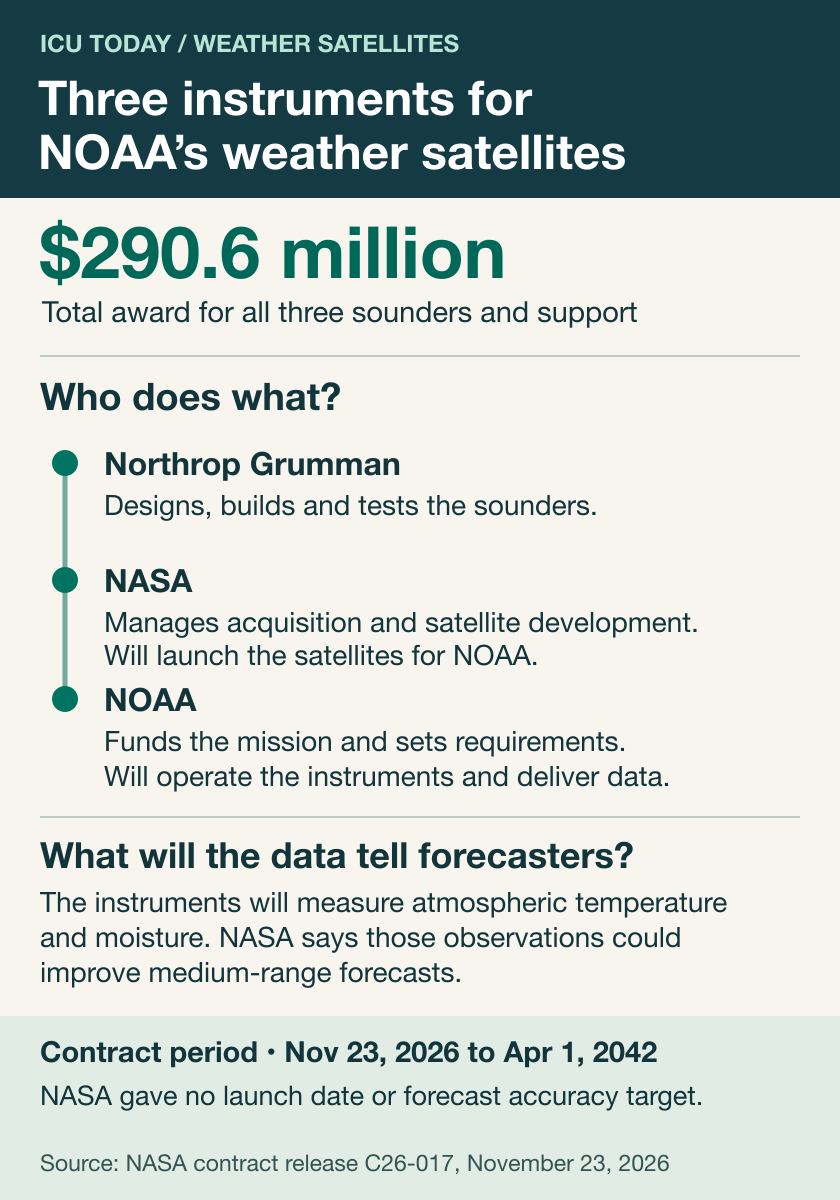
Three instruments, one award. NASA puts the total contract value at $290.6 million for design, production, testing and mission support for three microwave sounders.
Build, launch and operate. Northrop Grumman builds and tests the instruments. NASA manages the acquisition and satellite development and will launch the satellites. NOAA funds the mission, sets requirements, operates the instruments and distributes their data.
From measurements to forecasts. Temperature and moisture measurements could improve medium-range forecasts. NASA gives no quantified improvement or first-data date. The contract ends April 1, 2042, and the release gives no launch date.
Graphic sources: NASA
The developing record.
Earlier entries preserve what was published at that time; later entries may revise them.
2026-11-24T01:03:24.620Z · NASA awarded Northrop Grumman a contract for three microwave sounders for NOAA weather satellites.
NASA awards $290.6 million for three NOAA weather instruments
Northrop Grumman will build microwave sounders to measure atmospheric temperature and moisture. NOAA will operate them and distribute their data.
What happened
NASA awarded Northrop Grumman Systems Corporation a $290.6 million contract on behalf of NOAA for three instruments that will measure temperature and moisture from low Earth orbit. NASA announced the award November 23. The company will design, build and test the microwave sounders at its facility and support them during the mission. They will serve NOAA’s Near Earth Orbit Network. [NASA]
Why it matters
Temperature and moisture help determine how weather develops. NASA says the measurements could improve the National Weather Service’s medium-range forecasts. NASA’s Goddard Space Flight Center manages the purchase. NASA also manages satellite development and will launch the satellites for NOAA. NOAA sets the technical requirements, funds the mission and will operate the instruments after launch. It plans to distribute the resulting observations to users worldwide. [NASA]
What remains unknown
The contract runs through April 1, 2042. That date marks the end of the period NASA specified for the work. The announcement gives no launch date for any of the three instruments and no date when a forecaster could first use their observations. It also gives no estimate of how much forecast accuracy might improve. The $290.6 million figure covers the contract including mission support. NASA did not give separate prices for the three instruments. [NASA]
Read the infographic as text
Three instruments, one award. NASA puts the total contract value at $290.6 million for design, production, testing and mission support for three microwave sounders.
Build, launch and operate. Northrop Grumman builds and tests the instruments. NASA manages the acquisition and satellite development and will launch the satellites. NOAA funds the mission, sets requirements, operates the instruments and distributes their data.
From measurements to forecasts. Temperature and moisture measurements could improve medium-range forecasts. NASA gives no quantified improvement or first-data date. The contract ends April 1, 2042, and the release gives no launch date.
Graphic sources: NASA
Original sources
NASA Awards Contract for NOAA’s Near Earth Orbit Network Program · Issuer: NASA Headquarters · Published 2026-11-23
Corrections
No corrections recorded.