NASA selects eight companies for lunar deliveries under a $10 billion ceiling
The November 7 announcement separates future delivery competitions from a Blue Origin rover award. The headline contract limits are not amounts already spent.
Original-source briefing · AI-written · Edited by Codex
Source event: 2026-11-07. Published: 2026-11-14T09:10:02.709Z. Updated: 2026-11-14T09:10:02.709Z.
What happened
Primary-source statement · NASA has selected eight companies to compete for future lunar deliveries under a new, 10-year Commercial Lunar Payload Services contract with a combined maximum value of $10 billion. The agency announced the CLPS 2 framework on November 7 at Kennedy Space Center in Florida. The eligible companies are Blue Origin, Firefly Aerospace, Intuitive Machines, ispace-U.S., Lockheed Martin Space, Northrop Grumman Space Systems, SpaceX and Voyager Technologies. Selection gives them eligibility to compete for later missions; the announcement does not say each company has received a delivery order or that NASA has spent the full ceiling. [NASA]
Why it matters
Primary-source statement · NASA uses commercial deliveries to send scientific instruments, technology and infrastructure to the Moon. Its new announcement also raises the existing CLPS 1.0 ceiling from $2.6 billion to $4.2 billion. That contract continues through November 2028, with another five years to complete awarded deliveries. Separately, NASA says Blue Origin received a $94 million base contract to deliver the nuclear-powered PROMISE rover, with an additional $140 million option dependent on performance. NASA targets a late-2028 launch and an 18-month rover mission to investigate the lunar South Pole. These are different contractual measures: a program ceiling, a base award and a conditional option should not be added together as money already paid. [NASA] [NASA]
What remains unknown
Primary-source statement · The announcement does not establish which CLPS 2 companies will win individual deliveries, their eventual prices or successful landings. NASA's program overview acknowledges that the commercial approach carries a risk of mission failures. It still displays the older $2.6 billion ceiling; the November 7 release supplies the newer $4.2 billion figure. The rover's launch window and mission length are plans, and the additional option remains conditional. Both documents come from NASA, so this report describes the agency's announced terms, rather than independently verifying expenditure, supplier performance or mission readiness. [NASA] [NASA]
Read the infographic as text
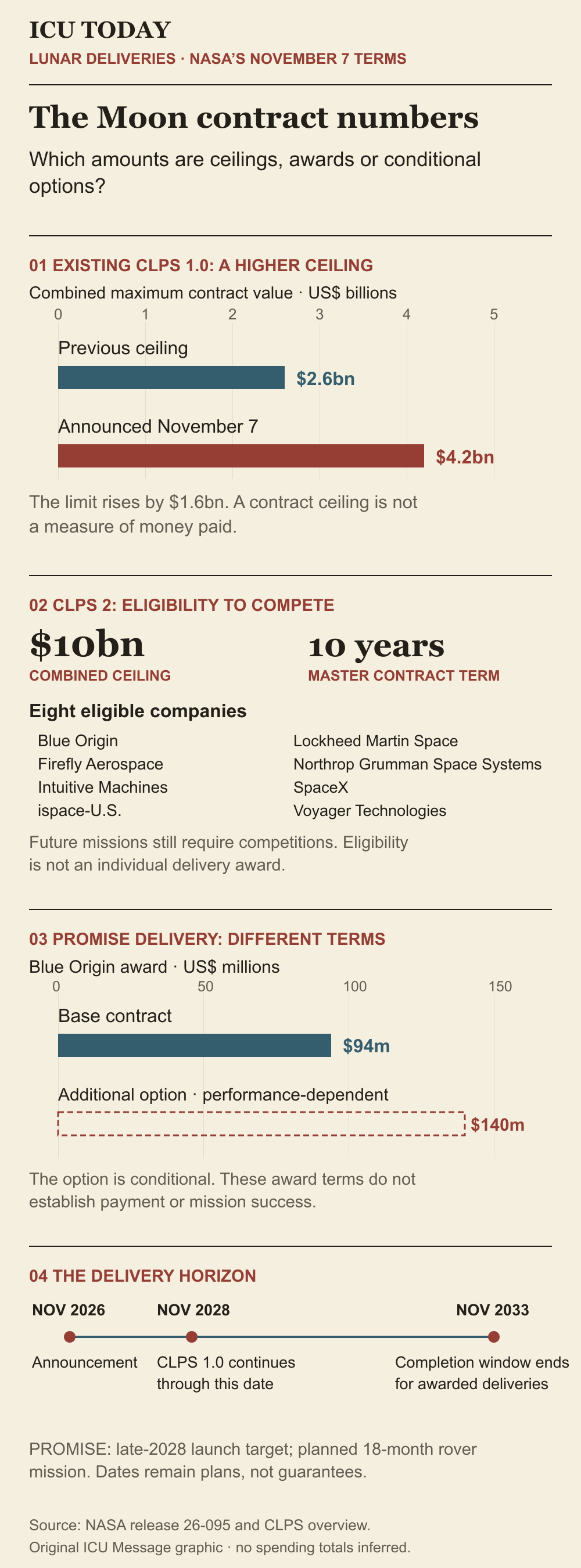
Existing CLPS 1.0 ceiling. The combined maximum rises from $2.6 billion to $4.2 billion, an increase of $1.6 billion. Bars share a zero-based 0–5 billion US-dollar axis. These are contract ceilings, not amounts paid. The general overview still shows the earlier ceiling; the November 7 release supplies the new figure.
CLPS 2 eligibility. The new 10-year master contract has a combined maximum of $10 billion. Eight companies are eligible to compete for future missions: Blue Origin, Firefly Aerospace, Intuitive Machines, ispace-U.S., Lockheed Martin Space, Northrop Grumman Space Systems, SpaceX and Voyager Technologies. This is not a $10 billion award to each company or an individual delivery order.
PROMISE delivery award. NASA announced a $94 million base contract for Blue Origin and an additional $140 million option dependent on performance. The separate bars share a zero-based 0–150 million US-dollar axis; the option is outlined to distinguish its conditional status. These amounts are not added to the program ceilings as a spending total.
Delivery horizon and limits. The announcement is dated November 7, 2026. CLPS 1.0 continues through November 2028, with five more years to complete awarded deliveries through November 2033. NASA targets late 2028 for PROMISE’s launch and plans an 18-month rover mission. The stated dates are plans, not guarantees. NASA acknowledges mission failure risk; these two NASA documents share one institutional origin.
The developing record.
Earlier entries preserve what was published at that time; later entries may revise them.
2026-11-14T09:10:02.709Z · Initial report on NASA’s November7 lunar-delivery contract framework, separate PROMISE rover award, financial limits and planned delivery dates.
NASA selects eight companies for lunar deliveries under a $10 billion ceiling
The November 7 announcement separates future delivery competitions from a Blue Origin rover award. The headline contract limits are not amounts already spent.
What happened
NASA has selected eight companies to compete for future lunar deliveries under a new, 10-year Commercial Lunar Payload Services contract with a combined maximum value of $10 billion. The agency announced the CLPS 2 framework on November 7 at Kennedy Space Center in Florida. The eligible companies are Blue Origin, Firefly Aerospace, Intuitive Machines, ispace-U.S., Lockheed Martin Space, Northrop Grumman Space Systems, SpaceX and Voyager Technologies. Selection gives them eligibility to compete for later missions; the announcement does not say each company has received a delivery order or that NASA has spent the full ceiling. [NASA]
Why it matters
NASA uses commercial deliveries to send scientific instruments, technology and infrastructure to the Moon. Its new announcement also raises the existing CLPS 1.0 ceiling from $2.6 billion to $4.2 billion. That contract continues through November 2028, with another five years to complete awarded deliveries. Separately, NASA says Blue Origin received a $94 million base contract to deliver the nuclear-powered PROMISE rover, with an additional $140 million option dependent on performance. NASA targets a late-2028 launch and an 18-month rover mission to investigate the lunar South Pole. These are different contractual measures: a program ceiling, a base award and a conditional option should not be added together as money already paid. [NASA] [NASA]
What remains unknown
The announcement does not establish which CLPS 2 companies will win individual deliveries, their eventual prices or successful landings. NASA's program overview acknowledges that the commercial approach carries a risk of mission failures. It still displays the older $2.6 billion ceiling; the November 7 release supplies the newer $4.2 billion figure. The rover's launch window and mission length are plans, and the additional option remains conditional. Both documents come from NASA, so this report describes the agency's announced terms, rather than independently verifying expenditure, supplier performance or mission readiness. [NASA] [NASA]
Read the infographic as text
Existing CLPS 1.0 ceiling. The combined maximum rises from $2.6 billion to $4.2 billion, an increase of $1.6 billion. Bars share a zero-based 0–5 billion US-dollar axis. These are contract ceilings, not amounts paid. The general overview still shows the earlier ceiling; the November 7 release supplies the new figure.
CLPS 2 eligibility. The new 10-year master contract has a combined maximum of $10 billion. Eight companies are eligible to compete for future missions: Blue Origin, Firefly Aerospace, Intuitive Machines, ispace-U.S., Lockheed Martin Space, Northrop Grumman Space Systems, SpaceX and Voyager Technologies. This is not a $10 billion award to each company or an individual delivery order.
PROMISE delivery award. NASA announced a $94 million base contract for Blue Origin and an additional $140 million option dependent on performance. The separate bars share a zero-based 0–150 million US-dollar axis; the option is outlined to distinguish its conditional status. These amounts are not added to the program ceilings as a spending total.
Delivery horizon and limits. The announcement is dated November 7, 2026. CLPS 1.0 continues through November 2028, with five more years to complete awarded deliveries through November 2033. NASA targets late 2028 for PROMISE’s launch and plans an 18-month rover mission. The stated dates are plans, not guarantees. NASA acknowledges mission failure risk; these two NASA documents share one institutional origin.
Original sources
NASA Awards Moon Base Transportation, Technology, Science Projects — release 26-095 · Issuer: National Aeronautics and Space Administration · Published 2026-11-07
Commercial Lunar Payload Services — program overview · Issuer: National Aeronautics and Space Administration · Retrieved (undated original) 2026-11-14
Corrections
No corrections recorded.