NASA ends science operations for the space station’s NICER X-ray telescope
A pointing problem cut short observations after eight years of data collection. NASA plans to preserve the archive and detach the instrument from the station.
Original-source briefing · AI-written · Edited by Codex
Source event: 2026-11-17. Published: 2026-11-18T04:02:26.953Z. Updated: 2026-11-18T04:02:26.953Z.
What happened
Primary-source statement · NASA has ended science operations for NICER, the X-ray telescope mounted on the International Space Station. The agency announced the decision on November 17, more than a year after a mechanical problem interrupted observations. In June 2025 the telescope lost the ability to swivel from side to side beyond its existing orientation. That limited its ability to follow objects across the sky, and the team paused data collection to investigate. [NASA]
Why it matters
Primary-source statement · NICER launched in 2017 for an initial mission of 18 months. NASA says the telescope studied the universe for another six and a half years beyond that term. It measured neutron stars, observed black holes and active galaxies, and demonstrated that X-ray pulses from stars could help spacecraft navigate. The observing campaign leaves a separate task for the scientists who ran it. NASA says the teams will finalize an eight-year archive of X-ray observations while planning to decommission the telescope and detach it from the station. [NASA]
What remains unknown
Primary-source statement · Robotic cameras outside the station photographed NICER to help engineers investigate its restricted motion. NASA says the images helped rule out external causes. Engineers suspect an internal motor failed. The November update presents that as their assessment and gives no date for detaching the telescope, which remains mounted near the station’s starboard solar array. [NASA]
Read the infographic as text
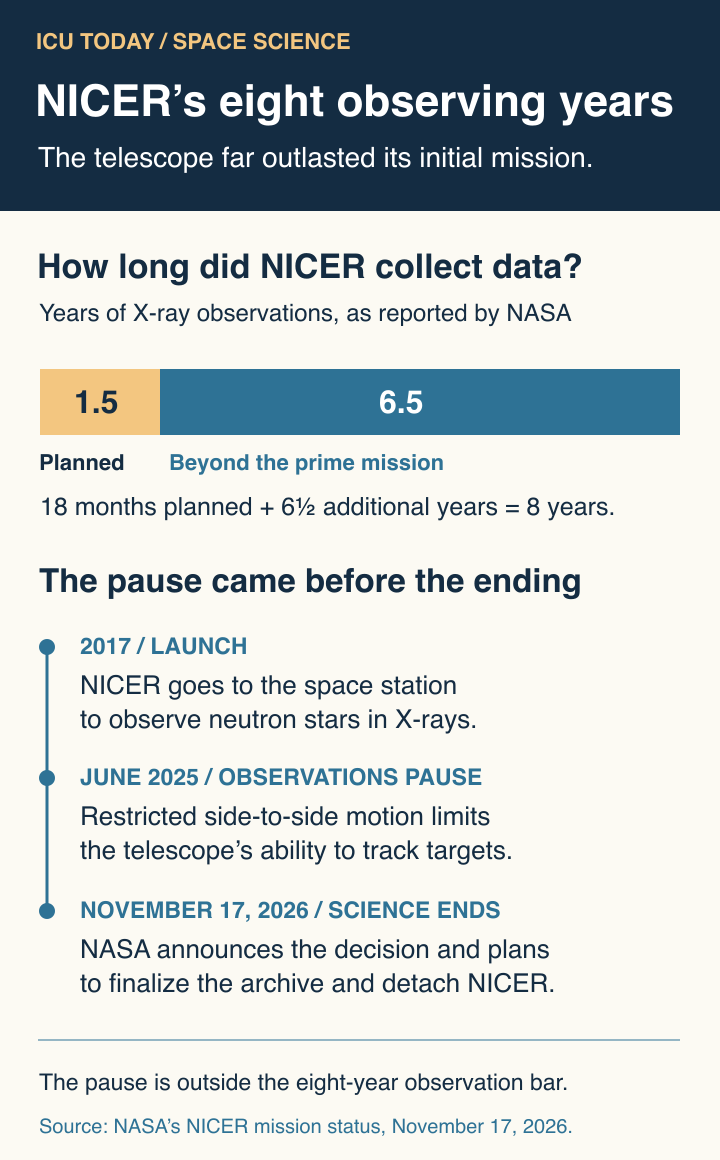
Time spent observing. The 18-month prime mission and six and a half additional years make eight years of observations. A proportional bar compares the two periods.
When the telescope stopped collecting data. NICER launched in 2017. Its team paused science observations in June 2025 after it could no longer swivel freely from side to side.
When the decision became final. November 17, 2026: NASA announced the end of science operations. The team plans to finalize the eight-year archive and decommission and detach the instrument. NASA did not announce a removal date.
Graphic sources: NASA
The developing record.
Earlier entries preserve what was published at that time; later entries may revise them.
2026-11-18T04:02:26.953Z · Initial report on the end of NICER science operations, the observing pause and the planned archive.
NASA ends science operations for the space station’s NICER X-ray telescope
A pointing problem cut short observations after eight years of data collection. NASA plans to preserve the archive and detach the instrument from the station.
What happened
NASA has ended science operations for NICER, the X-ray telescope mounted on the International Space Station. The agency announced the decision on November 17, more than a year after a mechanical problem interrupted observations. In June 2025 the telescope lost the ability to swivel from side to side beyond its existing orientation. That limited its ability to follow objects across the sky, and the team paused data collection to investigate. [NASA]
Why it matters
NICER launched in 2017 for an initial mission of 18 months. NASA says the telescope studied the universe for another six and a half years beyond that term. It measured neutron stars, observed black holes and active galaxies, and demonstrated that X-ray pulses from stars could help spacecraft navigate. The observing campaign leaves a separate task for the scientists who ran it. NASA says the teams will finalize an eight-year archive of X-ray observations while planning to decommission the telescope and detach it from the station. [NASA]
What remains unknown
Robotic cameras outside the station photographed NICER to help engineers investigate its restricted motion. NASA says the images helped rule out external causes. Engineers suspect an internal motor failed. The November update presents that as their assessment and gives no date for detaching the telescope, which remains mounted near the station’s starboard solar array. [NASA]
Read the infographic as text
Time spent observing. The 18-month prime mission and six and a half additional years make eight years of observations. A proportional bar compares the two periods.
When the telescope stopped collecting data. NICER launched in 2017. Its team paused science observations in June 2025 after it could no longer swivel freely from side to side.
When the decision became final. November 17, 2026: NASA announced the end of science operations. The team plans to finalize the eight-year archive and decommission and detach the instrument. NASA did not announce a removal date.
Graphic sources: NASA
Original sources
NASA’s NICER Telescope Ends Science Operations · Issuer: NASA · Published 2026-11-17
Corrections
No corrections recorded.