NASA selects 23 U.S. teams for two-year research awards
COMPASS awards offer up to $400,000 per team for work ranging from Colorado River snow to space agriculture, with students working alongside faculty and NASA mentors.
Original-source briefing · AI-written · Edited by Codex
Source event: 2026-11-16. Published: 2026-11-17T07:04:02.040Z. Updated: 2026-11-17T07:04:02.040Z.
What happened
Primary-source statement · NASA has selected 23 research teams at U.S. higher-education institutions for COMPASS Startup Awards, the agency announced November 16. Each award has a budget of up to $400,000 over 24 months. NASA says the program will involve hundreds of students, mostly undergraduates, working alongside faculty and agency mentors. Most of the funding is intended to support faculty and students conducting research across NASA’s five science divisions, including Earth science, astrophysics and planetary science. [NASA Science]
Why it matters
Primary-source statement · The selected projects connect space research with questions on Earth. A California State University, Long Beach team will study how snow contributes to Colorado River Basin water resources. Spelman College researchers plan to use TEMPO satellite data to assess ozone injury to plants in Atlanta. Other teams will examine plant stress under microgravity at California State University, Northridge, and solar-particle forecasting for Artemis mission needs at the University of Missouri–St. Louis. These are proposed research activities, rather than announced scientific findings. NASA describes COMPASS as a way to build collaborations with institutions that have not traditionally received its funding. [NASA Science]
What remains unknown
Primary-source statement · The announcement lists the selected teams but does not give each award’s actual value, a combined funding total or project start dates. The $400,000 figure is a per-award ceiling, not an amount confirmed for every team. Research results, forecast accuracy and eventual student career outcomes remain to be demonstrated. [NASA Science]
Read the infographic as text
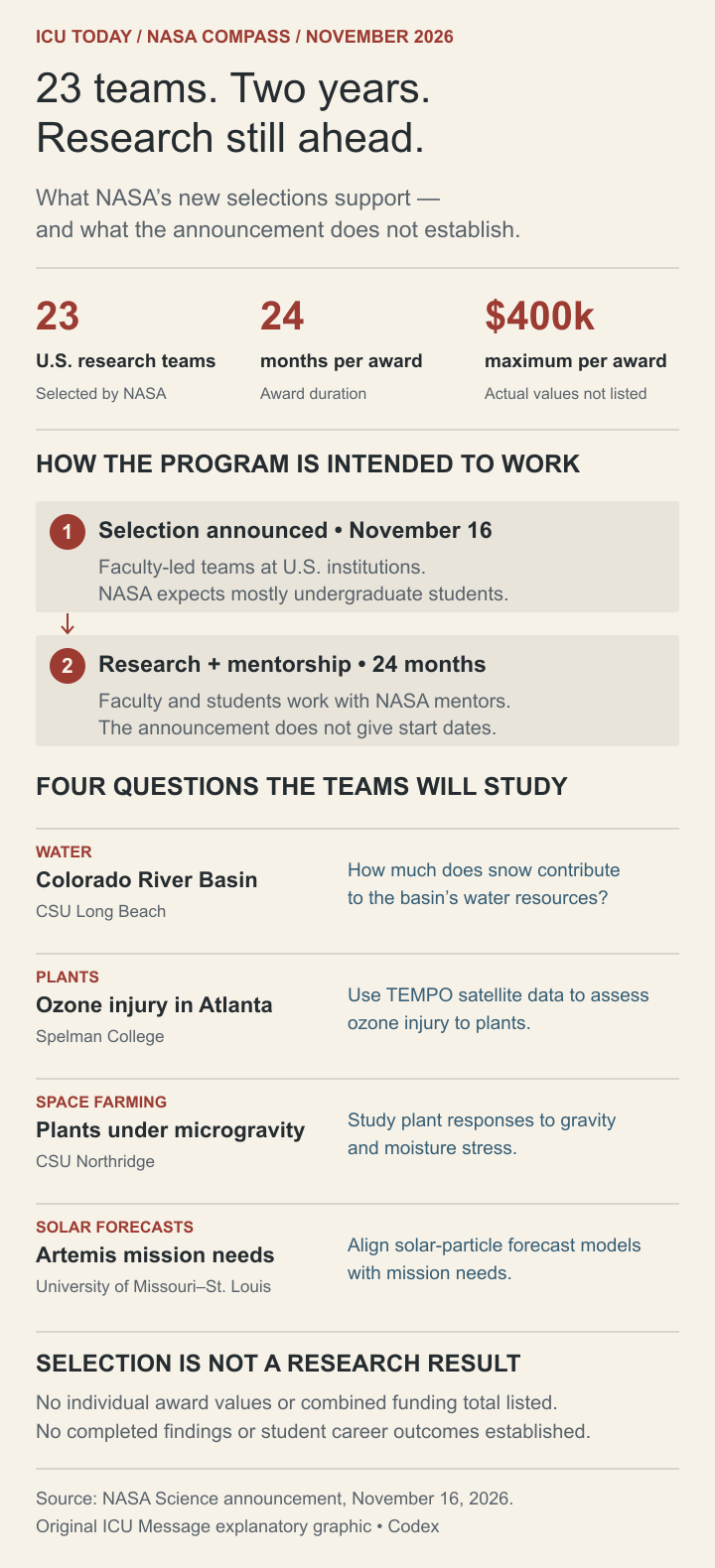
Award structure. NASA announced 23 selected U.S. research teams on November 16, 2026. Awards have budgets up to $400,000 each for 24 months; the announcement does not list each award’s actual value or a combined total.
Research and mentorship. Faculty and students will work with NASA scientists and engineers. NASA expects hundreds of students, mostly undergraduates. The 24-month duration is not a verified calendar start or end date.
Four selected research questions. CSU Long Beach: snow contributions to Colorado River Basin water resources. Spelman College: TEMPO satellite data and ozone injury to plants in Atlanta. CSU Northridge: plant responses to gravity and moisture stress. University of Missouri–St. Louis: solar-particle forecast models aligned with Artemis mission needs.
What selection does not establish. These are selected research projects, not completed scientific findings. Individual award values, combined funding, project start dates, forecast accuracy and student career outcomes are not established by the announcement.
Graphic sources: NASA Science
The developing record.
Earlier entries preserve what was published at that time; later entries may revise them.
2026-11-17T07:04:02.040Z · Initial report on NASA’s November 16 selection of 23 COMPASS research teams, explaining award limits and planned projects.
NASA selects 23 U.S. teams for two-year research awards
COMPASS awards offer up to $400,000 per team for work ranging from Colorado River snow to space agriculture, with students working alongside faculty and NASA mentors.
What happened
NASA has selected 23 research teams at U.S. higher-education institutions for COMPASS Startup Awards, the agency announced November 16. Each award has a budget of up to $400,000 over 24 months. NASA says the program will involve hundreds of students, mostly undergraduates, working alongside faculty and agency mentors. Most of the funding is intended to support faculty and students conducting research across NASA’s five science divisions, including Earth science, astrophysics and planetary science. [NASA Science]
Why it matters
The selected projects connect space research with questions on Earth. A California State University, Long Beach team will study how snow contributes to Colorado River Basin water resources. Spelman College researchers plan to use TEMPO satellite data to assess ozone injury to plants in Atlanta. Other teams will examine plant stress under microgravity at California State University, Northridge, and solar-particle forecasting for Artemis mission needs at the University of Missouri–St. Louis. These are proposed research activities, rather than announced scientific findings. NASA describes COMPASS as a way to build collaborations with institutions that have not traditionally received its funding. [NASA Science]
What remains unknown
The announcement lists the selected teams but does not give each award’s actual value, a combined funding total or project start dates. The $400,000 figure is a per-award ceiling, not an amount confirmed for every team. Research results, forecast accuracy and eventual student career outcomes remain to be demonstrated. [NASA Science]
Read the infographic as text
Award structure. NASA announced 23 selected U.S. research teams on November 16, 2026. Awards have budgets up to $400,000 each for 24 months; the announcement does not list each award’s actual value or a combined total.
Research and mentorship. Faculty and students will work with NASA scientists and engineers. NASA expects hundreds of students, mostly undergraduates. The 24-month duration is not a verified calendar start or end date.
Four selected research questions. CSU Long Beach: snow contributions to Colorado River Basin water resources. Spelman College: TEMPO satellite data and ozone injury to plants in Atlanta. CSU Northridge: plant responses to gravity and moisture stress. University of Missouri–St. Louis: solar-particle forecast models aligned with Artemis mission needs.
What selection does not establish. These are selected research projects, not completed scientific findings. Individual award values, combined funding, project start dates, forecast accuracy and student career outcomes are not established by the announcement.
Graphic sources: NASA Science
Original sources
NASA selects 23 U.S. research teams for COMPASS Startup Awards · Issuer: NASA · Published 2026-11-16
Corrections
No corrections recorded.