NASA’s new Arctic laser station can track polar satellites on nearly every orbit
From Maryland, the same satellites may come into view just two or three times a day. NASA explains what the view from Svalbard adds to measurements of Earth’s ice and oceans.
Original-source briefing · AI-written · Edited by Codex
Source event: 2026-10-12. Published: 2026-11-23T06:51:28.823Z. Updated: 2026-11-23T06:51:28.823Z.
What happened
Primary-source statement · From NASA’s observatory in Maryland, scientists may see a polar-orbiting satellite two or three times a day. From Ny-Ålesund in Norway’s Svalbard archipelago, they can see it on almost every orbit, according to Stephen Merkowitz, who manages NASA’s Space Geodesy Project. NASA described the difference on November 23 in an account of its first operating next-generation satellite laser ranging system. The instrument debuted October 12 at an Arctic observatory operated by the Norwegian Mapping Authority. [NASA Earth Observatory]
Why it matters
Primary-source statement · A pulse of laser light travels from the ground to a reflector on a satellite and back. Timing that round trip gives scientists a distance they can use to check the satellite’s orbit. For a mission such as ICESat-2, which measures the height of ice, knowing precisely where the spacecraft was helps scientists place its observations on a map. The Arctic station can send thousands of pulses per second, compared with tens per second from older instruments, according to NASA. A more sensitive detector can register even a single returning photon. [NASA Earth Observatory]
What remains unknown
Primary-source statement · A chance to see a satellite is only the first step toward a measurement. NASA’s account gives no count of successful passes at Ny-Ålesund or measured improvement in ICESat-2’s ice-height estimates. Those are different questions from how often a spacecraft comes within view. NASA says it is building two more systems to replace older equipment in Maryland and Texas. Its account gives no opening date for either one. [NASA Earth Observatory]
Read the infographic as text
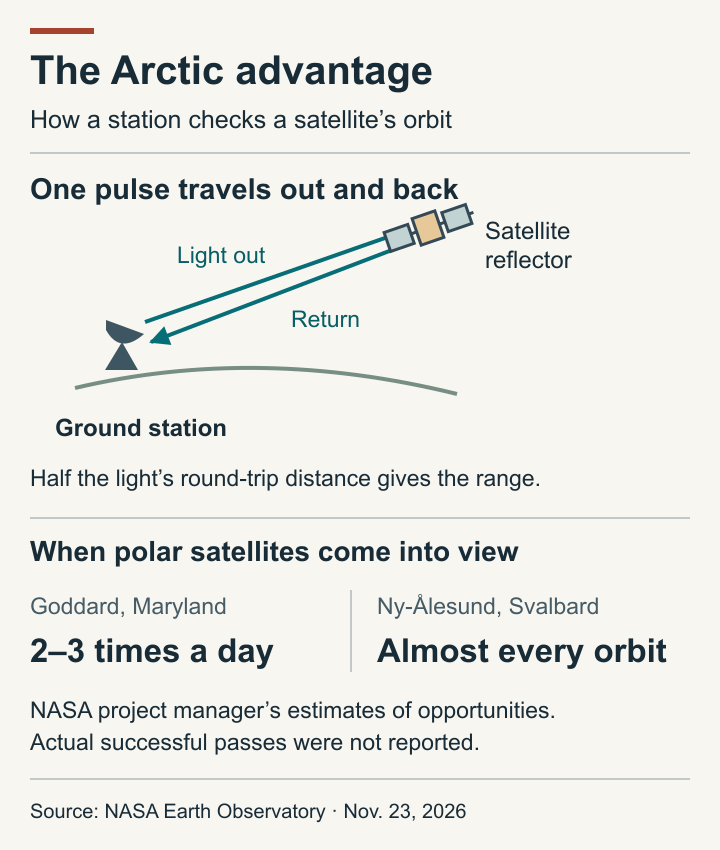
One pulse, one round trip. A station sends a laser pulse to a satellite reflector. It times the return. Light travels the station-to-satellite distance twice, so half the round-trip travel distance gives the range.
Two views of a polar orbit. NASA’s project manager estimates perhaps two or three opportunities per day at Goddard in Maryland and almost every orbit at Ny-Ålesund in Svalbard. These are viewing opportunities, not measured successful passes.
What the receiver can see. The new system fires thousands of pulses per second compared with tens on older systems and can detect a single returning photon. NASA did not report an ice-height accuracy gain.
Graphic sources: NASA Earth Observatory
The developing record.
Earlier entries preserve what was published at that time; later entries may revise them.
2026-11-23T06:51:28.823Z · NASA describes why a laser station in Svalbard can see polar-orbiting satellites more often than its station in Maryland.
NASA’s new Arctic laser station can track polar satellites on nearly every orbit
From Maryland, the same satellites may come into view just two or three times a day. NASA explains what the view from Svalbard adds to measurements of Earth’s ice and oceans.
What happened
From NASA’s observatory in Maryland, scientists may see a polar-orbiting satellite two or three times a day. From Ny-Ålesund in Norway’s Svalbard archipelago, they can see it on almost every orbit, according to Stephen Merkowitz, who manages NASA’s Space Geodesy Project. NASA described the difference on November 23 in an account of its first operating next-generation satellite laser ranging system. The instrument debuted October 12 at an Arctic observatory operated by the Norwegian Mapping Authority. [NASA Earth Observatory]
Why it matters
A pulse of laser light travels from the ground to a reflector on a satellite and back. Timing that round trip gives scientists a distance they can use to check the satellite’s orbit. For a mission such as ICESat-2, which measures the height of ice, knowing precisely where the spacecraft was helps scientists place its observations on a map. The Arctic station can send thousands of pulses per second, compared with tens per second from older instruments, according to NASA. A more sensitive detector can register even a single returning photon. [NASA Earth Observatory]
What remains unknown
A chance to see a satellite is only the first step toward a measurement. NASA’s account gives no count of successful passes at Ny-Ålesund or measured improvement in ICESat-2’s ice-height estimates. Those are different questions from how often a spacecraft comes within view. NASA says it is building two more systems to replace older equipment in Maryland and Texas. Its account gives no opening date for either one. [NASA Earth Observatory]
Read the infographic as text
One pulse, one round trip. A station sends a laser pulse to a satellite reflector. It times the return. Light travels the station-to-satellite distance twice, so half the round-trip travel distance gives the range.
Two views of a polar orbit. NASA’s project manager estimates perhaps two or three opportunities per day at Goddard in Maryland and almost every orbit at Ny-Ålesund in Svalbard. These are viewing opportunities, not measured successful passes.
What the receiver can see. The new system fires thousands of pulses per second compared with tens on older systems and can detect a single returning photon. NASA did not report an ice-height accuracy gain.
Graphic sources: NASA Earth Observatory
Original sources
Laser Focus at the Top of the World · Issuer: NASA Earth Observatory · Published 2026-11-23
Corrections
No corrections recorded.