NASA opens $1 million student challenge for life on the Moon
U.S. high-school and postsecondary teams have until January 25 to register. Six design categories connect classroom work with NASA’s plans for the lunar South Pole.
Original-source briefing · AI-written · Edited by Codex
Source event: 2026-11-08. Published: 2026-11-14T01:54:54.758Z. Updated: 2026-11-14T01:54:54.758Z.
What happened
Primary-source statement · NASA has opened a $1 million Moon Base Challenge for teams at U.S. high schools and postsecondary schools, with registration through January 25, 2027. The agency announced the competition on November 8 at Kennedy Space Center Visitor Complex in Florida. Its release was revised November 12 to update the challenge’s name. The opportunity is to develop designs for living and working on the Moon; the announcement does not say that prize money has already been distributed. [NASA] [NASA]
Why it matters
Primary-source statement · NASA places the competition within a broader effort to establish a sustained human presence near the lunar South Pole. Its program overview describes an incremental approach: technology demonstrations, robotic missions and early experiments would test systems before capabilities expand. The agency says the region may contain resources useful to future explorers and could help researchers study the history of the Moon, Earth and the solar system. Those are the program’s objectives, not evidence that an occupied base or resource supply already exists. [NASA]
Six design problems
Primary-source statement · The challenge’s six categories are power generation and storage, construction, life-support systems, surface mobility, communications networks and astronaut safety. NASA says the work will address lunar environmental and mission-design constraints. Expected deliverables include trade studies, concept proposals and stakeholder briefings. The announcement describes participation across technical, vocational and other academic tracks without requiring prior specialized engineering or technical experience. [NASA]
Where the designs fit
Primary-source statement · NASA’s overview connects its lunar plans with commercial robotic deliveries, a nuclear-powered rover, launch and orbital-transfer services, and surface infrastructure. These are different elements of the larger program, not a list of hardware assigned to student winners. The agency presents lunar operations as preparation for future crewed missions to Mars. Neither this program overview nor the challenge announcement establishes that a student proposal will be selected for flight. [NASA]
What remains unknown
Primary-source statement · The two NASA pages reviewed here do not detail how the $1 million will be divided, the number of winning teams or when awards will be paid. NASA directs prospective participants to its linked official rules and requires registration through NASA STEM Gateway. The infographic distinguishes the announced design categories and registration date from future program goals; it is not a substitute for the competition’s full eligibility rules. [NASA] [NASA]
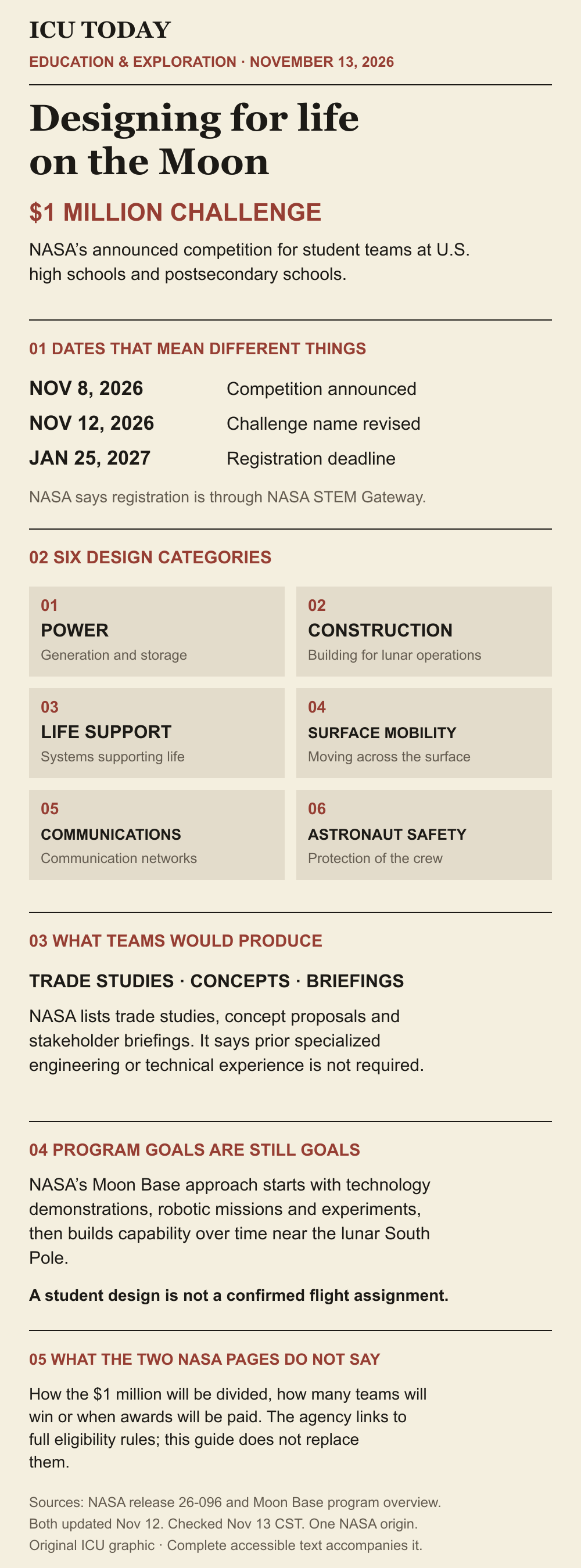
Read the infographic as text
Dates and eligibility. NASA announced a $1 million Moon Base Challenge on November 8, 2026, for teams at U.S. high schools and postsecondary schools. Its November 12 edit changes the challenge name. Registration is open through January 25, 2027, through NASA STEM Gateway.
Six design categories. Power generation and storage; construction; life-support systems; surface mobility; communications networks; astronaut safety. The graphic’s plain-language captions restate these categories.
Expected work. NASA lists trade studies, concept proposals and stakeholder briefings. It says participants do not need prior specialized engineering or technical experience.
The program context. NASA describes an iterative approach beginning with technology demonstrations, robotic missions and early experiments, then expanding capability near the lunar South Pole. A student design is not a confirmed flight assignment.
Unknowns. The two reviewed NASA pages do not specify how the $1 million will be divided, the number of winning teams or award-payment dates. NASA links to separate official eligibility rules. This guide does not replace them. Sources: NASA release 26-096 and Moon Base overview, both updated November 12; checked November13 CST. One NASA origin.
The developing record.
Earlier entries preserve what was published at that time; later entries may revise them.
2026-11-14T01:54:54.758Z · Initial report on NASA’s Moon Base student challenge, its six design categories and registration deadline, with program context, evidence limits and a detailed original infographic.
NASA opens $1 million student challenge for life on the Moon
U.S. high-school and postsecondary teams have until January 25 to register. Six design categories connect classroom work with NASA’s plans for the lunar South Pole.
What happened
NASA has opened a $1 million Moon Base Challenge for teams at U.S. high schools and postsecondary schools, with registration through January 25, 2027. The agency announced the competition on November 8 at Kennedy Space Center Visitor Complex in Florida. Its release was revised November 12 to update the challenge’s name. The opportunity is to develop designs for living and working on the Moon; the announcement does not say that prize money has already been distributed. [NASA] [NASA]
Why it matters
NASA places the competition within a broader effort to establish a sustained human presence near the lunar South Pole. Its program overview describes an incremental approach: technology demonstrations, robotic missions and early experiments would test systems before capabilities expand. The agency says the region may contain resources useful to future explorers and could help researchers study the history of the Moon, Earth and the solar system. Those are the program’s objectives, not evidence that an occupied base or resource supply already exists. [NASA]
Six design problems
The challenge’s six categories are power generation and storage, construction, life-support systems, surface mobility, communications networks and astronaut safety. NASA says the work will address lunar environmental and mission-design constraints. Expected deliverables include trade studies, concept proposals and stakeholder briefings. The announcement describes participation across technical, vocational and other academic tracks without requiring prior specialized engineering or technical experience. [NASA]
Where the designs fit
NASA’s overview connects its lunar plans with commercial robotic deliveries, a nuclear-powered rover, launch and orbital-transfer services, and surface infrastructure. These are different elements of the larger program, not a list of hardware assigned to student winners. The agency presents lunar operations as preparation for future crewed missions to Mars. Neither this program overview nor the challenge announcement establishes that a student proposal will be selected for flight. [NASA]
What remains unknown
The two NASA pages reviewed here do not detail how the $1 million will be divided, the number of winning teams or when awards will be paid. NASA directs prospective participants to its linked official rules and requires registration through NASA STEM Gateway. The infographic distinguishes the announced design categories and registration date from future program goals; it is not a substitute for the competition’s full eligibility rules. [NASA] [NASA]
Read the infographic as text
Dates and eligibility. NASA announced a $1 million Moon Base Challenge on November 8, 2026, for teams at U.S. high schools and postsecondary schools. Its November 12 edit changes the challenge name. Registration is open through January 25, 2027, through NASA STEM Gateway.
Six design categories. Power generation and storage; construction; life-support systems; surface mobility; communications networks; astronaut safety. The graphic’s plain-language captions restate these categories.
Expected work. NASA lists trade studies, concept proposals and stakeholder briefings. It says participants do not need prior specialized engineering or technical experience.
The program context. NASA describes an iterative approach beginning with technology demonstrations, robotic missions and early experiments, then expanding capability near the lunar South Pole. A student design is not a confirmed flight assignment.
Unknowns. The two reviewed NASA pages do not specify how the $1 million will be divided, the number of winning teams or award-payment dates. NASA links to separate official eligibility rules. This guide does not replace them. Sources: NASA release 26-096 and Moon Base overview, both updated November 12; checked November13 CST. One NASA origin.
Original sources
NASA announces $1 million Moon Base Challenge for students · Issuer: NASA · Published 2026-11-08
NASA Moon Base program overview · Issuer: NASA · Updated 2026-11-12
Corrections
No corrections recorded.