NASA outlines how gravitational waves could reveal hidden planets
Two studies described by NASA explore a future search around paired stellar remnants. A planet’s tug could alter their gravitational-wave signal, with infrared observations helping test some candidates.
Original-source briefing · AI-written · Edited by Codex
Source event: 2026-11-10. Published: 2026-11-13T11:23:13.914Z. Updated: 2026-11-13T11:23:13.914Z.
What happened
Primary-source statement · NASA described two studies on November 10 that examine how the planned Laser Interferometer Space Antenna, or LISA, could find planets around tightly orbiting pairs of white dwarfs. These are Earth-sized remnants of stars like the Sun. In NASA’s account, one study examines the planet masses and orbital periods suited to the detection method; the other explores how the James Webb Space Telescope could help confirm candidates. The work concerns a future observing technique. LISA is still in development, and NASA presents no planet discovery from the observatory. [NASA Science]
A wobble in the signal
Primary-source statement · The mechanism described by NASA starts with the pair of white dwarfs. Their orbit produces gravitational waves at a nearly continuous frequency. A sufficiently massive planet orbiting the system would tug on the pair, making it wobble. That motion would modify the gravitational-wave signal through the Doppler effect. NASA says LISA would see sidebands: secondary signals at frequencies above and below the main signal. The analogy is to radial-velocity searches that already use changes in a star’s light to infer a planet’s pull. Here the proposed measurement uses gravitational waves instead of shifts in the star’s spectrum. [NASA Science]
Why it matters
Primary-source statement · NASA says planets have been found around some isolated white dwarfs, but none had been found around a binary white dwarf in the record described by its report. Successful detections would therefore open a different population for study. The underlying idea is older than this week’s papers: NASA traces it to a proposal by astronomer Naoki Seto in 2008. The new work develops the detection conditions and a way to check candidates. The agency describes LISA as an ESA-led mission with NASA contributions, slated for launch in the mid-2030s. [NASA Science]
How a candidate could be checked
Primary-source statement · The proposed Webb check looks for infrared light beyond what the two stars alone should produce. NASA reports an illustrative system 500 light-years away in which Webb could detect a planet about five times Jupiter’s mass, while LISA could detect one below Jupiter’s mass under ideal conditions. Those are different thresholds from a test case, not a guarantee that Webb could confirm every LISA candidate. The researchers’ goal, as NASA describes it, is to help distinguish a genuine planet signal from a false positive. [NASA Science]
What remains unknown
Evidence limits · The announcement does not supply observed LISA planet detections or a measured discovery yield. The mission’s launch timing and future observing results remain ahead. Its planned three spacecraft would form a triangle with sides about 2.5 million kilometers long, using laser links to measure extremely small changes in their relative distances. The accompanying graphic separates that proposed observatory, the planet-signature mechanism and the illustrative Webb comparison. This report explains NASA’s account of the research; it is not an independent assessment of the papers or a claim that the proposed method has already found a planet. [NASA Science]
Read the infographic as text
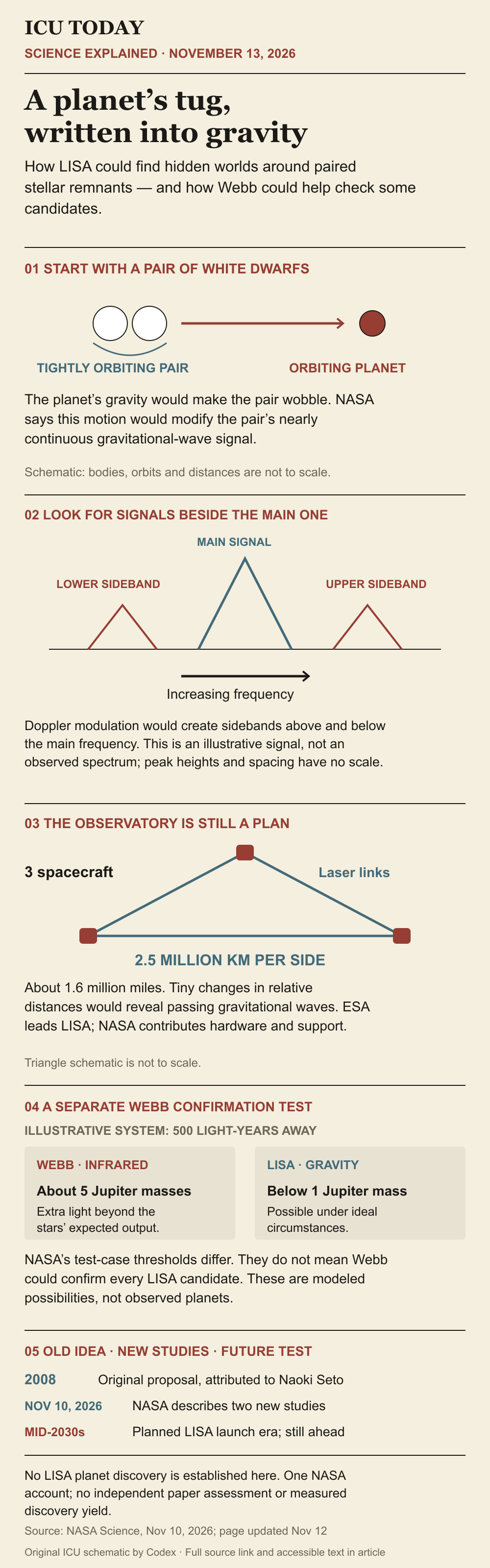
The proposed signal path. Two white dwarfs in a tight orbit produce a nearly continuous gravitational-wave frequency. An orbiting, sufficiently massive planet would tug on the pair and make it wobble. NASA says the resulting Doppler modulation would add sidebands, at frequencies below and above the main signal. The diagram is conceptual, not measured data; sizes, distances, heights and frequency spacing are not to scale.
LISA would measure tiny distance changes. The planned ESA-led LISA observatory would use three spacecraft in a triangular formation following Earth around the Sun. Each side would span about 2.5 million kilometers (1.6 million miles). Laser links would measure extremely small changes in relative spacecraft distances as gravitational waves pass. NASA describes a mid-2030s launch plan; the observatory is still in development.
A separate proposed confirmation test. Webb could look for infrared light beyond what the two white dwarfs alone should produce. NASA reports a test system 500 light-years away: Webb could detect a planet about five times Jupiter’s mass, while LISA could detect a sub-Jupiter planet under ideal circumstances. These are different modeled thresholds, not observed planets or a promise that Webb can confirm every LISA candidate.
What is old, new and still ahead. 2008: NASA traces the original proposal to Naoki Seto. November 10, 2026: NASA describes two new studies, one on detection conditions and one on Webb confirmation; the NASA page is marked updated November 12. Mid-2030s: NASA’s stated planned launch era for LISA. The studies do not establish an actual LISA planet discovery.
Evidence limits. This graphic explains one NASA institutional account, not an independent review of the two papers. No observed LISA spectrum, measured discovery yield or confirmed new planet is shown. The mechanism and example numbers are attributed to NASA’s account; future detections and confirmation remain unobserved here.
Graphic sources: NASA Science
The developing record.
Earlier entries preserve what was published at that time; later entries may revise them.
2026-11-13T11:23:13.914Z · Initial NASA-attributed explanation of the proposed LISA planet signature, historical idea, Webb confirmation example and unobserved outcomes.
NASA outlines how gravitational waves could reveal hidden planets
Two studies described by NASA explore a future search around paired stellar remnants. A planet’s tug could alter their gravitational-wave signal, with infrared observations helping test some candidates.
What happened
NASA described two studies on November 10 that examine how the planned Laser Interferometer Space Antenna, or LISA, could find planets around tightly orbiting pairs of white dwarfs. These are Earth-sized remnants of stars like the Sun. In NASA’s account, one study examines the planet masses and orbital periods suited to the detection method; the other explores how the James Webb Space Telescope could help confirm candidates. The work concerns a future observing technique. LISA is still in development, and NASA presents no planet discovery from the observatory. [NASA Science]
A wobble in the signal
The mechanism described by NASA starts with the pair of white dwarfs. Their orbit produces gravitational waves at a nearly continuous frequency. A sufficiently massive planet orbiting the system would tug on the pair, making it wobble. That motion would modify the gravitational-wave signal through the Doppler effect. NASA says LISA would see sidebands: secondary signals at frequencies above and below the main signal. The analogy is to radial-velocity searches that already use changes in a star’s light to infer a planet’s pull. Here the proposed measurement uses gravitational waves instead of shifts in the star’s spectrum. [NASA Science]
Why it matters
NASA says planets have been found around some isolated white dwarfs, but none had been found around a binary white dwarf in the record described by its report. Successful detections would therefore open a different population for study. The underlying idea is older than this week’s papers: NASA traces it to a proposal by astronomer Naoki Seto in 2008. The new work develops the detection conditions and a way to check candidates. The agency describes LISA as an ESA-led mission with NASA contributions, slated for launch in the mid-2030s. [NASA Science]
How a candidate could be checked
The proposed Webb check looks for infrared light beyond what the two stars alone should produce. NASA reports an illustrative system 500 light-years away in which Webb could detect a planet about five times Jupiter’s mass, while LISA could detect one below Jupiter’s mass under ideal conditions. Those are different thresholds from a test case, not a guarantee that Webb could confirm every LISA candidate. The researchers’ goal, as NASA describes it, is to help distinguish a genuine planet signal from a false positive. [NASA Science]
What remains unknown
The announcement does not supply observed LISA planet detections or a measured discovery yield. The mission’s launch timing and future observing results remain ahead. Its planned three spacecraft would form a triangle with sides about 2.5 million kilometers long, using laser links to measure extremely small changes in their relative distances. The accompanying graphic separates that proposed observatory, the planet-signature mechanism and the illustrative Webb comparison. This report explains NASA’s account of the research; it is not an independent assessment of the papers or a claim that the proposed method has already found a planet. [NASA Science]
Read the infographic as text
The proposed signal path. Two white dwarfs in a tight orbit produce a nearly continuous gravitational-wave frequency. An orbiting, sufficiently massive planet would tug on the pair and make it wobble. NASA says the resulting Doppler modulation would add sidebands, at frequencies below and above the main signal. The diagram is conceptual, not measured data; sizes, distances, heights and frequency spacing are not to scale.
LISA would measure tiny distance changes. The planned ESA-led LISA observatory would use three spacecraft in a triangular formation following Earth around the Sun. Each side would span about 2.5 million kilometers (1.6 million miles). Laser links would measure extremely small changes in relative spacecraft distances as gravitational waves pass. NASA describes a mid-2030s launch plan; the observatory is still in development.
A separate proposed confirmation test. Webb could look for infrared light beyond what the two white dwarfs alone should produce. NASA reports a test system 500 light-years away: Webb could detect a planet about five times Jupiter’s mass, while LISA could detect a sub-Jupiter planet under ideal circumstances. These are different modeled thresholds, not observed planets or a promise that Webb can confirm every LISA candidate.
What is old, new and still ahead. 2008: NASA traces the original proposal to Naoki Seto. November 10, 2026: NASA describes two new studies, one on detection conditions and one on Webb confirmation; the NASA page is marked updated November 12. Mid-2030s: NASA’s stated planned launch era for LISA. The studies do not establish an actual LISA planet discovery.
Evidence limits. This graphic explains one NASA institutional account, not an independent review of the two papers. No observed LISA spectrum, measured discovery yield or confirmed new planet is shown. The mechanism and example numbers are attributed to NASA’s account; future detections and confirmation remain unobserved here.
Graphic sources: NASA Science
Original sources
NASA Scientists Show How Gravitational Waves Can Reveal New Worlds · Issuer: NASA · 2026-11-10
Corrections
No corrections recorded.