KeepTrack analysis describes Russian satellite’s close approach to ICEYE craft
An original orbital reconstruction describes a sustained close approach, while warning that public data cannot establish the much-repeated 86-foot figure.
Original-source briefing · AI-written · Edited by Codex
Source event: 2026-10-19. Published: 2026-10-21T14:53:08.009Z. Updated: 2026-10-21T14:53:08.009Z.
What happened
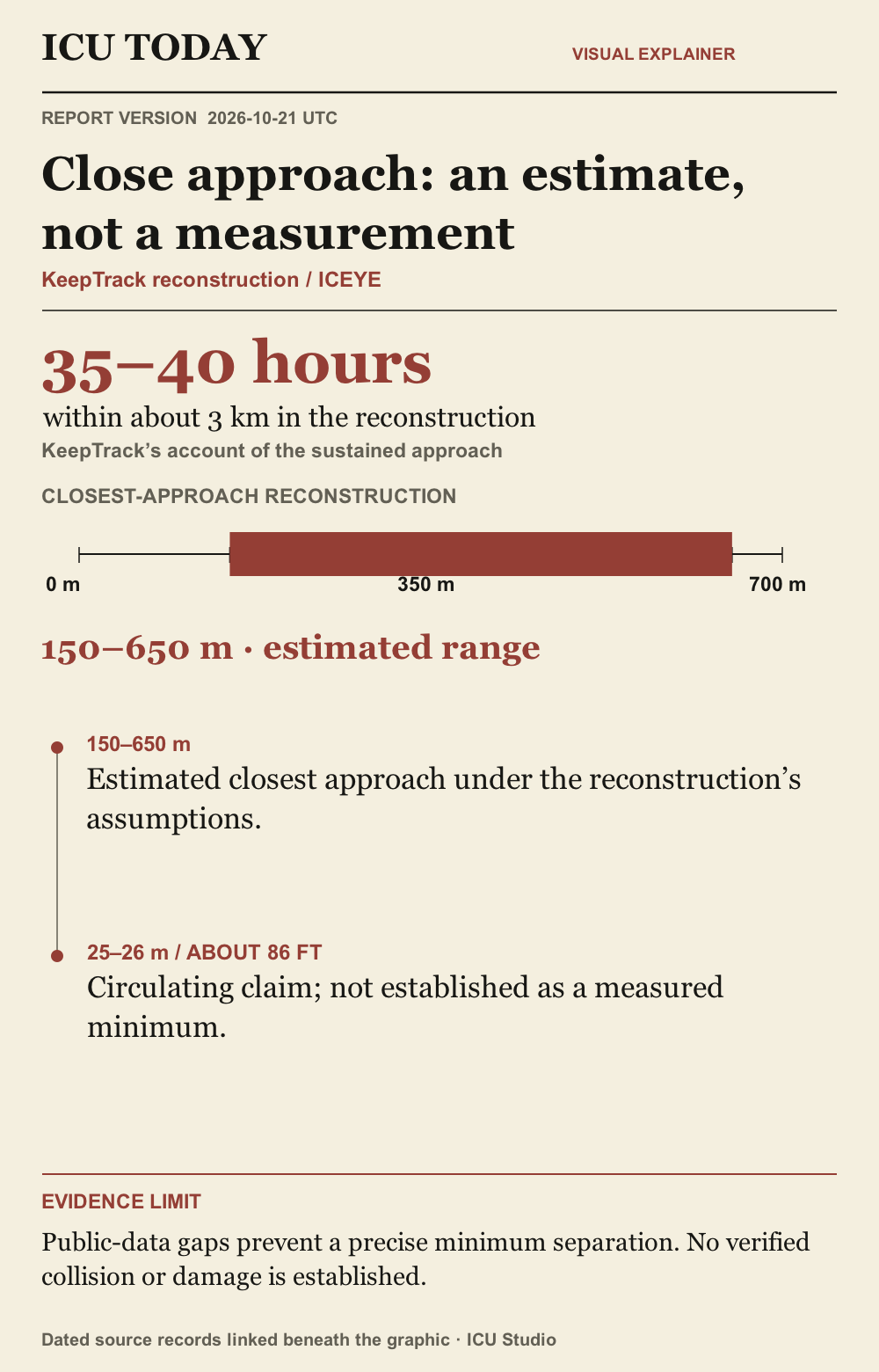
Primary-source statement · A reconstruction published by KeepTrack on October 19 says Russia’s Kosmos 2612 maneuvered toward the commercial radar-imaging satellite ICEYE-X36, remained within about three kilometers for 35–40 hours, then moved away on October 18. The analysis uses public orbital elements rather than a direct measurement of the closest encounter. KeepTrack estimates roughly 150–650 meters for the closest approach under its reconstruction’s assumptions. It specifically cautions against treating the circulating 25–26-meter figure, roughly 86 feet, as a measurement: gaps in the public data cover the relevant maneuver, and the timing assumptions change the result. [KeepTrack]
Why it matters
Primary-source statement · KeepTrack interprets the matching orbits and controlled departure as a rendezvous and proximity operation around another company’s spacecraft. Separately, ICEYE announced on January 19 that a Ukrainian Ministry of Defence customer had expanded access to radar imagery from its constellation. That company statement concerns broader imagery access; it does not establish that X36 itself served that customer or that NATO owns it. The subject is an imaging spacecraft, not the communications satellite described in some versions of the claim. [KeepTrack] [ICEYE]
What remains unknown
Evidence limits · Neither reviewed original establishes the precise minimum separation, the Russian mission’s purpose, a collision, damage or service interruption. KeepTrack reports no orbital change indicating a collision or push, while noting that only ICEYE and its customers could confirm the satellite’s operational condition. Its estimated range should remain attached to its method and uncertainty, not be substituted for an independently measured distance. No case-specific Russian response was obtained in this bounded review. [KeepTrack] [ICEYE]
Orbital estimates and company statements are attributed to their issuers. Exact separation, intent and operational effects have not been independently established.
Read the infographic as text
35–40 hours. within about 3 km in the reconstruction. KeepTrack’s account of the sustained approach
150–650 m. Estimated closest approach under the reconstruction’s assumptions.
25–26 m / ABOUT 86 FT. Circulating claim; not established as a measured minimum.
Evidence limit. Public-data gaps prevent a precise minimum separation. No verified collision or damage is established.
The developing record.
Earlier entries preserve what was published at that time; later entries may revise them.
2026-10-21T14:53:08.009Z · Initial report based on directly checked original documents, with attributed claims and stated evidence limits.
KeepTrack analysis describes Russian satellite’s close approach to ICEYE craft
An original orbital reconstruction describes a sustained close approach, while warning that public data cannot establish the much-repeated 86-foot figure.
What happened
A reconstruction published by KeepTrack on October 19 says Russia’s Kosmos 2612 maneuvered toward the commercial radar-imaging satellite ICEYE-X36, remained within about three kilometers for 35–40 hours, then moved away on October 18. The analysis uses public orbital elements rather than a direct measurement of the closest encounter. KeepTrack estimates roughly 150–650 meters for the closest approach under its reconstruction’s assumptions. It specifically cautions against treating the circulating 25–26-meter figure, roughly 86 feet, as a measurement: gaps in the public data cover the relevant maneuver, and the timing assumptions change the result. [KeepTrack]
Why it matters
KeepTrack interprets the matching orbits and controlled departure as a rendezvous and proximity operation around another company’s spacecraft. Separately, ICEYE announced on January 19 that a Ukrainian Ministry of Defence customer had expanded access to radar imagery from its constellation. That company statement concerns broader imagery access; it does not establish that X36 itself served that customer or that NATO owns it. The subject is an imaging spacecraft, not the communications satellite described in some versions of the claim. [KeepTrack] [ICEYE]
What remains unknown
Neither reviewed original establishes the precise minimum separation, the Russian mission’s purpose, a collision, damage or service interruption. KeepTrack reports no orbital change indicating a collision or push, while noting that only ICEYE and its customers could confirm the satellite’s operational condition. Its estimated range should remain attached to its method and uncertainty, not be substituted for an independently measured distance. No case-specific Russian response was obtained in this bounded review. [KeepTrack] [ICEYE]
Original sources
How Cosmos 2612 Ran Down ICEYE-X36 · Issuer: Theodore Kruczek / KeepTrack · 2026-10-19
Ukraine expands partnership with ICEYE · Issuer: ICEYE · 2026-01-19
Corrections
No corrections recorded.