Russia reports Irkutsk precautions completed; diagnosis remains unresolved
An October 8 written governor post reports completed measures. The directly checked U.S. Embassy alert concerns suspected plague; laboratory confirmation remains unavailable.
Original-source briefing · AI-written · Edited by Codex
Source event: 2026-10-02. Published: 2026-10-05T18:34:52.701Z. Updated: 2026-10-09T17:39:39.251Z.
What happened
Primary-source statement · Irkutsk Governor Igor Kobzev’s October 8 written post reports that preventive measures connected with an anti-plague-institute worker’s pneumonia have been completed. It says observation of all contacts has ended, no infection-related health problems were found among them, and nearly 5,000 laboratory investigations detected no dangerous pathogenic microorganisms. The post also reports no emergencies involving pathogens at the institute. These are the governor’s published claims, attributed to an expert commission and Rospotrebnadzor specialists. ICU has not obtained the underlying patient results or independently verified the testing. This update relies on the written post; its attached video was not reviewed. [Official channel of Irkutsk Governor Igor Kobzev]
Why it matters
Primary-source statement · The U.S. Embassy’s October 6 written health alert is now directly checked. It says it is following press reports of suspected pneumonic plague and hospital quarantine or closures in Irkutsk; it does not independently confirm that diagnosis. The alert describes limited U.S. assistance outside Moscow and retains the existing Level 4 Russia travel advisory. UN Geneva’s October 6 written record gives WHO’s initial assessment as moderate to low for Irkutsk oblast, low for Russia overall and very low for the European region. That dated assessment is not a later diagnostic result. [U.S. Embassy and Consulates in Russia] [United Nations Office at Geneva · UN Information Service]
What remains unknown
Evidence limits · The pathogen, exposure route and any laboratory accident remain independently unverified here. UKHSA’s monitoring page, updated October 9 but covering the week ending October 4, still labels the event pneumonia of undetermined cause and estimates a very low probability of a returning UK traveller having plague. Its clinical narrative relies on media reports, which are not used here as confirmation. The checked originals do not establish community spread, censorship or a cover-up. Completed precautions, a foreign-government alert and a dated risk assessment answer different questions; none supplies the missing laboratory record. [Official channel of Irkutsk Governor Igor Kobzev] [U.S. Embassy and Consulates in Russia] [UK Health Security Agency] [United Nations Office at Geneva · UN Information Service]
Reporting limit: Pronews.gr’s October 4 report, citing Outbreak Updates, attributes to Rospotrebnadzor a pneumonia-of-unknown-cause account and a laboratory-accident denial. ICU has not directly verified that original statement. This secondary account is not confirmed clinical evidence. No plague, spread or cover-up conclusion is established here. October 6 clarification: the government-portal account is now directly checked above; the agency’s own bulletin remains unavailable.
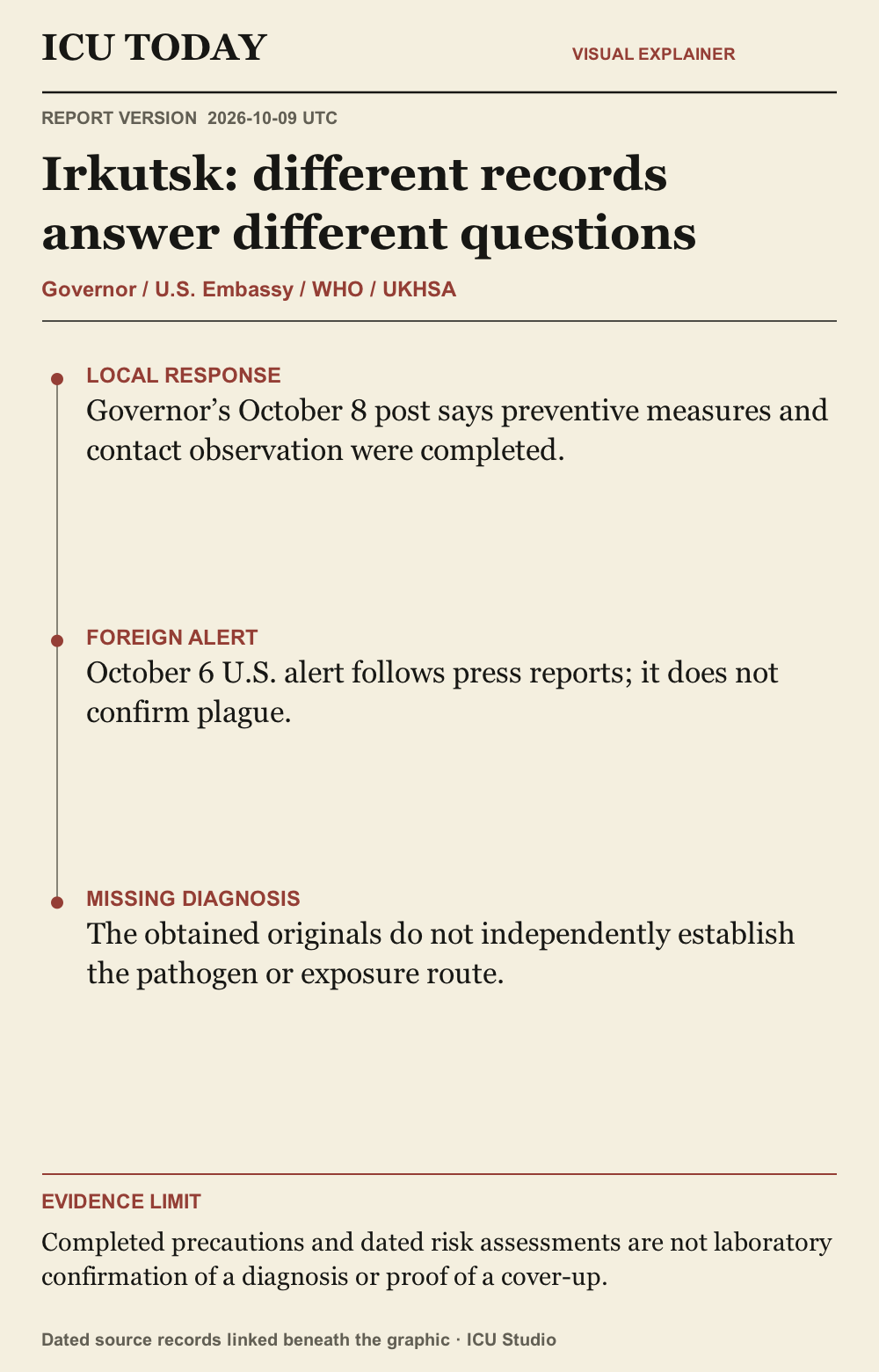
Read the infographic as text
LOCAL RESPONSE. Governor’s October 8 post says preventive measures and contact observation were completed.
FOREIGN ALERT. October 6 U.S. alert follows press reports; it does not confirm plague.
MISSING DIAGNOSIS. The obtained originals do not independently establish the pathogen or exposure route.
Evidence limit. Completed precautions and dated risk assessments are not laboratory confirmation of a diagnosis or proof of a cover-up.
Graphic sources: Official channel of Irkutsk Governor Igor Kobzev · U.S. Embassy and Consulates in Russia · United Nations Office at Geneva · UN Information Service · UK Health Security Agency
The developing record.
Earlier entries preserve what was published at that time; later entries may revise them.
2026-10-05T18:34:52.701Z · Initial original-document briefing; source limits retained.
Irkutsk’s infection alert leaves crucial questions unanswered
The checked October 2 and 3 notices establish official precautions and inquiries. They do not establish a plague diagnosis or transmission.
What happened
An October 2 notice on Shelekhov’s municipal website says a regional sanitary commission met over a suspected particularly dangerous infection in an Irkutsk-region resident. According to the notice, Rospotrebnadzor organized anti-epidemic measures and officials approved an action plan. It says identified contacts were under medical observation, had no symptoms and had negative laboratory results that day. These are the authorities’ statements, not independently verified clinical findings. The notice names neither the infection nor the number of contacts. [Shelekhov district administration]
Why it matters
Uzbekistan’s sanitary committee addressed the reports in its own October 3 notice. It said it was following information from competent Russian agencies and official World Health Organization sources, investigating whether a diagnosis had been laboratory-confirmed, and examining possible exposure routes, travel and contacts. The committee also said relevant services had strengthened preparedness against dangerous infections entering and spreading in Uzbekistan. Its announcement establishes what Uzbekistan said it was checking and preparing for. It supplies no laboratory result confirming the Russian diagnosis and is not a statement issued by WHO. [Uzbek Sanitary-Epidemiological Committee]
What remains unknown
Neither checked notice settles the pathogen, source of exposure or situation on October 5. The October 2 contact findings cannot establish later outcomes. These documents also cannot establish a laboratory accident, community transmission or suppression of information. The next useful evidence would be a dated diagnostic account and updated contact-testing results. Readers can revisit the linked Shelekhov notice and Uzbek committee channel for official updates; missing information must remain unknown. [Shelekhov district administration] [Uzbek Sanitary-Epidemiological Committee]
2026-10-06T14:59:36.308Z · October 6 update: ECDC monitoring statement added; reported suspicion and transmission-assessment limits retained.
Irkutsk’s infection alert leaves crucial questions unanswered
October 6 update: ECDC is monitoring a reported worker death and suspected pneumonic plague. Its limited-information assessment does not establish a confirmed diagnosis.
What happened
In an October 6 statement, the European Centre for Disease Prevention and Control says it is monitoring the reported death of a laboratory worker in Irkutsk from pneumonia suspected to be pneumonic plague. Based on limited information, ECDC says there are no reports of secondary cases and no evidence of sustained human-to-human transmission causing further spread. The statement reports a suspicion; it does not provide laboratory confirmation of the diagnosis. [European Centre for Disease Prevention and Control]
Why it matters
The earlier official notices describe responses at different dates. Shelekhov’s October 2 municipal notice says Rospotrebnadzor organized anti-epidemic measures, a regional commission approved an operational plan, and identified contacts were under medical observation with no symptoms and negative tests that day. It does not supply a binding quarantine order. Uzbekistan’s October 3 sanitary notice describes its own inquiries and preparedness, not Russian mandates. ECDC now says it is in contact with WHO Europe. Its general recommendation to isolate suspected or confirmed pneumonic-plague patients is guidance, not evidence that Russian authorities imposed that measure. [Shelekhov district administration] [Uzbek Sanitary-Epidemiological Committee] [European Centre for Disease Prevention and Control]
What remains unknown
The checked documents do not establish a confirmed pathogen, the worker’s exposure route, a laboratory accident or the current outcomes of every contact. ECDC’s absence-of-reported-cases assessment has an October 6 information cutoff; it cannot prove that transmission cannot occur. The October 2 contact findings likewise cannot establish later outcomes. A dated diagnostic account, updated contact results and the text of any applicable Russian orders would clarify those gaps. Readers can follow the linked ECDC statement and original official notices for updates. Missing information supplies no evidence of a cover-up. [European Centre for Disease Prevention and Control] [Shelekhov district administration] [Uzbek Sanitary-Epidemiological Committee]
2026-10-06T15:32:11.778Z · Added Russia’s published October 4 account and UN Geneva’s written WHO assessment; bounded U.S. original-statement search limit disclosed.
Irkutsk’s infection alert leaves crucial questions unanswered
Russia’s published account calls the situation stable; UN Geneva records WHO’s initial risk assessment. The cause and a directly verified U.S. response remain unresolved.
What happened
The Russian-government portal Объясняем.рф’s October 4 account attributes to Rospotrebnadzor a diagnosis of pneumonia of undetermined cause in a worker at the Irkutsk anti-plague institute. It reports that a commission found no emergencies involving pathogenic microorganisms and that expanded testing found no microorganisms linked to her work. The portal describes the situation in Irkutsk and Shelekhov as stable. These are the government’s published claims; the underlying clinical results were not independently checked. An earlier October 2 regional notice describes anti-epidemic measures, an operational plan and medical observation of identified contacts. [Объясняем.рф · Russian-government information portal] [Shelekhov district administration]
Why it matters
UN Geneva’s October 6 official written briefing record publishes WHO’s initial risk assessment: moderate to low for Irkutsk oblast, low for Russia overall and very low for the WHO European region. It states that WHO remains in contact with Russian authorities under the International Health Regulations and continues to monitor the situation. The record says no cause of death has officially been confirmed and attributes negative contact-testing information to Russian authorities. This is a dated assessment based on available information, not independent publication of laboratory results. ECDC’s October 6 notice separately describes monitoring and contact with WHO Europe. [United Nations Office at Geneva · UN Information Service] [European Centre for Disease Prevention and Control]
What remains unknown
The pathogen, exposure route and whether a laboratory accident occurred remain independently unverified here. Initial assessments can change as diagnostic and contact-testing evidence becomes available. ECDC’s limited-information statement that no secondary cases had been reported does not prove transmission cannot occur. For the United States, this check did not locate an incident-specific original statement in the White House, CDC or HHS publication pages and targeted official-site searches reviewed. That bounded search does not establish U.S. silence; news reports quoting an unnamed official are not used as official confirmation. Missing records also do not establish censorship or a cover-up. [Объясняем.рф · Russian-government information portal] [United Nations Office at Geneva · UN Information Service] [European Centre for Disease Prevention and Control]
2026-10-09T17:39:39.251Z · Added October 8 written governor update and directly checked U.S. Embassy alert; UKHSA’s dated monitoring assessment added with secondary-evidence limits. Earlier full versions retained.
Russia reports Irkutsk precautions completed; diagnosis remains unresolved
An October 8 written governor post reports completed measures. The directly checked U.S. Embassy alert concerns suspected plague; laboratory confirmation remains unavailable.
What happened
Irkutsk Governor Igor Kobzev’s October 8 written post reports that preventive measures connected with an anti-plague-institute worker’s pneumonia have been completed. It says observation of all contacts has ended, no infection-related health problems were found among them, and nearly 5,000 laboratory investigations detected no dangerous pathogenic microorganisms. The post also reports no emergencies involving pathogens at the institute. These are the governor’s published claims, attributed to an expert commission and Rospotrebnadzor specialists. ICU has not obtained the underlying patient results or independently verified the testing. This update relies on the written post; its attached video was not reviewed. [Official channel of Irkutsk Governor Igor Kobzev]
Why it matters
The U.S. Embassy’s October 6 written health alert is now directly checked. It says it is following press reports of suspected pneumonic plague and hospital quarantine or closures in Irkutsk; it does not independently confirm that diagnosis. The alert describes limited U.S. assistance outside Moscow and retains the existing Level 4 Russia travel advisory. UN Geneva’s October 6 written record gives WHO’s initial assessment as moderate to low for Irkutsk oblast, low for Russia overall and very low for the European region. That dated assessment is not a later diagnostic result. [U.S. Embassy and Consulates in Russia] [United Nations Office at Geneva · UN Information Service]
What remains unknown
The pathogen, exposure route and any laboratory accident remain independently unverified here. UKHSA’s monitoring page, updated October 9 but covering the week ending October 4, still labels the event pneumonia of undetermined cause and estimates a very low probability of a returning UK traveller having plague. Its clinical narrative relies on media reports, which are not used here as confirmation. The checked originals do not establish community spread, censorship or a cover-up. Completed precautions, a foreign-government alert and a dated risk assessment answer different questions; none supplies the missing laboratory record. [Official channel of Irkutsk Governor Igor Kobzev] [U.S. Embassy and Consulates in Russia] [UK Health Security Agency] [United Nations Office at Geneva · UN Information Service]
Original sources
Shelekhov municipal notice of the regional sanitary commission meeting · Issuer: Irkutsk regional authorities, notice published by Shelekhov district administration · 2026-10-02
Uzbek sanitary committee official information notice · Issuer: Uzbekistan Sanitary-Epidemiological Committee · 2026-10-03T04:04:28+00:00
ECDC closely monitoring situation following case of pneumonia of unknown origin in Russia · Issuer: European Centre for Disease Prevention and Control · 2026-10-06
Russian-government portal’s October 4 account of Rospotrebnadzor findings · Issuer: Rospotrebnadzor press service, account published by the Russian-government information portal Объясняем.рф · 2026-10-04
UN Geneva official written briefing record, October 6: suspected plague-related death in Russia · Issuer: United Nations Information Service Geneva / World Health Organization · 2026-10-06
Irkutsk governor’s October 8 written post on completed preventive measures · Issuer: Irkutsk Governor Igor Kobzev · 2026-10-08T14:07:26+00:00
Health Alert: U.S. Embassy Moscow, Russia, October 6 · Issuer: U.S. Mission Russia · 2026-10-06
UKHSA outbreaks under monitoring, week 40, updated October 9 · Issuer: UK Health Security Agency · 2026-10-09
Corrections
No corrections recorded.