FDA approves first treatment for the neurological symptoms of type 3 Gaucher disease
In a yearlong trial, people taking Infilbray did better on a combined measure of coordination and thinking than those continuing enzyme replacement. The FDA also flagged serious psychiatric risks.
Original-source briefing · AI-written · Edited by Codex
Source event: 2026-11-18. Published: 2026-11-18T23:02:28.450Z. Updated: 2026-11-18T23:02:28.450Z.
What happened
Primary-source statement · The U.S. Food and Drug Administration approved Infilbray on November 18 for the neurological symptoms of type 3 Gaucher disease. The agency said the tablets, also called venglustat, are the first treatment approved for these symptoms in adults and children weighing at least 15 kilograms, or about 33 pounds. People with this inherited disease have trouble breaking down certain fatty substances. The buildup can affect balance, speech and thinking. The FDA says the drug can reach the brain and reduce that buildup. [U.S. Food and Drug Administration] [U.S. Food and Drug Administration]
Why it matters
Primary-source statement · The trial addressed a question families can face even after treatment has stabilized symptoms elsewhere in the body. Can treatment make a difference to coordination and thinking? Researchers randomly assigned 43 people aged 12 and older whose disease outside the nervous system had stabilized on enzyme replacement. One group took Infilbray tablets daily. The other continued enzyme infusions every two weeks. At 52 weeks, the FDA said the group taking the tablets did better on a measure that combined assessments of muscle coordination and cognitive function. [U.S. Food and Drug Administration]
What remains unknown
Evidence limits · The FDA did not say how large the difference was or how much each assessment contributed. Its announcement also leaves open how long the improvement lasts beyond one year. The agency reported digestive and mood-related side effects and serious psychiatric risks, including suicidal thoughts and behavior. It identified separate potential risks to vision in younger patients and to fetal development from animal studies. [U.S. Food and Drug Administration]
Read the infographic as text
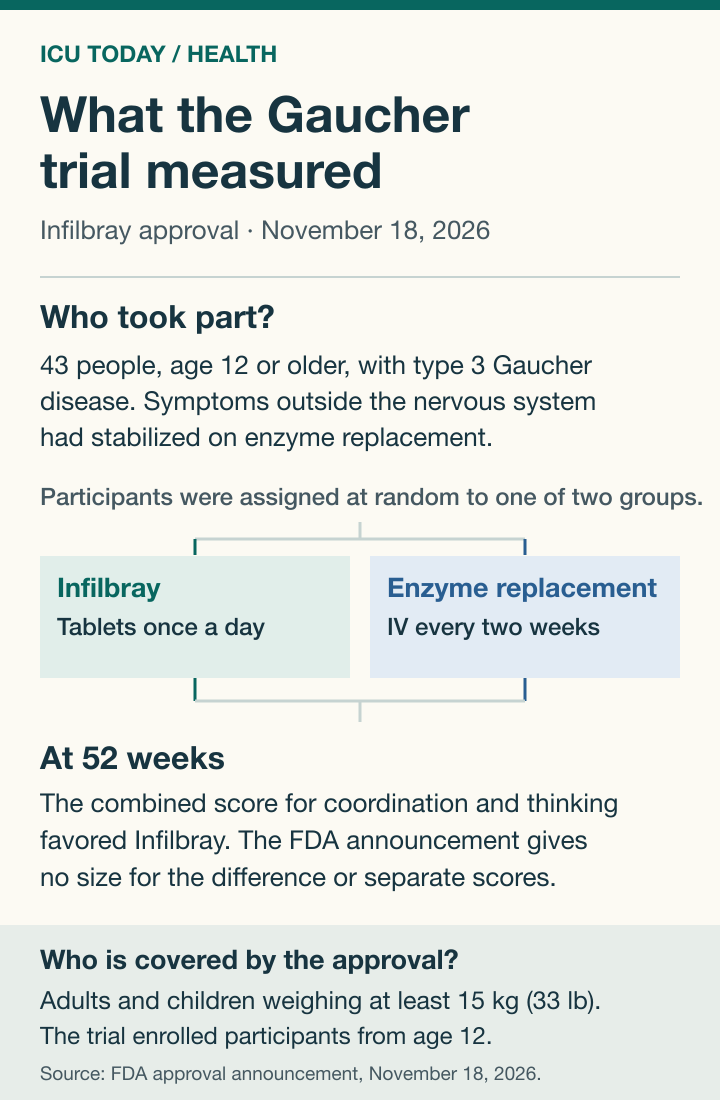
Who entered. The 43 participants were at least 12 years old and had previously received enzyme replacement for type 3 Gaucher disease.
What was compared. The randomized, double-blind trial compared daily oral Infilbray and enzyme infusions every two weeks. At 52 weeks a joint measure of ataxia and cognitive function favored Infilbray. The FDA release does not give an effect size.
Who the FDA approval covers. Adults and children weighing at least 15 kg, approximately 33 lb. The approval and the trial describe different populations.
Graphic sources: U.S. Food and Drug Administration
The developing record.
Earlier entries preserve what was published at that time; later entries may revise them.
2026-11-18T23:02:28.450Z · Initial report on the Infilbray approval, the trial population and its combined neurological assessment.
FDA approves first treatment for the neurological symptoms of type 3 Gaucher disease
In a yearlong trial, people taking Infilbray did better on a combined measure of coordination and thinking than those continuing enzyme replacement. The FDA also flagged serious psychiatric risks.
What happened
The U.S. Food and Drug Administration approved Infilbray on November 18 for the neurological symptoms of type 3 Gaucher disease. The agency said the tablets, also called venglustat, are the first treatment approved for these symptoms in adults and children weighing at least 15 kilograms, or about 33 pounds. People with this inherited disease have trouble breaking down certain fatty substances. The buildup can affect balance, speech and thinking. The FDA says the drug can reach the brain and reduce that buildup. [U.S. Food and Drug Administration] [U.S. Food and Drug Administration]
Why it matters
The trial addressed a question families can face even after treatment has stabilized symptoms elsewhere in the body. Can treatment make a difference to coordination and thinking? Researchers randomly assigned 43 people aged 12 and older whose disease outside the nervous system had stabilized on enzyme replacement. One group took Infilbray tablets daily. The other continued enzyme infusions every two weeks. At 52 weeks, the FDA said the group taking the tablets did better on a measure that combined assessments of muscle coordination and cognitive function. [U.S. Food and Drug Administration]
What remains unknown
The FDA did not say how large the difference was or how much each assessment contributed. Its announcement also leaves open how long the improvement lasts beyond one year. The agency reported digestive and mood-related side effects and serious psychiatric risks, including suicidal thoughts and behavior. It identified separate potential risks to vision in younger patients and to fetal development from animal studies. [U.S. Food and Drug Administration]
Read the infographic as text
Who entered. The 43 participants were at least 12 years old and had previously received enzyme replacement for type 3 Gaucher disease.
What was compared. The randomized, double-blind trial compared daily oral Infilbray and enzyme infusions every two weeks. At 52 weeks a joint measure of ataxia and cognitive function favored Infilbray. The FDA release does not give an effect size.
Who the FDA approval covers. Adults and children weighing at least 15 kg, approximately 33 lb. The approval and the trial describe different populations.
Graphic sources: U.S. Food and Drug Administration
Original sources
FDA approves first drug to treat neurological symptoms of type 3 Gaucher disease · Issuer: U.S. Food and Drug Administration · Published 2026-11-18
FDA news listing for November 18 · Issuer: U.S. Food and Drug Administration · Published 2026-11-18
Corrections
No corrections recorded.