Ilhan Omar’s home search: the evidence and the possible outcomes
Her office confirms a DHS search. The records reviewed do not establish guilt; criminal proceedings, citizenship and House discipline have different tests.
Original-source briefing · AI-written · Edited by Codex
Source event: 2026-10-12. Published: 2026-10-17T16:42:05.242Z. Updated: 2026-10-17T16:42:05.242Z.
What happened
Primary-source statement · U.S. Representative Ilhan Omar’s office confirmed a DHS search of her home in an October 12 statement, denied wrongdoing and alleged political targeting. Those are her office’s positions, not court findings. On October 15, fourteen press organizations filed a request in federal court in Washington to unseal the warrant and supporting records. That filing seeks disclosure; it does not charge Omar. As of our October 17 review, we had not verified a criminal charging document against her, the warrant’s underlying evidence, or FBI participation. [Office of Representative Ilhan Omar] [U.S. District Court filing, RECAP copy]
Why it matters
Verified reporting · A conviction is conditional on charges and proof, not a consequence of being searched. At trial, prosecutors must prove every element beyond reasonable doubt. A conviction would not itself expel her: Article I gives the House that power by a two-thirds vote. House rules say members convicted of offenses carrying a possible sentence of at least two years should refrain from voting and committee business, subject to specified exceptions. Without a conviction, the reason matters: no charge, dismissal and acquittal are different outcomes. An acquittal means the criminal case did not establish guilt to the required standard; it does not itself establish misconduct by investigators. Any citizenship challenge would be distinct: federal law permits separate proceedings to revoke improperly obtained naturalization. [U.S. Government Publishing Office] [National Archives] [House Committee on Rules] [Office of the Law Revision Counsel, U.S. House] [U.S. Department of Justice]
What remains unknown
Analysis · Analysis: a properly supported conviction would strengthen the case for political accountability, while an acquittal or dismissal could increase pressure to explain the investigation. Neither outcome alone answers whether officials used their powers lawfully. DOJ policy bars choosing investigative timing to help or hurt a candidate and excludes political beliefs from prosecution decisions. The lasting institutional test is whether those standards protect opponents and allies alike. We cannot determine motive, compliance with the warrant, any eventual sentence or electoral effects from the originals obtained. The underlying court records and a direct government response are needed to assess the disputed accusations. [U.S. Department of Justice] [U.S. Department of Justice] [U.S. Government Publishing Office] [U.S. District Court filing, RECAP copy]
Public-record reporting and conditional legal analysis, not personal legal advice. No criminal charge or guilt is established by the originals obtained. We have not verified the warrant, supporting affidavit or a case-specific government response in an original publication. Political targeting remains an allegation.
Read the infographic as text
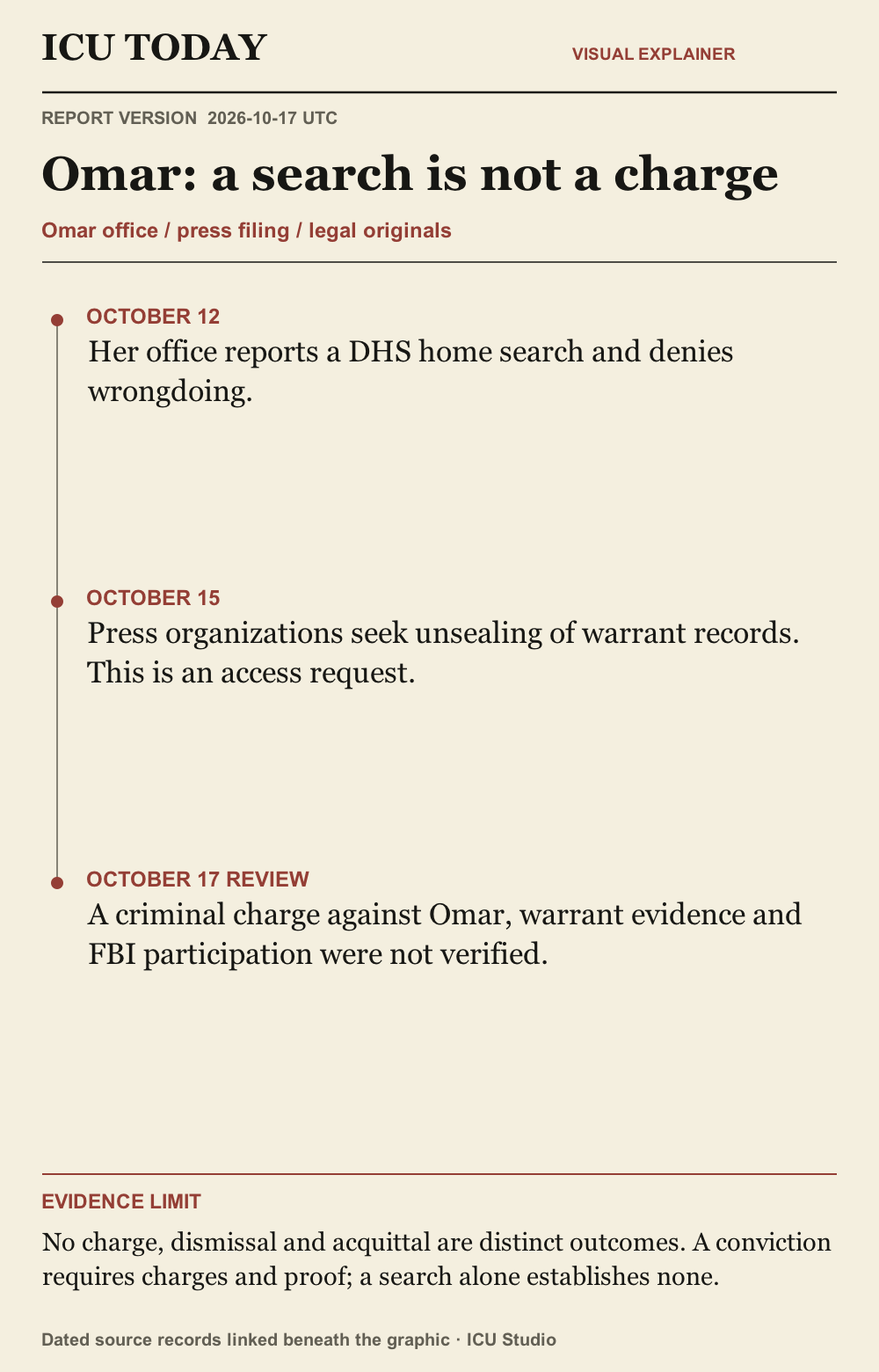
OCTOBER 12. Her office reports a DHS home search and denies wrongdoing.
OCTOBER 15. Press organizations seek unsealing of warrant records. This is an access request.
OCTOBER 17 REVIEW. A criminal charge against Omar, warrant evidence and FBI participation were not verified.
Evidence limit. No charge, dismissal and acquittal are distinct outcomes. A conviction requires charges and proof; a search alone establishes none.
Graphic sources: Office of Representative Ilhan Omar · U.S. District Court filing, RECAP copy · U.S. Government Publishing Office · National Archives
The developing record.
Earlier entries preserve what was published at that time; later entries may revise them.
2026-10-17T16:42:05.242Z · Initial original-document review distinguishes the acknowledged home search from unverified charges, and explains conditional legal and political outcomes.
Ilhan Omar’s home search: the evidence and the possible outcomes
Her office confirms a DHS search. The records reviewed do not establish guilt; criminal proceedings, citizenship and House discipline have different tests.
What happened
U.S. Representative Ilhan Omar’s office confirmed a DHS search of her home in an October 12 statement, denied wrongdoing and alleged political targeting. Those are her office’s positions, not court findings. On October 15, fourteen press organizations filed a request in federal court in Washington to unseal the warrant and supporting records. That filing seeks disclosure; it does not charge Omar. As of our October 17 review, we had not verified a criminal charging document against her, the warrant’s underlying evidence, or FBI participation. [Office of Representative Ilhan Omar] [U.S. District Court filing, RECAP copy]
Why it matters
A conviction is conditional on charges and proof, not a consequence of being searched. At trial, prosecutors must prove every element beyond reasonable doubt. A conviction would not itself expel her: Article I gives the House that power by a two-thirds vote. House rules say members convicted of offenses carrying a possible sentence of at least two years should refrain from voting and committee business, subject to specified exceptions. Without a conviction, the reason matters: no charge, dismissal and acquittal are different outcomes. An acquittal means the criminal case did not establish guilt to the required standard; it does not itself establish misconduct by investigators. Any citizenship challenge would be distinct: federal law permits separate proceedings to revoke improperly obtained naturalization. [U.S. Government Publishing Office] [National Archives] [House Committee on Rules] [Office of the Law Revision Counsel, U.S. House] [U.S. Department of Justice]
What remains unknown
Analysis: a properly supported conviction would strengthen the case for political accountability, while an acquittal or dismissal could increase pressure to explain the investigation. Neither outcome alone answers whether officials used their powers lawfully. DOJ policy bars choosing investigative timing to help or hurt a candidate and excludes political beliefs from prosecution decisions. The lasting institutional test is whether those standards protect opponents and allies alike. We cannot determine motive, compliance with the warrant, any eventual sentence or electoral effects from the originals obtained. The underlying court records and a direct government response are needed to assess the disputed accusations. [U.S. Department of Justice] [U.S. Department of Justice] [U.S. Government Publishing Office] [U.S. District Court filing, RECAP copy]
Original sources
Office of Rep. Ilhan Omar statement on the DHS search · Issuer: Office of Representative Ilhan Omar · 2026-10-12
Fourteen press organizations: application to unseal Omar search records · Issuer: Fourteen press organizations through Ballard Spahr LLP · 2026-10-15
U.S. Constitution, Article I, Sections 2 and 5 · Issuer: United States Constitution · 1787-09-17
119th House rules: Code of Official Conduct, clause 10 · Issuer: U.S. House of Representatives · 2025-01-16
8 U.S.C. 1451: revocation of naturalization (code current through October 7, 2026) · Issuer: U.S. Congress · 2026-10-07
Justice Manual: investigations involving Congress and election timing · Issuer: U.S. Department of Justice · 2015-02-19
Justice Manual: impermissible prosecution considerations · Issuer: U.S. Department of Justice · 2015-02-19
In re Winship: criminal proof beyond reasonable doubt · Issuer: Supreme Court of the United States · 1970-03-31
Corrections
No corrections recorded.