NASA tests eight cameras meant to spot crop stress from space
At Goddard, engineers varied the color and brightness of a single light source. The test gives Hydrosat a reference for interpreting the light its cameras will see over a field.
Original-source briefing · AI-written · Edited by Codex
Source event: 2026-10-30. Published: 2026-11-19T01:03:10.297Z. Updated: 2026-11-19T01:03:10.297Z.
What happened
Primary-source statement · NASA said on November 18 that its Goddard Space Flight Center in Maryland had finished calibrating instruments for Hydrosat Osiris, a planned fleet of four Earth-observing satellites. The visible and near-infrared cameras arrived on October 16. Three days later, engineers pointed eight of them at a hollow sphere lit by a laser. Light scattered around the inside, giving all eight cameras a uniform target. NASA said the calibration was complete on October 30. [NASA Goddard Space Flight Center]
Why it matters
Primary-source statement · A cornfield can look green to someone walking through it even as parts begin to dry out. NASA says reflected light beyond what the eye can see could help researchers pick out those patches. A separate set of sensors on the satellites will measure thermal infrared light. Together, the two kinds of observations could help farmers decide where to irrigate. At Goddard, the team changed the wavelength of the light and checked the cameras against it. They also turned the brightness up and down to see how the instruments would respond to the differences they will encounter over soil, water or ice. [NASA Goddard Space Flight Center]
What remains unknown
Evidence limits · The lab test does not show how precisely the new cameras can identify a stressed crop from orbit. NASA’s report gives no field accuracy figure or measured water savings. Hydrosat already has two satellites, launched in 2024 and 2025. NASA says authorized users will be able to obtain Osiris observations through its program for evaluating and acquiring commercial Earth science data. [NASA Goddard Space Flight Center] [NASA]
Read the infographic as text
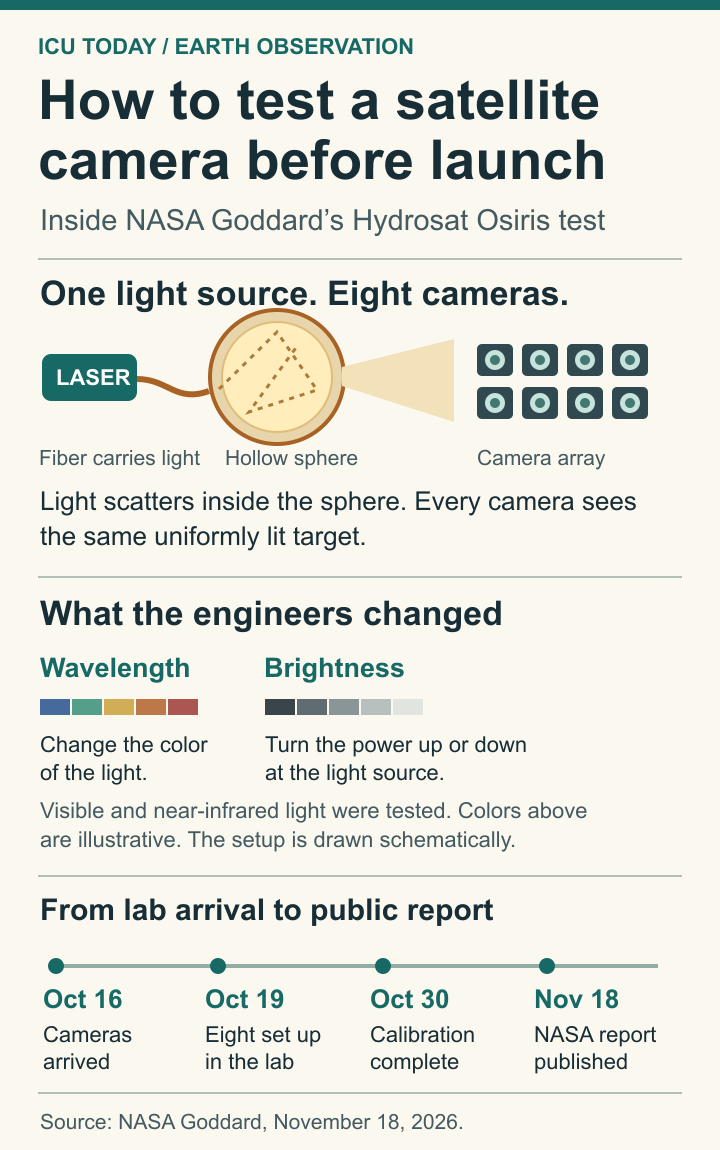
One target for eight cameras. A tunable laser fed light through a fiber into a hollow integrating sphere. Light reflected around its interior, giving eight visible and near-infrared cameras a uniform target.
Two settings checked different responses. The team changed the wavelength to check which light the cameras recorded, then varied the power to check their response to different brightness levels. The drawing is schematic and the colors are illustrative.
Where the test fits. The cameras arrived at Goddard on October 16 and went into the lab on October 19. NASA completed calibration October 30 and reported it November 18. Field accuracy and water savings were not measured in this lab test.
Graphic sources: NASA Goddard Space Flight Center
The developing record.
Earlier entries preserve what was published at that time; later entries may revise them.
2026-11-19T01:03:10.297Z · Initial report on NASA’s prelaunch calibration of eight cameras, the uniform light source and what remains unknown about field performance.
NASA tests eight cameras meant to spot crop stress from space
At Goddard, engineers varied the color and brightness of a single light source. The test gives Hydrosat a reference for interpreting the light its cameras will see over a field.
What happened
NASA said on November 18 that its Goddard Space Flight Center in Maryland had finished calibrating instruments for Hydrosat Osiris, a planned fleet of four Earth-observing satellites. The visible and near-infrared cameras arrived on October 16. Three days later, engineers pointed eight of them at a hollow sphere lit by a laser. Light scattered around the inside, giving all eight cameras a uniform target. NASA said the calibration was complete on October 30. [NASA Goddard Space Flight Center]
Why it matters
A cornfield can look green to someone walking through it even as parts begin to dry out. NASA says reflected light beyond what the eye can see could help researchers pick out those patches. A separate set of sensors on the satellites will measure thermal infrared light. Together, the two kinds of observations could help farmers decide where to irrigate. At Goddard, the team changed the wavelength of the light and checked the cameras against it. They also turned the brightness up and down to see how the instruments would respond to the differences they will encounter over soil, water or ice. [NASA Goddard Space Flight Center]
What remains unknown
The lab test does not show how precisely the new cameras can identify a stressed crop from orbit. NASA’s report gives no field accuracy figure or measured water savings. Hydrosat already has two satellites, launched in 2024 and 2025. NASA says authorized users will be able to obtain Osiris observations through its program for evaluating and acquiring commercial Earth science data. [NASA Goddard Space Flight Center] [NASA]
Read the infographic as text
One target for eight cameras. A tunable laser fed light through a fiber into a hollow integrating sphere. Light reflected around its interior, giving eight visible and near-infrared cameras a uniform target.
Two settings checked different responses. The team changed the wavelength to check which light the cameras recorded, then varied the power to check their response to different brightness levels. The drawing is schematic and the colors are illustrative.
Where the test fits. The cameras arrived at Goddard on October 16 and went into the lab on October 19. NASA completed calibration October 30 and reported it November 18. Field accuracy and water savings were not measured in this lab test.
Graphic sources: NASA Goddard Space Flight Center
Original sources
NASA completes prelaunch instrument testing for Hydrosat Osiris · Issuer: NASA Goddard Space Flight Center · Published 2026-11-18
Commercial Satellite Data Acquisition Program · Issuer: NASA · Updated 2026-09-21
Corrections
No corrections recorded.