Hubble’s bent-light gallery points to Roman’s next questions
NASA’s new sampler shows arcs, rings and repeated galaxy images. The observations provide targets and modeling questions, rather than a completed dark-matter result.
Original-source briefing · AI-written · Edited by Codex
Source event: 2026-11-12. Published: 2026-11-13T07:32:30.602Z. Updated: 2026-11-13T07:32:30.602Z.
What happened
Primary-source statement · NASA published a Hubble image gallery on November 12 showing how foreground galaxies bend and magnify light from galaxies farther away. The agency describes the images as a sampler for follow-up work with the Nancy Grace Roman Space Telescope. Its account traces the targets from initial detection with the Dark Energy Spectroscopic Instrument at Kitt Peak to subsequent Hubble observations. The examples include paired arcs, an almost complete Einstein ring and a background galaxy appearing four times around a foreground lens. Those repeated images are views of the same distant object, rather than four separate galaxies. [NASA]
Why it matters
Primary-source statement · The shape of a distorted image gives researchers information to model the foreground system’s mass, including matter that does not emit detectable light. NASA says small irregularities in the arcs could help investigate small dark-matter clumps. That is a proposed use of the observations, not a finding that the clumps have already been measured. The telescopes also offer different views of the same problem. NASA’s observatory comparison gives both a 2.4-meter primary mirror, while Roman’s Wide Field Instrument covers roughly 100 times the sky area of Hubble’s Advanced Camera for Surveys. This is an area comparison, not a claim of 100-fold sharper images. Hubble supplies ultraviolet, visible and near-infrared observations; Roman emphasizes near-infrared light with some visible coverage. In one gallery example, NASA says a dust lane may interrupt the apparent ring. Infrared follow-up could help test whether dust is hiding a more complete structure. [NASA] [NASA]
What remains unknown
Evidence limits · The November 12 account does not provide final mass measurements for these examples or a completed test of cold dark matter. It also gives no target-by-target Roman observation timetable. The two cited NASA pages explain the agency’s observations and intended research; they are one institutional source, not independent confirmation of a discovery. Whether the proposed modeling will resolve the small-scale structure of dark matter remains an open research question. [NASA] [NASA]
Read the infographic as text
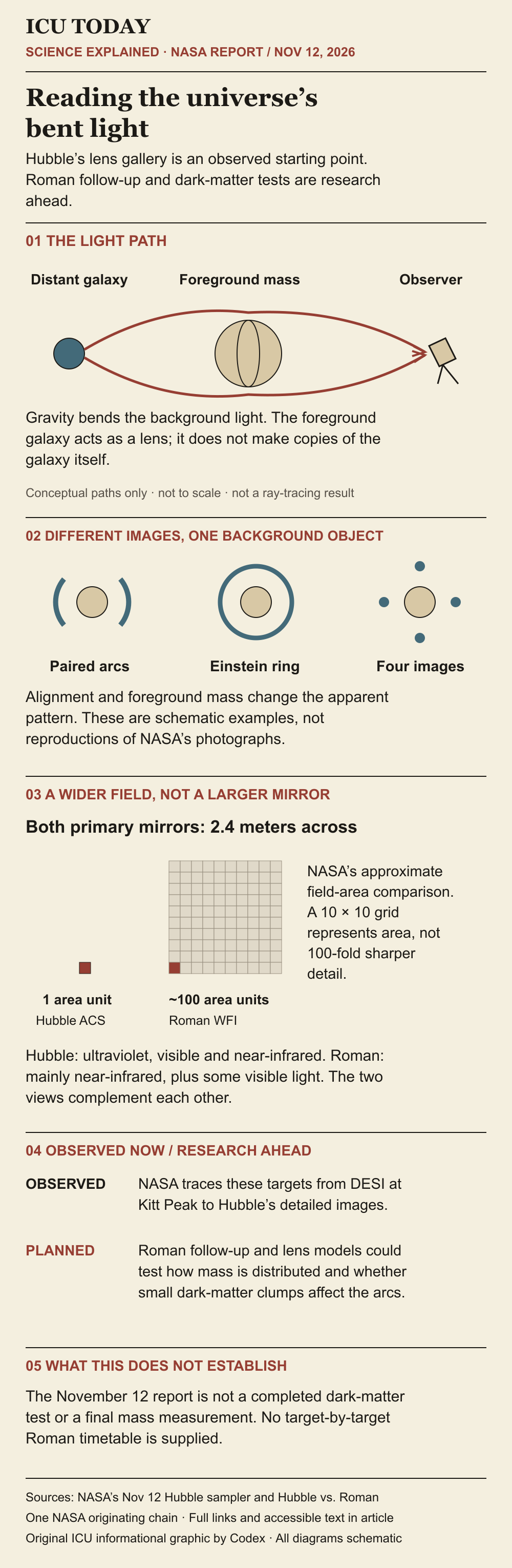
The light path. Light from a distant galaxy passes a foreground galaxy and reaches an observer. The foreground mass bends and magnifies the light, acting as a gravitational lens. The diagram shows two conceptual routes, not a ray-tracing result or physical scale. The lens does not duplicate the galaxy itself.
Different images, one background object. The apparent pattern depends on alignment and foreground mass. Hubble’s gallery includes paired arcs, a nearly complete Einstein ring and four images of one background galaxy. The graphic’s arcs, ring and four dots are schematic examples, not reproductions of NASA’s photographs.
A wider field, not a larger mirror. NASA gives both primary mirrors a diameter of 2.4 meters. Roman’s Wide Field Instrument has roughly 100 times the field area of Hubble’s Advanced Camera for Surveys. One square and a 10-by-10 grid depict the approximate area comparison, not 100-fold sharper detail. Hubble covers ultraviolet, visible and near-infrared light. Roman emphasizes near-infrared with some visible coverage.
Observed now and research ahead. NASA traces these targets from detection with DESI at Kitt Peak to Hubble’s detailed images. Roman follow-up and lens models are work ahead. They could test how foreground mass is distributed and whether small dark-matter clumps affect the arcs.
What this does not establish. The November 12 report does not establish a completed dark-matter test or final mass measurement, and supplies no target-by-target Roman timetable. Both cited pages originate with NASA. Source links are in the article; the graphic is an original ICU illustration by Codex.
The developing record.
Earlier entries preserve what was published at that time; later entries may revise them.
2026-11-13T07:32:30.602Z · Initial NASA-attributed report: the observed Hubble lens gallery, its DESI background, Hubble/Roman field-area and wavelength comparison, and research questions still open.
Hubble’s bent-light gallery points to Roman’s next questions
NASA’s new sampler shows arcs, rings and repeated galaxy images. The observations provide targets and modeling questions, rather than a completed dark-matter result.
What happened
NASA published a Hubble image gallery on November 12 showing how foreground galaxies bend and magnify light from galaxies farther away. The agency describes the images as a sampler for follow-up work with the Nancy Grace Roman Space Telescope. Its account traces the targets from initial detection with the Dark Energy Spectroscopic Instrument at Kitt Peak to subsequent Hubble observations. The examples include paired arcs, an almost complete Einstein ring and a background galaxy appearing four times around a foreground lens. Those repeated images are views of the same distant object, rather than four separate galaxies. [NASA]
Why it matters
The shape of a distorted image gives researchers information to model the foreground system’s mass, including matter that does not emit detectable light. NASA says small irregularities in the arcs could help investigate small dark-matter clumps. That is a proposed use of the observations, not a finding that the clumps have already been measured. The telescopes also offer different views of the same problem. NASA’s observatory comparison gives both a 2.4-meter primary mirror, while Roman’s Wide Field Instrument covers roughly 100 times the sky area of Hubble’s Advanced Camera for Surveys. This is an area comparison, not a claim of 100-fold sharper images. Hubble supplies ultraviolet, visible and near-infrared observations; Roman emphasizes near-infrared light with some visible coverage. In one gallery example, NASA says a dust lane may interrupt the apparent ring. Infrared follow-up could help test whether dust is hiding a more complete structure. [NASA] [NASA]
What remains unknown
The November 12 account does not provide final mass measurements for these examples or a completed test of cold dark matter. It also gives no target-by-target Roman observation timetable. The two cited NASA pages explain the agency’s observations and intended research; they are one institutional source, not independent confirmation of a discovery. Whether the proposed modeling will resolve the small-scale structure of dark matter remains an open research question. [NASA] [NASA]
Read the infographic as text
The light path. Light from a distant galaxy passes a foreground galaxy and reaches an observer. The foreground mass bends and magnifies the light, acting as a gravitational lens. The diagram shows two conceptual routes, not a ray-tracing result or physical scale. The lens does not duplicate the galaxy itself.
Different images, one background object. The apparent pattern depends on alignment and foreground mass. Hubble’s gallery includes paired arcs, a nearly complete Einstein ring and four images of one background galaxy. The graphic’s arcs, ring and four dots are schematic examples, not reproductions of NASA’s photographs.
A wider field, not a larger mirror. NASA gives both primary mirrors a diameter of 2.4 meters. Roman’s Wide Field Instrument has roughly 100 times the field area of Hubble’s Advanced Camera for Surveys. One square and a 10-by-10 grid depict the approximate area comparison, not 100-fold sharper detail. Hubble covers ultraviolet, visible and near-infrared light. Roman emphasizes near-infrared with some visible coverage.
Observed now and research ahead. NASA traces these targets from detection with DESI at Kitt Peak to Hubble’s detailed images. Roman follow-up and lens models are work ahead. They could test how foreground mass is distributed and whether small dark-matter clumps affect the arcs.
What this does not establish. The November 12 report does not establish a completed dark-matter test or final mass measurement, and supplies no target-by-target Roman timetable. Both cited pages originate with NASA. Source links are in the article; the graphic is an original ICU illustration by Codex.
Original sources
NASA’s Hubble Offers Cosmic Sampler of Targets for Roman · Issuer: NASA · 2026-11-12
Hubble vs. Roman · Issuer: NASA · 2026-08-14
Corrections
No corrections recorded.