NASA reports an oxygen gap in nearby dwarf galaxies
A Hubble study of 37 small galaxies found less oxygen than expected, NASA reports. Where most of the missing material went remains unresolved.
Original-source briefing · AI-written · Edited by Codex
Source event: 2026-11-02. Published: 2026-11-04T13:11:53.970Z. Updated: 2026-11-04T13:11:53.970Z.
What happened
Primary-source statement · NASA reported November 2 that researchers studying 37 nearby dwarf galaxies found much of the oxygen expected in those systems was missing. The agency describes a study using archived Hubble Space Telescope images to examine individual stars and reconstruct their formation histories and compositions. The team combined those observations with data from the retired Spitzer telescope and ground-based radio observatories. According to NASA, the galaxies retained only a small share of the oxygen their stars had produced. [NASA]
Why it matters
Primary-source statement · NASA says oxygen is useful for following how chemical elements move through galaxies because it is comparatively easy to measure and its production is well understood. Tracking what stars make and what galaxies retain helps researchers investigate galaxy evolution and the enrichment of surrounding space, the agency explains. NASA's account says the findings suggest winds driven by supernova explosions remove oxygen from small galaxies more effectively than current models predict. [NASA]
What remains unknown
Evidence limits · NASA leaves the main destination question open: most of the missing oxygen might remain in diffuse gas around the galaxies, or it might have traveled beyond their surroundings. The sample was selected within a particular range of galaxy masses, and all 37 systems were close enough for Hubble to distinguish individual stars. NASA notes that most known dwarf galaxies are too distant for that approach. The reported result therefore concerns this selected nearby sample. [NASA]
This report attributes the study's findings and interpretation to NASA's written account. The result concerns a selected sample of 37 nearby dwarf galaxies; the location of most of the missing oxygen remains unresolved.
Read the infographic as text
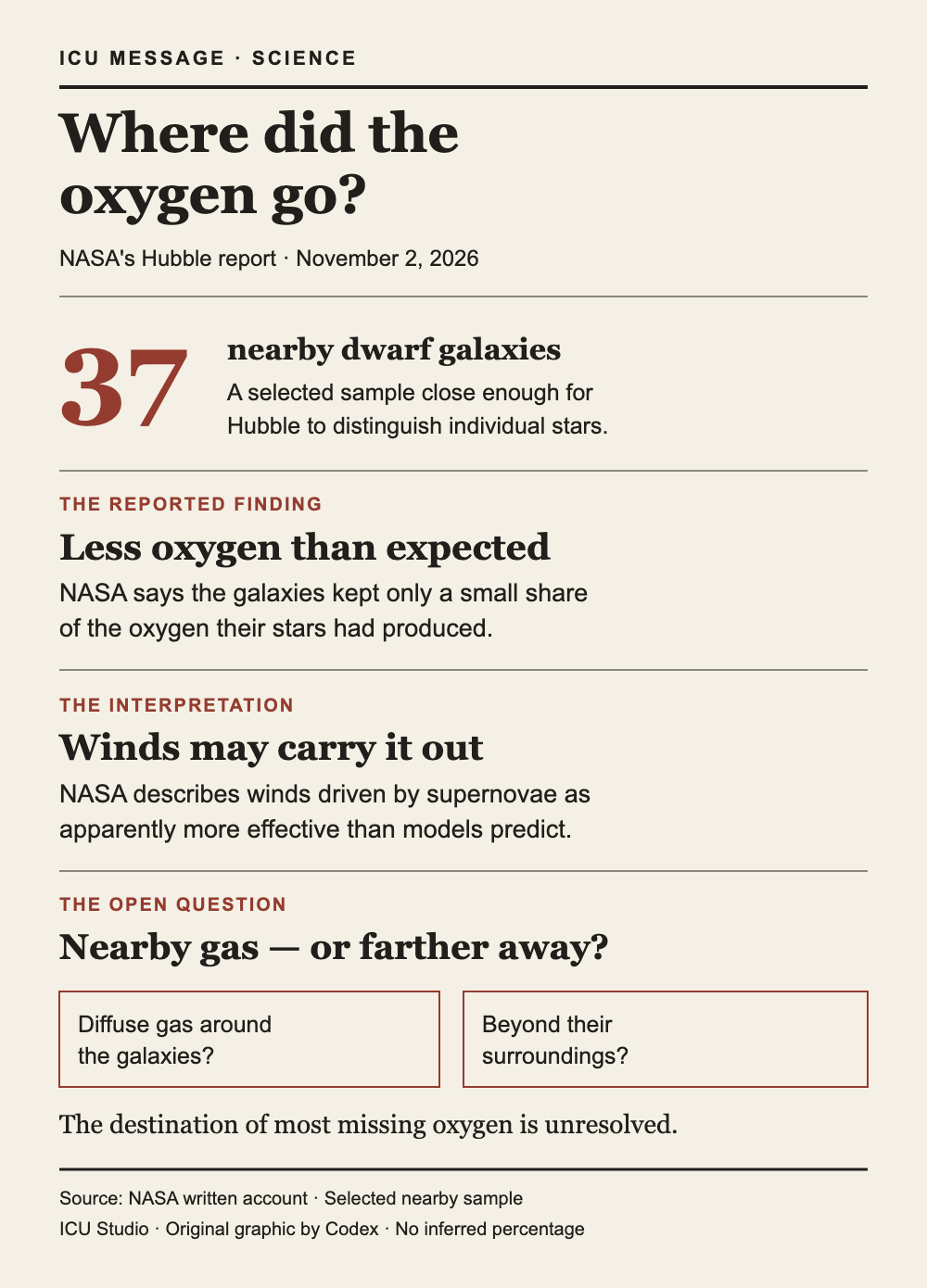
What happened. NASA reported November 2 that researchers studying 37 nearby dwarf galaxies found much of the oxygen expected in those systems was missing. The agency describes a study using archived Hubble Space Telescope images to examine individual stars and reconstruct their formation histories and compositions. The team combined those observations with data from the retired Spitzer telescope and ground-based radio observatories. According to NASA, the galaxies retained only a small share of the oxygen their stars had produced.
Why it matters. NASA says oxygen is useful for following how chemical elements move through galaxies because it is comparatively easy to measure and its production is well understood. Tracking what stars make and what galaxies retain helps researchers investigate galaxy evolution and the enrichment of surrounding space, the agency explains. NASA's account says the findings suggest winds driven by supernova explosions remove oxygen from small galaxies more effectively than current models predict.
What remains unknown. NASA leaves the main destination question open: most of the missing oxygen might remain in diffuse gas around the galaxies, or it might have traveled beyond their surroundings. The sample was selected within a particular range of galaxy masses, and all 37 systems were close enough for Hubble to distinguish individual stars. NASA notes that most known dwarf galaxies are too distant for that approach. The reported result therefore concerns this selected nearby sample.
Graphic sources: NASA
The developing record.
Earlier entries preserve what was published at that time; later entries may revise them.
2026-11-04T13:11:53.970Z · Initial attributed report on NASA’s November 2 account of the 37-galaxy oxygen study, its methods, interpretation and unresolved destination.
NASA reports an oxygen gap in nearby dwarf galaxies
A Hubble study of 37 small galaxies found less oxygen than expected, NASA reports. Where most of the missing material went remains unresolved.
What happened
NASA reported November 2 that researchers studying 37 nearby dwarf galaxies found much of the oxygen expected in those systems was missing. The agency describes a study using archived Hubble Space Telescope images to examine individual stars and reconstruct their formation histories and compositions. The team combined those observations with data from the retired Spitzer telescope and ground-based radio observatories. According to NASA, the galaxies retained only a small share of the oxygen their stars had produced. [NASA]
Why it matters
NASA says oxygen is useful for following how chemical elements move through galaxies because it is comparatively easy to measure and its production is well understood. Tracking what stars make and what galaxies retain helps researchers investigate galaxy evolution and the enrichment of surrounding space, the agency explains. NASA's account says the findings suggest winds driven by supernova explosions remove oxygen from small galaxies more effectively than current models predict. [NASA]
What remains unknown
NASA leaves the main destination question open: most of the missing oxygen might remain in diffuse gas around the galaxies, or it might have traveled beyond their surroundings. The sample was selected within a particular range of galaxy masses, and all 37 systems were close enough for Hubble to distinguish individual stars. NASA notes that most known dwarf galaxies are too distant for that approach. The reported result therefore concerns this selected nearby sample. [NASA]
Read the infographic as text
What happened. NASA reported November 2 that researchers studying 37 nearby dwarf galaxies found much of the oxygen expected in those systems was missing. The agency describes a study using archived Hubble Space Telescope images to examine individual stars and reconstruct their formation histories and compositions. The team combined those observations with data from the retired Spitzer telescope and ground-based radio observatories. According to NASA, the galaxies retained only a small share of the oxygen their stars had produced.
Why it matters. NASA says oxygen is useful for following how chemical elements move through galaxies because it is comparatively easy to measure and its production is well understood. Tracking what stars make and what galaxies retain helps researchers investigate galaxy evolution and the enrichment of surrounding space, the agency explains. NASA's account says the findings suggest winds driven by supernova explosions remove oxygen from small galaxies more effectively than current models predict.
What remains unknown. NASA leaves the main destination question open: most of the missing oxygen might remain in diffuse gas around the galaxies, or it might have traveled beyond their surroundings. The sample was selected within a particular range of galaxy masses, and all 37 systems were close enough for Hubble to distinguish individual stars. NASA notes that most known dwarf galaxies are too distant for that approach. The reported result therefore concerns this selected nearby sample.
Graphic sources: NASA
Original sources
NASA's Hubble Uncovers Case of Missing Oxygen in Nearby Dwarf Galaxies · Issuer: NASA Hubble Mission Team, Goddard Space Flight Center · Published 2026-11-02
Corrections
No corrections recorded.