House chairmen seek limits on Chinese AI models in federal systems
A joint report follows three different paths into American products, from an Airbnb support assistant to the model beneath Cursor’s coding software.
Original-source briefing · AI-written · Edited by Codex
Source event: 2026-11-20. Published: 2026-11-20T21:50:52.964Z. Updated: 2026-11-20T21:50:52.964Z.
What happened
Primary-source statement · Two House committee chairmen called on November 20 for restrictions on Chinese-developed AI models in federal systems and federal contract work. Their public report, “Beijing’s AI Playbook”, draws on material supplied by Airbnb, Anysphere and DoorDash. The Republicans who chair the Homeland Security Committee and the Select Committee on the Chinese Communist Party put forward twelve recommendations. One would phase models out of high-risk infrastructure functions as alternatives become available. The report itself changes no purchasing rules. [U.S. House of Representatives]
Why it matters
Primary-source statement · A customer can use an American service without ever seeing the name of the model behind it. The committees say an Airbnb support assistant using a customized Alibaba Qwen model handles roughly 80,000 guest and host interactions a day. They say Anysphere built Composer 2, a model in its Cursor coding product, on a base model from Moonshot AI. DoorDash told investigators it had authorized and deployed 25 model families that met its threshold of at least $5,000 in computing and serving costs per family. It also said replacing one embedded model could take up to six months, while most other uses could switch almost immediately. That difference matters to anyone setting a single replacement deadline. [U.S. House of Representatives]
What remains unknown
Primary-source statement · The three companies were case studies. Their answers do not establish how common those practices are across American businesses or how many federal systems use the same models. The public report describes a classified annex. ICU Message reviewed the public document. The company figures above are the committees’ account of what the companies supplied. [U.S. House of Representatives]
Read the infographic as text
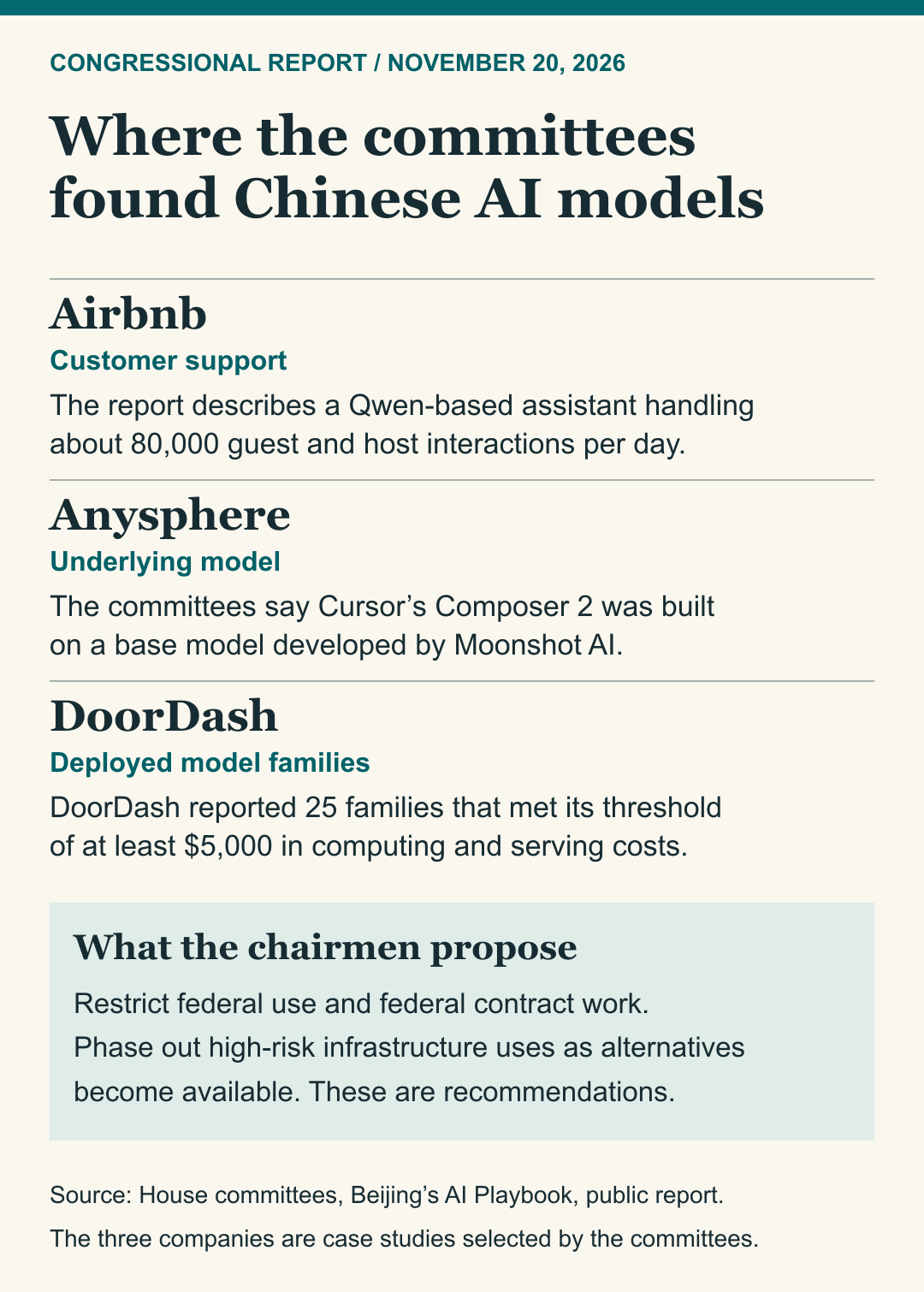
Airbnb. The committees report that a customized Qwen-based customer support assistant handles approximately 80,000 guest and host interactions a day.
Anysphere. The report says Anysphere built its Cursor coding model Composer 2 on a base developed by Moonshot AI.
DoorDash. DoorDash reported 25 deployed model families that each met a threshold of at least $5,000 in computing and serving costs.
Policy proposal. The chairmen urge limits on federal systems and contract work and the phased removal of models used for high-risk infrastructure functions as alternatives become available.
Graphic sources: U.S. House of Representatives
The developing record.
Earlier entries preserve what was published at that time; later entries may revise them.
2026-11-20T21:50:52.964Z · House committee chairmen released a public report on Chinese-developed models and recommended federal restrictions.
House chairmen seek limits on Chinese AI models in federal systems
A joint report follows three different paths into American products, from an Airbnb support assistant to the model beneath Cursor’s coding software.
What happened
Two House committee chairmen called on November 20 for restrictions on Chinese-developed AI models in federal systems and federal contract work. Their public report, “Beijing’s AI Playbook”, draws on material supplied by Airbnb, Anysphere and DoorDash. The Republicans who chair the Homeland Security Committee and the Select Committee on the Chinese Communist Party put forward twelve recommendations. One would phase models out of high-risk infrastructure functions as alternatives become available. The report itself changes no purchasing rules. [U.S. House of Representatives]
Why it matters
A customer can use an American service without ever seeing the name of the model behind it. The committees say an Airbnb support assistant using a customized Alibaba Qwen model handles roughly 80,000 guest and host interactions a day. They say Anysphere built Composer 2, a model in its Cursor coding product, on a base model from Moonshot AI. DoorDash told investigators it had authorized and deployed 25 model families that met its threshold of at least $5,000 in computing and serving costs per family. It also said replacing one embedded model could take up to six months, while most other uses could switch almost immediately. That difference matters to anyone setting a single replacement deadline. [U.S. House of Representatives]
What remains unknown
The three companies were case studies. Their answers do not establish how common those practices are across American businesses or how many federal systems use the same models. The public report describes a classified annex. ICU Message reviewed the public document. The company figures above are the committees’ account of what the companies supplied. [U.S. House of Representatives]
Read the infographic as text
Airbnb. The committees report that a customized Qwen-based customer support assistant handles approximately 80,000 guest and host interactions a day.
Anysphere. The report says Anysphere built its Cursor coding model Composer 2 on a base developed by Moonshot AI.
DoorDash. DoorDash reported 25 deployed model families that each met a threshold of at least $5,000 in computing and serving costs.
Policy proposal. The chairmen urge limits on federal systems and contract work and the phased removal of models used for high-risk infrastructure functions as alternatives become available.
Graphic sources: U.S. House of Representatives
Original sources
Beijing’s AI Playbook: Joint Investigative Report · Issuer: House Homeland Security Committee and Select Committee on the CCP · Published 2026-11-20
Corrections
No corrections recorded.