HealthStream reports stolen customer files and $250,000 in net cyber costs
Its November 5 filing describes data taken from files for 39 credentialing customers. That figure is not a patient count, and the expense is after insurance.
Original-source briefing · AI-written · Edited by Codex
Source event: 2026-11-05. Published: 2026-11-15T13:55:33.075Z. Updated: 2026-11-15T13:55:33.075Z.
What happened
Primary-source statement · HealthStream says an intruder took data copied to its corporate file servers for 39 credentialing customers. Its quarterly report, signed November 5, says three customer files included a limited amount of protected health information. The company previously disclosed the incident on July 29. It reported no business interruption and said its investigation found no access to or compromise of customer-facing systems. [HealthStream; filing hosted by the SEC]
Why it matters
Primary-source statement · The company says the affected customer data had been copied for conversion, analytics and troubleshooting. The distinction matters: its account describes stolen working copies, while reporting no compromise of the systems customers use. HealthStream recorded $250,000 in incident expense for the quarter ended September 30 after related insurance recoveries. That is a net quarterly expense, not a stated total cost of the attack. The company also expected further spending on monitoring, prevention and security improvements. [HealthStream; filing hosted by the SEC]
What remains unknown
Evidence limits · The 39-customer figure does not tell readers how many people were affected. This filing does not supply that total, an attacker identity, or a final cost estimate. HealthStream's view that the incident would not materially harm its business is management's assessment; it does not establish that exposed information posed no risk to individuals. These are the company's dated findings, not an independent forensic review or confirmation of its status today. The infographic separates the units and shows where the reported exposure occurred. [HealthStream; filing hosted by the SEC]
Read the infographic as text
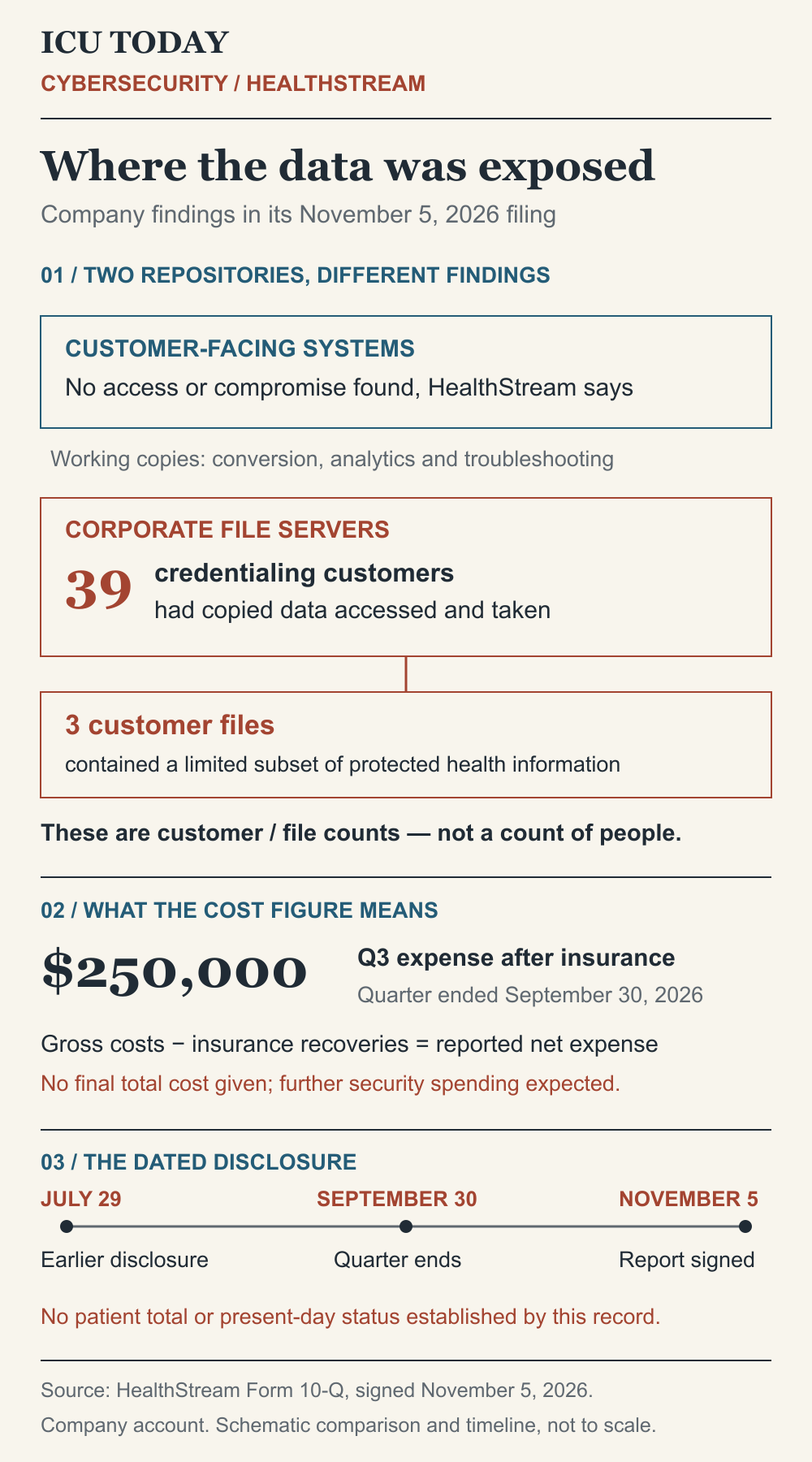
Two repositories, different findings. HealthStream said its investigation found no access to or compromise of customer-facing systems. On corporate file servers, data copied for conversion, analytics and troubleshooting for 39 credentialing customers was accessed and taken. Three customer files contained a limited subset of protected health information. These customer and file counts do not give the number of affected people. This comparison does not establish an attack path.
What the cost figure means. For the quarter ended September 30, 2026, HealthStream reported $250,000 in incident expense after related insurance recoveries. Gross costs minus insurance recoveries gives the net expense; the graphic supplies no unknown gross or insurance amounts. The filing gives no final total cost and expects further security spending.
Dated disclosure timeline. July 29, 2026: earlier disclosure, as identified in this quarterly report. September 30: quarter ends. November 5: report signed. The timeline is schematic and not to scale. The source is HealthStream’s company account, not an independent forensic review or present-day status confirmation.
Graphic sources: HealthStream; filing hosted by the SEC
The developing record.
Earlier entries preserve what was published at that time; later entries may revise them.
2026-11-15T13:55:33.075Z · Initial dated report on HealthStream’s November 5 customer-file exposure disclosure and net quarterly cyber expense, with a diagram separating repositories, affected units and reported costs.
HealthStream reports stolen customer files and $250,000 in net cyber costs
Its November 5 filing describes data taken from files for 39 credentialing customers. That figure is not a patient count, and the expense is after insurance.
What happened
HealthStream says an intruder took data copied to its corporate file servers for 39 credentialing customers. Its quarterly report, signed November 5, says three customer files included a limited amount of protected health information. The company previously disclosed the incident on July 29. It reported no business interruption and said its investigation found no access to or compromise of customer-facing systems. [HealthStream; filing hosted by the SEC]
Why it matters
The company says the affected customer data had been copied for conversion, analytics and troubleshooting. The distinction matters: its account describes stolen working copies, while reporting no compromise of the systems customers use. HealthStream recorded $250,000 in incident expense for the quarter ended September 30 after related insurance recoveries. That is a net quarterly expense, not a stated total cost of the attack. The company also expected further spending on monitoring, prevention and security improvements. [HealthStream; filing hosted by the SEC]
What remains unknown
The 39-customer figure does not tell readers how many people were affected. This filing does not supply that total, an attacker identity, or a final cost estimate. HealthStream's view that the incident would not materially harm its business is management's assessment; it does not establish that exposed information posed no risk to individuals. These are the company's dated findings, not an independent forensic review or confirmation of its status today. The infographic separates the units and shows where the reported exposure occurred. [HealthStream; filing hosted by the SEC]
Read the infographic as text
Two repositories, different findings. HealthStream said its investigation found no access to or compromise of customer-facing systems. On corporate file servers, data copied for conversion, analytics and troubleshooting for 39 credentialing customers was accessed and taken. Three customer files contained a limited subset of protected health information. These customer and file counts do not give the number of affected people. This comparison does not establish an attack path.
What the cost figure means. For the quarter ended September 30, 2026, HealthStream reported $250,000 in incident expense after related insurance recoveries. Gross costs minus insurance recoveries gives the net expense; the graphic supplies no unknown gross or insurance amounts. The filing gives no final total cost and expects further security spending.
Dated disclosure timeline. July 29, 2026: earlier disclosure, as identified in this quarterly report. September 30: quarter ends. November 5: report signed. The timeline is schematic and not to scale. The source is HealthStream’s company account, not an independent forensic review or present-day status confirmation.
Graphic sources: HealthStream; filing hosted by the SEC
Original sources
HealthStream Form 10-Q signed November 5, 2026: cybersecurity incident and quarterly costs · Issuer: HealthStream, Inc. · Announced 2026-11-05
Corrections
No corrections recorded.