France reports first human Shamonda infection; investigation continues
A patient with severe immunosuppression died in early October. French and European authorities are investigating the infection and its role in the illness.
Original-source briefing · AI-written · Edited by Codex
Source event: 2026-10-22. Published: 2026-10-23T20:14:55.741Z. Updated: 2026-10-23T20:14:55.741Z.
What happened
Primary-source statement · French health authorities reported the first documented human infection with Shamonda virus on October 22, in a patient with severe immunosuppression who was being treated for another serious illness. The patient died in early October. The European Centre for Disease Prevention and Control says investigators are still examining whether the virus caused or contributed to the death and how the infection occurred. [French health-authority notice hosted by Inserm's press office] [European Centre for Disease Prevention and Control]
Why it matters
Primary-source statement · ECDC says Shamonda had previously been detected only in animals. Its first European farm-animal detections followed signs of illness in June and identification of the virus in late July 2026; the agency lists detections in 12 countries and Jersey. ECDC is working with the relevant EU reference laboratory to strengthen testing and help identify any additional human cases. French authorities describe a link between this patient's brain complications and the infection as very likely, while clinical, biological and epidemiological investigations continue. [European Centre for Disease Prevention and Control] [French health-authority notice hosted by Inserm's press office]
What remains unknown
Evidence limits · The French investigation's current hypothesis is a bite from a Culicoides midge in eastern France. That remains a hypothesis; ECDC says the specific midge species involved is unknown. The French notice says no health risk to the general population had been identified on the information available at the time. Neither notice provides full laboratory methods or a complete clinical account. The reports concern one documented human infection, with the route of exposure and the virus's contribution to the death still under investigation. [French health-authority notice hosted by Inserm's press office] [European Centre for Disease Prevention and Control]
This reports public health-authority notices, not an independently reviewed clinical case or personal medical advice. The cause of death and route of infection remain under investigation.
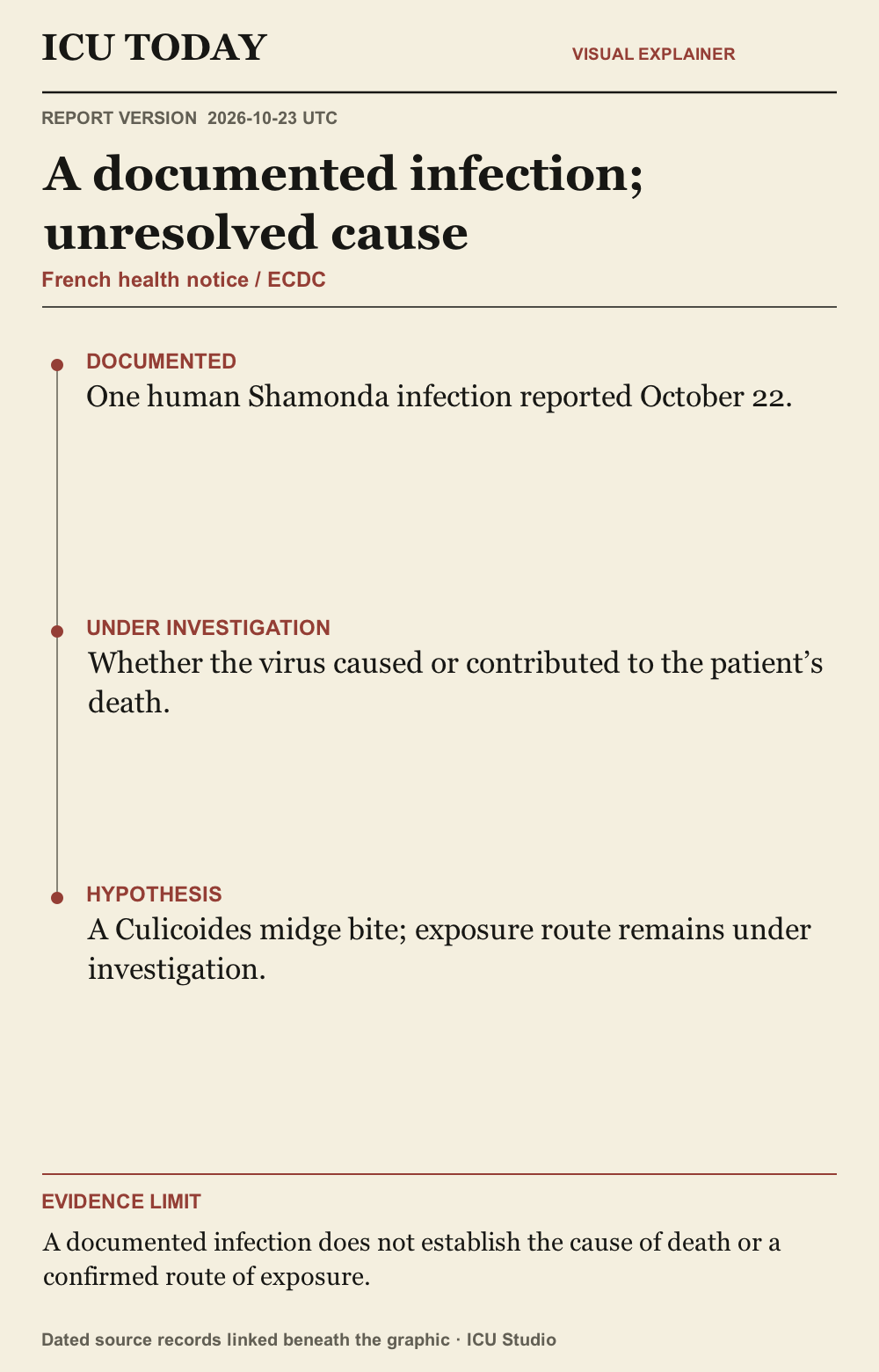
Read the infographic as text
DOCUMENTED. One human Shamonda infection reported October 22.
UNDER INVESTIGATION. Whether the virus caused or contributed to the patient’s death.
HYPOTHESIS. A Culicoides midge bite; exposure route remains under investigation.
Evidence limit. A documented infection does not establish the cause of death or a confirmed route of exposure.
Graphic sources: French health-authority notice hosted by Inserm's press office · European Centre for Disease Prevention and Control
The developing record.
Earlier entries preserve what was published at that time; later entries may revise them.
2026-10-23T20:14:55.741Z · Initial publication after reviewing the French notice and ECDC report; the cause of death and route of infection remain under investigation.
France reports first human Shamonda infection; investigation continues
A patient with severe immunosuppression died in early October. French and European authorities are investigating the infection and its role in the illness.
What happened
French health authorities reported the first documented human infection with Shamonda virus on October 22, in a patient with severe immunosuppression who was being treated for another serious illness. The patient died in early October. The European Centre for Disease Prevention and Control says investigators are still examining whether the virus caused or contributed to the death and how the infection occurred. [French health-authority notice hosted by Inserm's press office] [European Centre for Disease Prevention and Control]
Why it matters
ECDC says Shamonda had previously been detected only in animals. Its first European farm-animal detections followed signs of illness in June and identification of the virus in late July 2026; the agency lists detections in 12 countries and Jersey. ECDC is working with the relevant EU reference laboratory to strengthen testing and help identify any additional human cases. French authorities describe a link between this patient's brain complications and the infection as very likely, while clinical, biological and epidemiological investigations continue. [European Centre for Disease Prevention and Control] [French health-authority notice hosted by Inserm's press office]
What remains unknown
The French investigation's current hypothesis is a bite from a Culicoides midge in eastern France. That remains a hypothesis; ECDC says the specific midge species involved is unknown. The French notice says no health risk to the general population had been identified on the information available at the time. Neither notice provides full laboratory methods or a complete clinical account. The reports concern one documented human infection, with the route of exposure and the virus's contribution to the death still under investigation. [French health-authority notice hosted by Inserm's press office] [European Centre for Disease Prevention and Control]
Original sources
Virus Shamonda : une première détection chez l’être humain · Issuer: French health authorities; joint notice hosted by Inserm · 2026-10-22
Severely ill patient in France becomes first ever human infected with Shamonda virus · Issuer: European Centre for Disease Prevention and Control · 2026-10-22
Corrections
No corrections recorded.