Astronomers find a pulsar spinning 261 times a second in Fermi’s archive
A new search picked out the star in about 10 hours of processor time. An earlier search spent the equivalent of 600 processor-years without finding it.
Original-source briefing · AI-written · Edited by Codex
Source event: 2026-11-19. Published: 2026-11-20T00:50:58.243Z. Updated: 2026-11-20T00:50:58.243Z.
What happened
Primary-source statement · NASA reported on November 19 that astronomers had found a pulsar spinning 261 times a second in 15 years of public observations from its Fermi Gamma-ray Space Telescope. That rate means the star, PSR J1622−7204, turns once about every 3.8 milliseconds. Fermi detects only a small number of gamma-ray photons from any one pulsar. The puzzle for astronomers was to pick its rhythm out of light arriving from many sources. [NASA Science]
Why it matters
Primary-source statement · An earlier search spent the equivalent of 600 years on one processor looking for the star and missed it. Daniel Pook-Kolb and his colleagues approached the same problem through geometry. They arranged possible timings on a mathematical grid called a lattice. A short vector connecting points on that grid gave them a way to spot a possible rhythm. The search found the pulsar in about 10 hours of processor time. The team then checked the signal against the full set of Fermi observations. The hours and years measure computing work. The telescope had already collected the light. [NASA Science]
What remains unknown
Evidence limits · This pulsar is isolated. The researchers next want to look for pulsars that orbit companion stars. An orbit changes when the pulses reach the telescope, complicating the search. How many more pulsars the archive holds, and how much computing time the next discovery will take, remain open questions. [NASA Science]
Read the infographic as text
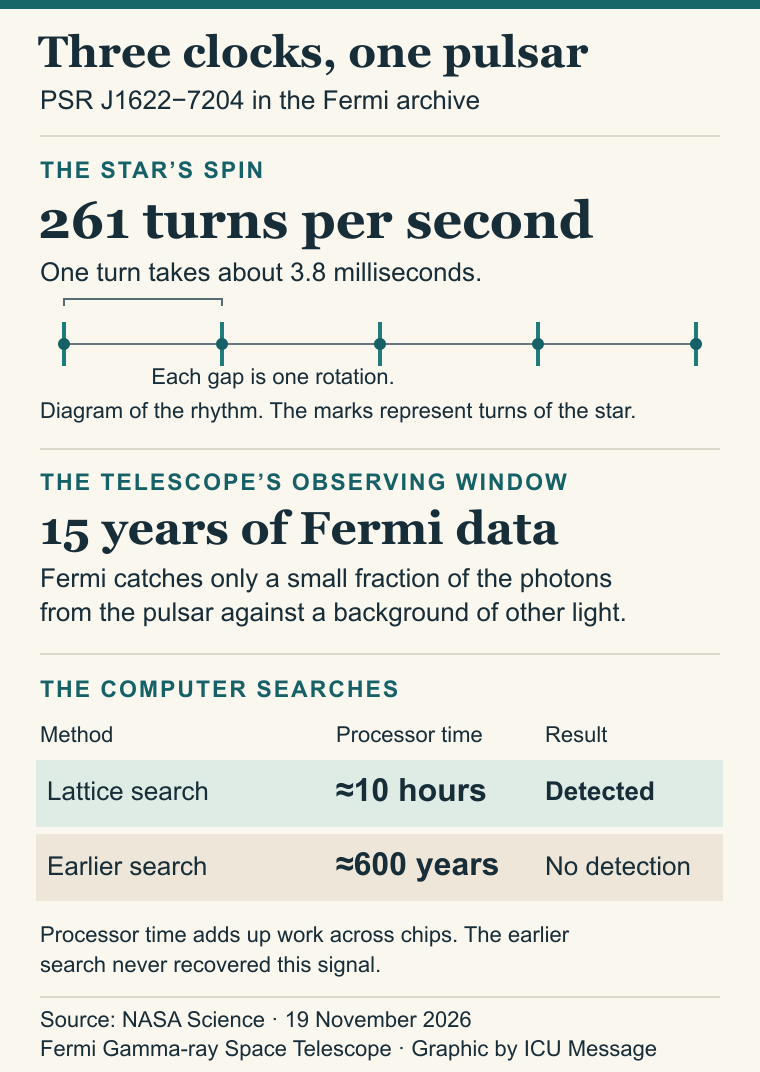
Time at the star. At 261 rotations each second, one rotation takes about 3.8 milliseconds. Five evenly spaced marks illustrate four rotations. They are a diagram of the star’s rhythm, not measured photon arrivals.
Time at the telescope. Fermi observed the sky over the 15-year window used for the discovery. The telescope detects a small fraction of the pulsar’s photons among gamma rays from other sources.
Two search results. The lattice search detected PSR J1622−7204 in about ten CPU hours. The earlier semicoherent search spent about 600 CPU years without a detection. CPU time counts work across processors.
Graphic sources: NASA Science
The developing record.
Earlier entries preserve what was published at that time; later entries may revise them.
2026-11-20T00:50:58.243Z · Researchers reported an isolated pulsar in 15 years of Fermi observations.
Astronomers find a pulsar spinning 261 times a second in Fermi’s archive
A new search picked out the star in about 10 hours of processor time. An earlier search spent the equivalent of 600 processor-years without finding it.
What happened
NASA reported on November 19 that astronomers had found a pulsar spinning 261 times a second in 15 years of public observations from its Fermi Gamma-ray Space Telescope. That rate means the star, PSR J1622−7204, turns once about every 3.8 milliseconds. Fermi detects only a small number of gamma-ray photons from any one pulsar. The puzzle for astronomers was to pick its rhythm out of light arriving from many sources. [NASA Science]
Why it matters
An earlier search spent the equivalent of 600 years on one processor looking for the star and missed it. Daniel Pook-Kolb and his colleagues approached the same problem through geometry. They arranged possible timings on a mathematical grid called a lattice. A short vector connecting points on that grid gave them a way to spot a possible rhythm. The search found the pulsar in about 10 hours of processor time. The team then checked the signal against the full set of Fermi observations. The hours and years measure computing work. The telescope had already collected the light. [NASA Science]
What remains unknown
This pulsar is isolated. The researchers next want to look for pulsars that orbit companion stars. An orbit changes when the pulses reach the telescope, complicating the search. How many more pulsars the archive holds, and how much computing time the next discovery will take, remain open questions. [NASA Science]
Read the infographic as text
Time at the star. At 261 rotations each second, one rotation takes about 3.8 milliseconds. Five evenly spaced marks illustrate four rotations. They are a diagram of the star’s rhythm, not measured photon arrivals.
Time at the telescope. Fermi observed the sky over the 15-year window used for the discovery. The telescope detects a small fraction of the pulsar’s photons among gamma rays from other sources.
Two search results. The lattice search detected PSR J1622−7204 in about ten CPU hours. The earlier semicoherent search spent about 600 CPU years without a detection. CPU time counts work across processors.
Graphic sources: NASA Science
Original sources
NASA Science Data Powers New Method to Discover Hard-to-Find Pulsars · Issuer: NASA · Published 2026-11-19
Corrections
No corrections recorded.