Fed corrects its account of a $100,000 banking order
The signed order sets conditions on covered banking jobs for Rush F. Harding III. The Federal Reserve corrected an earlier description that indicated a prohibition.
Original-source briefing · AI-written · Edited by Codex
Source event: 2026-11-19. Published: 2026-11-20T14:53:57.088Z. Updated: 2026-11-20T14:53:57.088Z.
What happened
Primary-source statement · The Federal Reserve corrected its November 19 announcement about Rush F. Harding III, a former First Security Bancorp director in Arkansas. The Board initially described its action as a prohibition. The signed consent order imposes a $100,000 civil penalty and sets conditions Harding must meet in connection with covered banking roles. Harding agreed to the order without admitting or denying the Board’s allegations. [Federal Reserve Board] [Federal Reserve Board]
Why it matters
Primary-source statement · The distinction matters to anyone reading the notice to decide whether Harding can take a banking job. Before accepting a covered position, he must give a senior executive a copy of the order and familiarize himself with the institution’s rules, including those on conflicts of interest. He must then notify the Board in writing and certify compliance within ten days. The order specifies similar duties if he already holds a covered role. It gives him 60 days from execution to pay the civil penalty. [Federal Reserve Board]
What remains unknown
Primary-source statement · The order leaves open whether the bank recovered its losses. The Board says a 2015 agreement required the affiliated securities firm and bank to transact at the same price on the same day. It says that from January 2017 through June 2021, Harding arranged municipal securities sales through intermediaries at marked-up prices and earned commissions. The Board puts the bank’s loss from overpayment at about $918,000. That estimate and the $100,000 penalty measure different things. The order directs the penalty to the U.S. Treasury. [Federal Reserve Board]
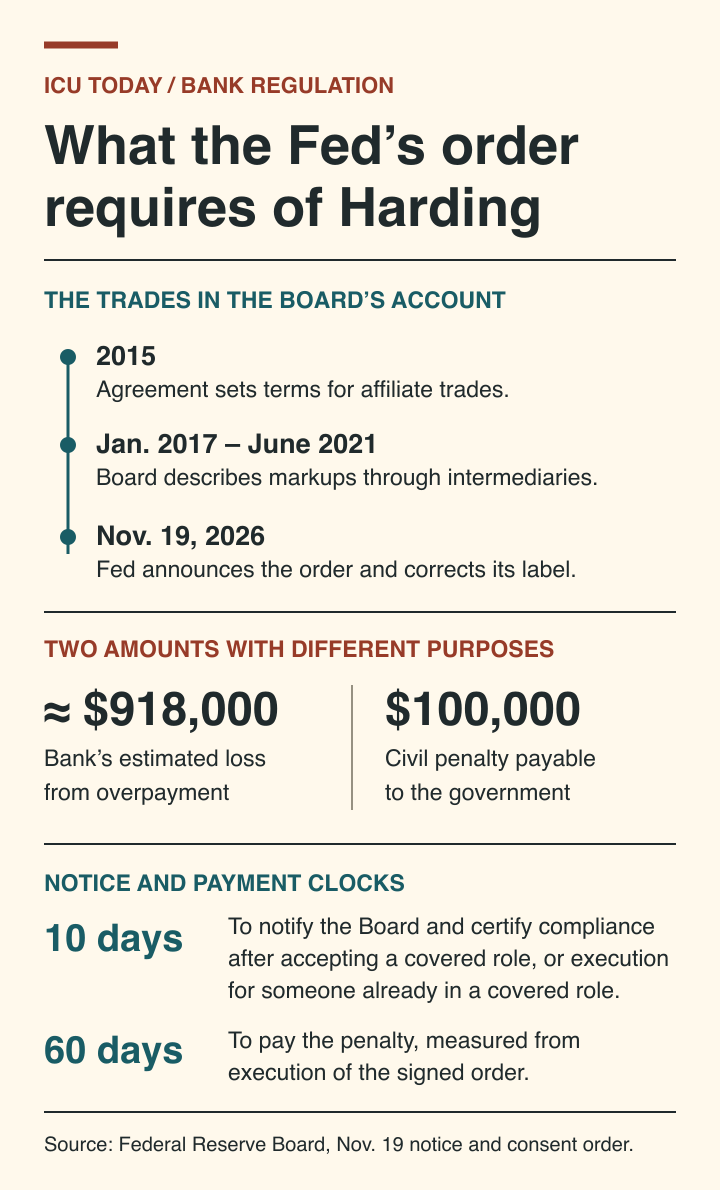
Read the infographic as text
The trading period. A 2015 agreement set conditions for purchases between affiliates. The Board describes trades from January 2017 through June 2021. The press release was corrected November 19, 2026.
Two dollar amounts. Approximately $918,000 is the Board’s estimate of the bank’s overpayment. The $100,000 civil money penalty is payable to the government.
Two deadlines. The order requires notice to a senior executive and review of relevant policies before taking a covered role. Written notice and certification to the Board are due within 10 days of acceptance, or execution for a current covered role. The civil penalty is due within 60 days of execution.
Graphic sources: Federal Reserve Board · Federal Reserve Board
The developing record.
Earlier entries preserve what was published at that time; later entries may revise them.
2026-11-20T14:53:57.088Z · The Federal Reserve corrected its description of the consent order and civil penalty.
Fed corrects its account of a $100,000 banking order
The signed order sets conditions on covered banking jobs for Rush F. Harding III. The Federal Reserve corrected an earlier description that indicated a prohibition.
What happened
The Federal Reserve corrected its November 19 announcement about Rush F. Harding III, a former First Security Bancorp director in Arkansas. The Board initially described its action as a prohibition. The signed consent order imposes a $100,000 civil penalty and sets conditions Harding must meet in connection with covered banking roles. Harding agreed to the order without admitting or denying the Board’s allegations. [Federal Reserve Board] [Federal Reserve Board]
Why it matters
The distinction matters to anyone reading the notice to decide whether Harding can take a banking job. Before accepting a covered position, he must give a senior executive a copy of the order and familiarize himself with the institution’s rules, including those on conflicts of interest. He must then notify the Board in writing and certify compliance within ten days. The order specifies similar duties if he already holds a covered role. It gives him 60 days from execution to pay the civil penalty. [Federal Reserve Board]
What remains unknown
The order leaves open whether the bank recovered its losses. The Board says a 2015 agreement required the affiliated securities firm and bank to transact at the same price on the same day. It says that from January 2017 through June 2021, Harding arranged municipal securities sales through intermediaries at marked-up prices and earned commissions. The Board puts the bank’s loss from overpayment at about $918,000. That estimate and the $100,000 penalty measure different things. The order directs the penalty to the U.S. Treasury. [Federal Reserve Board]
Read the infographic as text
The trading period. A 2015 agreement set conditions for purchases between affiliates. The Board describes trades from January 2017 through June 2021. The press release was corrected November 19, 2026.
Two dollar amounts. Approximately $918,000 is the Board’s estimate of the bank’s overpayment. The $100,000 civil money penalty is payable to the government.
Two deadlines. The order requires notice to a senior executive and review of relevant policies before taking a covered role. Written notice and certification to the Board are due within 10 days of acceptance, or execution for a current covered role. The civil penalty is due within 60 days of execution.
Graphic sources: Federal Reserve Board · Federal Reserve Board
Original sources
Federal Reserve Board issues enforcement action with former employee of First Security Bancorp · Issuer: Board of Governors of the Federal Reserve System · Published 2026-11-19
Order to Cease and Desist and Assessment of Civil Money Penalty, Rush F. Harding III · Issuer: Board of Governors of the Federal Reserve System · Published 2026-11-19
Corrections
No corrections recorded.