Bankers asked the Fed for clearer authority to pause suspected scam payments
A September meeting record now on the Fed’s website explains why bank representatives want more time to review suspicious deposits and intervene when a customer appears to have approved a transfer.
Original-source briefing · AI-written · Edited by Codex
Source event: 2026-09-03. Published: 2026-11-18T11:43:08.566Z. Updated: 2026-11-18T11:43:08.566Z.
What happened
Primary-source statement · A customer can approve a payment while someone is tricking them into sending it. At a September 3 meeting with the Federal Reserve Board, banking industry representatives asked regulators to clarify when a bank can pause or decline that transfer. The Federal Advisory Council also sought authority to hold an incoming deposit longer when there is credible evidence of fraud. The Fed lists the meeting record on its council page, updated November 17. The requests came from the 12-member council, which advises the Board. [Board of Governors of the Federal Reserve System] [Board of Governors of the Federal Reserve System]
Why it matters
Primary-source statement · The two requests affect customers at different points. Someone who deposits a check could have to wait longer to spend the money while a bank investigates. Someone sending money could see a transfer interrupted even after confirming it. The council said banks should have reasonable procedures for escalating concerns and communicating with customers. It also asked for common terms to distinguish scams in which the customer sends the money from transfers made without the customer’s permission. That distinction would help institutions compare fraud reports, the council said. [Board of Governors of the Federal Reserve System]
What remains unknown
Evidence limits · The meeting record gives no timetable for a rule change. It does not say how long an additional hold would last or estimate how many legitimate transactions it might delay. Customers cannot tell from this record whether their bank will change when it releases a deposit or processes a transfer. [Board of Governors of the Federal Reserve System]
Read the infographic as text
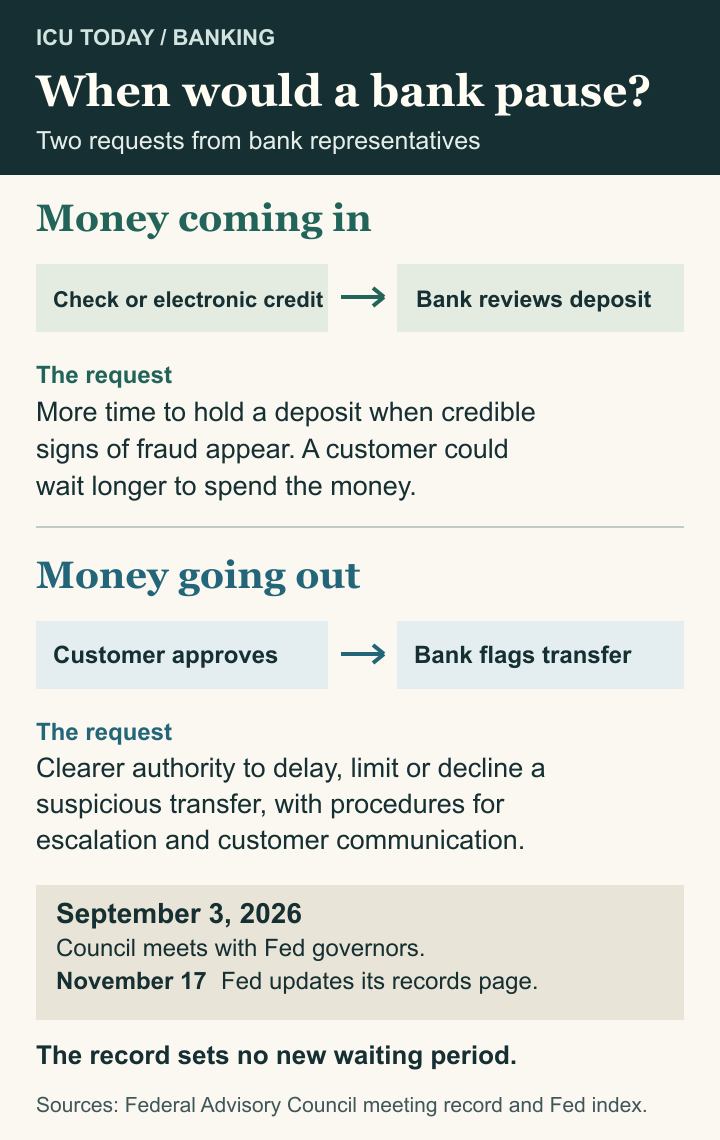
Money coming in. For check deposits and electronic credits, the council sought more time before funds become available when credible indicators point to fraud. A customer could have to wait to use the deposit.
Money going out. The council sought clarity on when banks may delay, limit or decline a suspicious transaction even if the customer appears to have authorized it. It called for reasonable procedures, escalation and communication with the customer.
Two dates, two meanings. The council met the Federal Reserve Board on September 3, 2026. The Board’s council index, updated November 17, links the record. Neither date establishes a new waiting period.
Graphic sources: Board of Governors of the Federal Reserve System · Board of Governors of the Federal Reserve System
The developing record.
Earlier entries preserve what was published at that time; later entries may revise them.
2026-11-18T11:43:08.566Z · Initial report on the banking council’s requests for deposit holds and intervention in suspected scam payments, and what remains unknown about their effect on customers.
Bankers asked the Fed for clearer authority to pause suspected scam payments
A September meeting record now on the Fed’s website explains why bank representatives want more time to review suspicious deposits and intervene when a customer appears to have approved a transfer.
What happened
A customer can approve a payment while someone is tricking them into sending it. At a September 3 meeting with the Federal Reserve Board, banking industry representatives asked regulators to clarify when a bank can pause or decline that transfer. The Federal Advisory Council also sought authority to hold an incoming deposit longer when there is credible evidence of fraud. The Fed lists the meeting record on its council page, updated November 17. The requests came from the 12-member council, which advises the Board. [Board of Governors of the Federal Reserve System] [Board of Governors of the Federal Reserve System]
Why it matters
The two requests affect customers at different points. Someone who deposits a check could have to wait longer to spend the money while a bank investigates. Someone sending money could see a transfer interrupted even after confirming it. The council said banks should have reasonable procedures for escalating concerns and communicating with customers. It also asked for common terms to distinguish scams in which the customer sends the money from transfers made without the customer’s permission. That distinction would help institutions compare fraud reports, the council said. [Board of Governors of the Federal Reserve System]
What remains unknown
The meeting record gives no timetable for a rule change. It does not say how long an additional hold would last or estimate how many legitimate transactions it might delay. Customers cannot tell from this record whether their bank will change when it releases a deposit or processes a transfer. [Board of Governors of the Federal Reserve System]
Read the infographic as text
Money coming in. For check deposits and electronic credits, the council sought more time before funds become available when credible indicators point to fraud. A customer could have to wait to use the deposit.
Money going out. The council sought clarity on when banks may delay, limit or decline a suspicious transaction even if the customer appears to have authorized it. It called for reasonable procedures, escalation and communication with the customer.
Two dates, two meanings. The council met the Federal Reserve Board on September 3, 2026. The Board’s council index, updated November 17, links the record. Neither date establishes a new waiting period.
Graphic sources: Board of Governors of the Federal Reserve System · Board of Governors of the Federal Reserve System
Original sources
Federal Advisory Council and Board of Governors, record of the September 3 meeting · Issuer: Federal Advisory Council, meeting with the Board of Governors · Edition dated 2026-09-03
Federal Advisory Council membership and records of meetings · Issuer: Board of Governors of the Federal Reserve System · Updated 2026-11-17
Corrections
No corrections recorded.