Fed study links earlier U.S. tariffs to lower Chinese import prices abroad
Newly released research estimates a 4.4% relative decline by 2021 in markets outside the U.S. and China. It does not measure the effects of today's tariffs.
Original-source briefing · AI-written · Edited by Codex
Source event: 2026-11-10. Published: 2026-11-15T15:03:30.621Z. Updated: 2026-11-15T15:03:30.621Z.
What happened
Primary-source statement · U.S. tariffs on China can change prices far beyond the American border, according to research released by the Federal Reserve on November 10. The authors estimate that Chinese products targeted by the 2018–19 tariffs experienced a 4.4% decline in import prices in other markets by 2021, relative to products outside those tariffs. The findings concern an earlier trade dispute, not a measured fall in current U.S. consumer prices. The paper's authors include three Federal Reserve researchers and a University of Texas researcher. [Federal Reserve Board] [Federal Reserve Board]
Why it matters
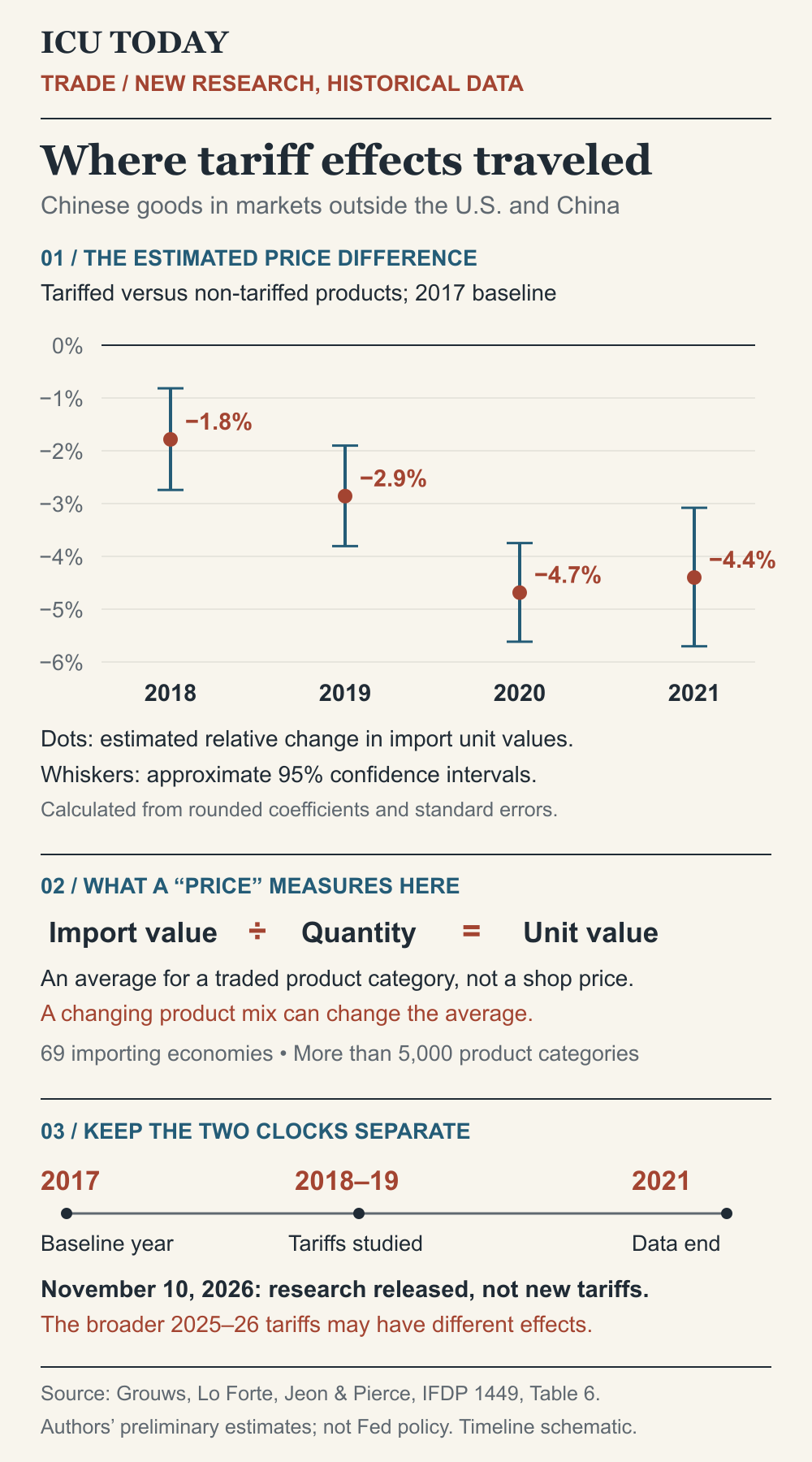
Primary-source statement · The study examines trade data from 2017 through 2021 across 69 importing economies and more than 5,000 product categories. Its statistical comparison accounts for differences among products, trading partners and years. The researchers find larger, more persistent price declines in emerging markets than in advanced economies. They interpret the results as evidence of trade deflection: Chinese exporters redirecting goods toward other buyers. That creates competing pressures, the authors explain. Lower-priced imports can benefit purchasers while challenging local producers and their workers. The graphic shows the estimated annual price differences and their uncertainty. [Federal Reserve Board]
What remains unknown
Evidence limits · The price measure is import value divided by quantity, so changes in the mix of products can move it even when individual prices do not change. The authors test alternative methods but acknowledge that measurement limit. They also caution that the broader 2025–26 tariffs could produce different effects. This preliminary working paper presents the researchers' findings, not Federal Reserve policy or a forecast of today's inflation. Its historical estimates do not establish how much any American household will save or pay under current trade rules. [Federal Reserve Board] [Federal Reserve Board]
Read the infographic as text
Estimated relative price differences. Relative to non-tariffed Chinese products and a 2017 baseline, estimated import unit-value differences were −1.8% in 2018, −2.9% in 2019, −4.7% in 2020 and −4.4% in 2021. Approximate 95% confidence intervals were −2.7% to −0.8%, −3.8% to −1.9%, −5.6% to −3.7% and −5.7% to −3.1%, respectively. These are not year-on-year retail-price changes. Dots and whiskers transform rounded Table 6 log coefficients and standard errors: 100 × (exp(coefficient) − 1); bounds use coefficient ± 1.96 standard errors.
What the measure covers. Import value divided by quantity gives a unit value, an average for a traded product category. Product-mix changes can move that average. The study examines 69 importing economies and more than 5,000 product categories. The authors report preliminary statistical estimates, not Federal Reserve policy.
Historical window and release date. 2017 is the baseline; the tariffs studied were imposed in 2018–19; the main data end in 2021. The paper was released November 10, 2026. The broader 2025–26 tariffs could have different effects. The timeline is schematic, not to scale.
Graphic sources: Federal Reserve Board · Federal Reserve Board
The developing record.
Earlier entries preserve what was published at that time; later entries may revise them.
2026-11-15T15:03:30.621Z · Initial report on the November 10 working paper about historical tariff-related price changes abroad, with a chart of annual estimates and uncertainty and an explanation of unit values.
Fed study links earlier U.S. tariffs to lower Chinese import prices abroad
Newly released research estimates a 4.4% relative decline by 2021 in markets outside the U.S. and China. It does not measure the effects of today's tariffs.
What happened
U.S. tariffs on China can change prices far beyond the American border, according to research released by the Federal Reserve on November 10. The authors estimate that Chinese products targeted by the 2018–19 tariffs experienced a 4.4% decline in import prices in other markets by 2021, relative to products outside those tariffs. The findings concern an earlier trade dispute, not a measured fall in current U.S. consumer prices. The paper's authors include three Federal Reserve researchers and a University of Texas researcher. [Federal Reserve Board] [Federal Reserve Board]
Why it matters
The study examines trade data from 2017 through 2021 across 69 importing economies and more than 5,000 product categories. Its statistical comparison accounts for differences among products, trading partners and years. The researchers find larger, more persistent price declines in emerging markets than in advanced economies. They interpret the results as evidence of trade deflection: Chinese exporters redirecting goods toward other buyers. That creates competing pressures, the authors explain. Lower-priced imports can benefit purchasers while challenging local producers and their workers. The graphic shows the estimated annual price differences and their uncertainty. [Federal Reserve Board]
What remains unknown
The price measure is import value divided by quantity, so changes in the mix of products can move it even when individual prices do not change. The authors test alternative methods but acknowledge that measurement limit. They also caution that the broader 2025–26 tariffs could produce different effects. This preliminary working paper presents the researchers' findings, not Federal Reserve policy or a forecast of today's inflation. Its historical estimates do not establish how much any American household will save or pay under current trade rules. [Federal Reserve Board] [Federal Reserve Board]
Read the infographic as text
Estimated relative price differences. Relative to non-tariffed Chinese products and a 2017 baseline, estimated import unit-value differences were −1.8% in 2018, −2.9% in 2019, −4.7% in 2020 and −4.4% in 2021. Approximate 95% confidence intervals were −2.7% to −0.8%, −3.8% to −1.9%, −5.6% to −3.7% and −5.7% to −3.1%, respectively. These are not year-on-year retail-price changes. Dots and whiskers transform rounded Table 6 log coefficients and standard errors: 100 × (exp(coefficient) − 1); bounds use coefficient ± 1.96 standard errors.
What the measure covers. Import value divided by quantity gives a unit value, an average for a traded product category. Product-mix changes can move that average. The study examines 69 importing economies and more than 5,000 product categories. The authors report preliminary statistical estimates, not Federal Reserve policy.
Historical window and release date. 2017 is the baseline; the tariffs studied were imposed in 2018–19; the main data end in 2021. The paper was released November 10, 2026. The broader 2025–26 tariffs could have different effects. The timeline is schematic, not to scale.
Graphic sources: Federal Reserve Board · Federal Reserve Board
Original sources
Trade Deflection: The Spillover Effects of U.S. Tariffs on Import Prices in Bystander Countries, IFDP 1449 · Issuer: Sofie Grouws, Giulia Lo Forte, Sharon Jeon and Justin Pierce · Published 2026-11-10
Federal Reserve publication page for IFDP 1449, updated November 10, 2026 · Issuer: Board of Governors of the Federal Reserve System · Published 2026-11-10
Corrections
No corrections recorded.