Fed minutes show why ten members voted to wait and two wanted higher rates
October’s 10–2 vote kept the target rate at 3.75% to 4%. The newly released minutes show how officials who agreed inflation was too high reached different conclusions about when to act.
Original-source briefing · AI-written · Edited by Codex
Source event: 2026-11-18. Published: 2026-11-18T20:13:27.303Z. Updated: 2026-11-18T20:13:27.303Z.
What happened
Primary-source statement · Ten members of the Federal Open Market Committee voted in October to keep the federal funds rate in a range of 3.75% to 4%. Two members, Lisa Cook and Beth Hammack, voted for an increase of a quarter of a percentage point. The Federal Reserve released the minutes of the October 27–28 meeting on November 18. They explain the disagreement behind the vote that had already taken place. [Board of Governors of the Federal Reserve System] [Board of Governors of the Federal Reserve System]
Why it matters
Primary-source statement · For officials who wanted to wait, one question was how much of September’s rate increase had worked its way through the economy. Some also wanted a clearer picture of business investment tied to artificial intelligence and the conditions companies faced when financing it. Several participants nevertheless saw inflation pressures extending beyond the industries building data centers. Those favoring an immediate increase saw little evidence that inflation was easing. A few warned that waiting could mean a larger, more disruptive increase later. Even among those who supported holding rates steady, a few described October’s decision as a close call. [Board of Governors of the Federal Reserve System]
What remains unknown
Evidence limits · The minutes distinguish the vote taken in October from participants’ expectations for later meetings. Almost all participants thought more rate increases would likely be appropriate if inflation and employment developed as they expected. A couple wanted an increase larger than a quarter point considered if the next inflation data proved unfavorable. Neither view settled the timing or size of the next decision. The Fed says this record describes conditions as officials understood them at the October meeting. [Board of Governors of the Federal Reserve System] [Board of Governors of the Federal Reserve System]
Read the infographic as text
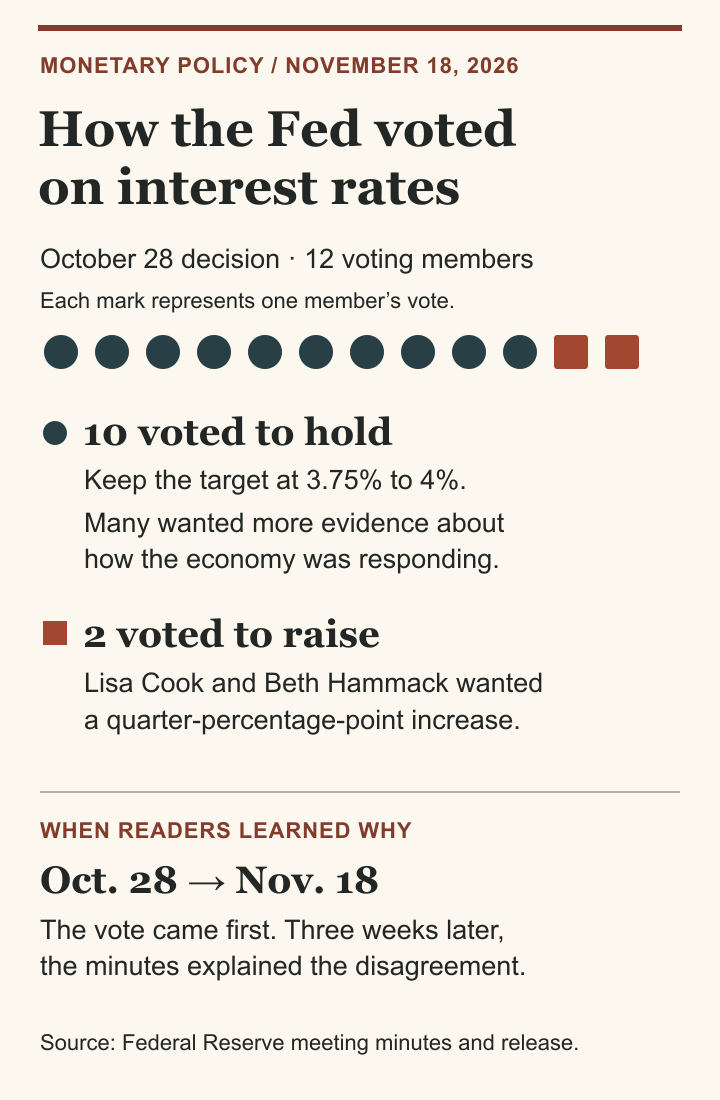
Ten voted to hold. The adopted October decision kept the federal funds target range at 3.75% to 4%. Supporters wanted more evidence, including the effects of the September increase.
Two voted to raise. Lisa Cook and Beth Hammack voted for a quarter-percentage-point increase. Participants favoring an increase cited persistent inflation.
Two dates, one decision. The committee voted on October 28. On November 18, the Fed released the minutes explaining the debate. Future decisions depended on incoming data.
Graphic sources: Board of Governors of the Federal Reserve System · Board of Governors of the Federal Reserve System
The developing record.
Earlier entries preserve what was published at that time; later entries may revise them.
2026-11-18T20:13:27.303Z · Initial report on the release of the October minutes, the 10–2 vote and the reasons officials gave for holding rates or raising them.
Fed minutes show why ten members voted to wait and two wanted higher rates
October’s 10–2 vote kept the target rate at 3.75% to 4%. The newly released minutes show how officials who agreed inflation was too high reached different conclusions about when to act.
What happened
Ten members of the Federal Open Market Committee voted in October to keep the federal funds rate in a range of 3.75% to 4%. Two members, Lisa Cook and Beth Hammack, voted for an increase of a quarter of a percentage point. The Federal Reserve released the minutes of the October 27–28 meeting on November 18. They explain the disagreement behind the vote that had already taken place. [Board of Governors of the Federal Reserve System] [Board of Governors of the Federal Reserve System]
Why it matters
For officials who wanted to wait, one question was how much of September’s rate increase had worked its way through the economy. Some also wanted a clearer picture of business investment tied to artificial intelligence and the conditions companies faced when financing it. Several participants nevertheless saw inflation pressures extending beyond the industries building data centers. Those favoring an immediate increase saw little evidence that inflation was easing. A few warned that waiting could mean a larger, more disruptive increase later. Even among those who supported holding rates steady, a few described October’s decision as a close call. [Board of Governors of the Federal Reserve System]
What remains unknown
The minutes distinguish the vote taken in October from participants’ expectations for later meetings. Almost all participants thought more rate increases would likely be appropriate if inflation and employment developed as they expected. A couple wanted an increase larger than a quarter point considered if the next inflation data proved unfavorable. Neither view settled the timing or size of the next decision. The Fed says this record describes conditions as officials understood them at the October meeting. [Board of Governors of the Federal Reserve System] [Board of Governors of the Federal Reserve System]
Read the infographic as text
Ten voted to hold. The adopted October decision kept the federal funds target range at 3.75% to 4%. Supporters wanted more evidence, including the effects of the September increase.
Two voted to raise. Lisa Cook and Beth Hammack voted for a quarter-percentage-point increase. Participants favoring an increase cited persistent inflation.
Two dates, one decision. The committee voted on October 28. On November 18, the Fed released the minutes explaining the debate. Future decisions depended on incoming data.
Graphic sources: Board of Governors of the Federal Reserve System · Board of Governors of the Federal Reserve System
Original sources
Minutes of the Federal Open Market Committee, October 27–28, 2026: release notice · Issuer: Federal Reserve · Published 2026-11-18
Minutes of the Federal Open Market Committee, October 27–28, 2026 · Issuer: Federal Reserve · Published 2026-11-18
Corrections
No corrections recorded.