What a proposed Fed index says about financial fragility
A September research paper separates the buildup of financial weaknesses from present credit conditions. Its findings are the authors’ claims, not a November risk reading.
Original-source briefing · AI-written · Edited by Codex
Source event: 2026-09-23. Published: 2026-11-13T17:03:49.591Z. Updated: 2026-11-13T17:03:49.591Z.
What happened
Primary-source statement · A September Federal Reserve staff paper proposes a Financial Vulnerability Index, or FVI, intended to track weaknesses accumulating in the U.S. financial system. Authors Michele Modugno, Benjamin Roscoe and Sarah Zoi distinguish it from financial condition indices, which describe current credit-market conditions and can surge during turmoil. Their published abstract says the FVI instead captures a gradual buildup of structural weaknesses and declines as turmoil materializes. The research page records a September 23 correction to the equity-premium definition in Appendix A, Table 2; the page itself was last updated October 9. This is an explanation of that earlier research, not a new November release. [Federal Reserve Board]
Why it matters
Primary-source statement · The authors report that adverse shocks are amplified when their index is high, with larger declines in consumption and investment. They also report an association between monetary tightening and a gradual decline in the index over several years. Those are research findings they describe, rather than independently verified forecasts. The Fed’s separate financial-stability overview explains the practical stakes: resilient markets and institutions keep functioning after a bad shock, supporting services such as business credit, mortgages, savings accounts and payments. The distinction gives readers two different questions to keep separate: what credit conditions look like now, and what weaknesses may have accumulated. The Fed cautions that staff research represents its authors’ views, without implying agreement by the Board or other staff. [Federal Reserve Board] [Federal Reserve Board]
What remains unknown
Evidence limits · The material reviewed for this article does not establish a current November FVI reading, predict the next crisis or show that the proposed index has been independently validated. ICU reviewed the authors’ abstract and the Fed’s public overview, not the full paper’s methods, data or robustness tests. The reported association with monetary tightening does not, by itself, establish that a particular policy change caused a reduction in financial risk. This informational account offers no recommendation about investments or interest-rate decisions. [Federal Reserve Board] [Federal Reserve Board]
Read the infographic as text
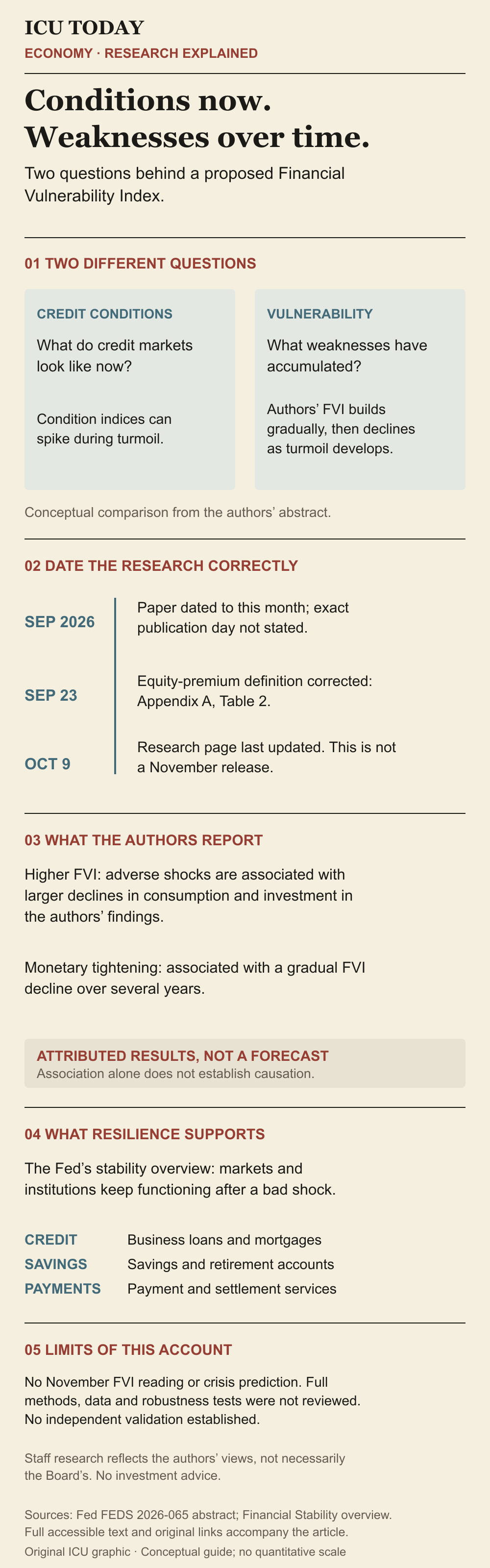
Two different questions. Financial condition indices describe current credit-market conditions and may spike during turmoil. The authors describe their proposed Financial Vulnerability Index as tracking the gradual buildup of structural financial weaknesses and declining as turmoil materializes. This is the authors’ distinction, not independent validation.
The research timeline. September 2026: the research page dates the paper to this month; no exact publication day is stated. September 23: the equity-premium definition in Appendix A, Table 2 was corrected. October 9: the research page’s last-update date. These dates do not describe a November release or a current risk measurement.
What the authors report. When the FVI is high, the authors report that adverse shocks are amplified, with larger declines in consumption and investment. They report that monetary tightening is associated with a gradual decline in the FVI over several years. These are attributed research findings, not proof of causation, independently verified predictions or a policy recommendation.
Why financial resilience matters. The Fed describes a stable financial system as markets and institutions that can function after a bad shock. Its examples of everyday services include business credit and mortgages, savings and retirement accounts, and effective payment and settlement systems.
What this evidence cannot establish. The abstract and official overview reviewed here do not establish a November FVI reading, the timing of another crisis or independent validation. ICU did not review the full methods, data or robustness tests. The Fed says this research represents the authors’ views, not necessarily those of the Board or other staff. No investment or interest-rate advice is offered.
Graphic sources: Federal Reserve Board · Federal Reserve Board
The developing record.
Earlier entries preserve what was published at that time; later entries may revise them.
2026-11-13T17:03:49.591Z · Initial informational account of the proposed Financial Vulnerability Index, September research chronology, authors-reported findings and explicit evidence limits, with a detailed original infographic.
What a proposed Fed index says about financial fragility
A September research paper separates the buildup of financial weaknesses from present credit conditions. Its findings are the authors’ claims, not a November risk reading.
What happened
A September Federal Reserve staff paper proposes a Financial Vulnerability Index, or FVI, intended to track weaknesses accumulating in the U.S. financial system. Authors Michele Modugno, Benjamin Roscoe and Sarah Zoi distinguish it from financial condition indices, which describe current credit-market conditions and can surge during turmoil. Their published abstract says the FVI instead captures a gradual buildup of structural weaknesses and declines as turmoil materializes. The research page records a September 23 correction to the equity-premium definition in Appendix A, Table 2; the page itself was last updated October 9. This is an explanation of that earlier research, not a new November release. [Federal Reserve Board]
Why it matters
The authors report that adverse shocks are amplified when their index is high, with larger declines in consumption and investment. They also report an association between monetary tightening and a gradual decline in the index over several years. Those are research findings they describe, rather than independently verified forecasts. The Fed’s separate financial-stability overview explains the practical stakes: resilient markets and institutions keep functioning after a bad shock, supporting services such as business credit, mortgages, savings accounts and payments. The distinction gives readers two different questions to keep separate: what credit conditions look like now, and what weaknesses may have accumulated. The Fed cautions that staff research represents its authors’ views, without implying agreement by the Board or other staff. [Federal Reserve Board] [Federal Reserve Board]
What remains unknown
The material reviewed for this article does not establish a current November FVI reading, predict the next crisis or show that the proposed index has been independently validated. ICU reviewed the authors’ abstract and the Fed’s public overview, not the full paper’s methods, data or robustness tests. The reported association with monetary tightening does not, by itself, establish that a particular policy change caused a reduction in financial risk. This informational account offers no recommendation about investments or interest-rate decisions. [Federal Reserve Board] [Federal Reserve Board]
Read the infographic as text
Two different questions. Financial condition indices describe current credit-market conditions and may spike during turmoil. The authors describe their proposed Financial Vulnerability Index as tracking the gradual buildup of structural financial weaknesses and declining as turmoil materializes. This is the authors’ distinction, not independent validation.
The research timeline. September 2026: the research page dates the paper to this month; no exact publication day is stated. September 23: the equity-premium definition in Appendix A, Table 2 was corrected. October 9: the research page’s last-update date. These dates do not describe a November release or a current risk measurement.
What the authors report. When the FVI is high, the authors report that adverse shocks are amplified, with larger declines in consumption and investment. They report that monetary tightening is associated with a gradual decline in the FVI over several years. These are attributed research findings, not proof of causation, independently verified predictions or a policy recommendation.
Why financial resilience matters. The Fed describes a stable financial system as markets and institutions that can function after a bad shock. Its examples of everyday services include business credit and mortgages, savings and retirement accounts, and effective payment and settlement systems.
What this evidence cannot establish. The abstract and official overview reviewed here do not establish a November FVI reading, the timing of another crisis or independent validation. ICU did not review the full methods, data or robustness tests. The Fed says this research represents the authors’ views, not necessarily those of the Board or other staff. No investment or interest-rate advice is offered.
Graphic sources: Federal Reserve Board · Federal Reserve Board
Original sources
Beyond Financial Conditions: Measuring Structural Vulnerabilities in the U.S. Financial System · Issuer: Michele Modugno, Benjamin Roscoe and Sarah Zoi · Updated 2026-10-09
Financial Stability · Issuer: Federal Reserve Board · Updated 2026-03-27
Corrections
No corrections recorded.