Fed flags high valuations and hedge-fund leverage in November stability report
The report also describes resilient banks and household finances. Its market-contact survey puts AI risks first; the findings largely reflect information available by October 28.
Original-source briefing · AI-written · Edited by Codex
Source event: 2026-11-13. Published: 2026-11-14T07:16:01.935Z. Updated: 2026-11-14T07:16:01.935Z.
What happened
Primary-source statement · The Federal Reserve's November Financial Stability Report flags elevated asset valuations and hedge-fund leverage at its highest level since the data began in 2013, concentrated in a small number of large funds. The report, linked from the Fed's November 13 update, also describes the banking system as sound and resilient. Its market conditions and data reflect October 28, 2026. In a separate survey included in the report, 87% of market contacts cited artificial intelligence as a potential risk, up from 50% in spring. Respondents' concerns included equity valuations, cyberattacks and complex financing arrangements. These are the contacts' views, not the Federal Reserve Board's stated position. [Federal Reserve] [Federal Reserve]
Why it matters
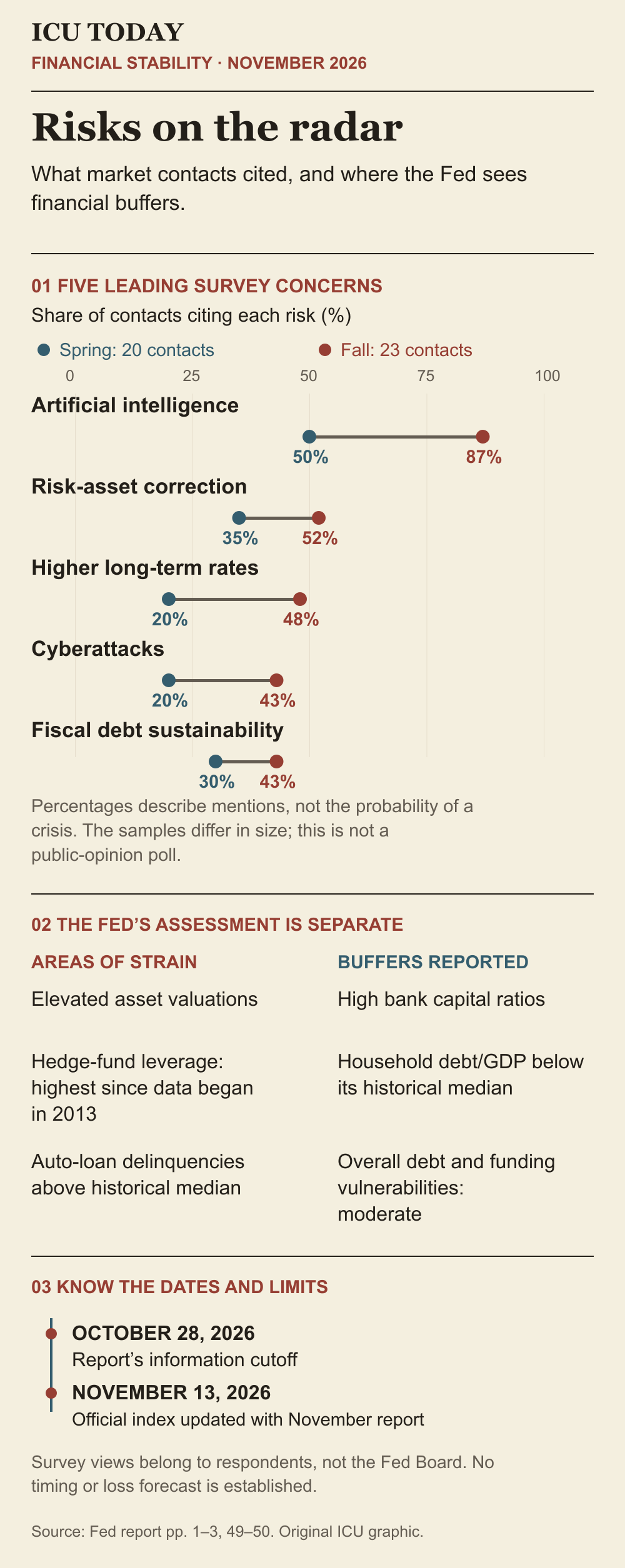
Primary-source statement · The Fed's framework examines weaknesses that could amplify an unexpected shock, rather than predicting when one will arrive. Its November assessment describes business and household debt vulnerabilities, and funding risks, as moderate. Banks held high regulatory capital ratios, while household debt relative to economic output remained below its historical median. Those buffers coexist with strains: the Fed reports weaker debt-servicing capacity among lower-rated firms, elevated auto-loan delinquencies and sizable bank losses in the fair value of fixed-rate assets. In the survey, 52% cited a risk-asset correction, 48% higher long-term rates, and 43% each cyberattacks and fiscal debt sustainability. The accompanying graphic compares those five leading concerns with spring and separates the survey from the Fed's system assessment. [Federal Reserve]
What remains unknown
Primary-source statement · The fall survey collected responses from 23 market contacts in September and October; spring had 20 contacts in March and April. These small outreach samples do not measure the probability of a crisis or the views of the public. The report does not establish whether any listed shock will occur, when it would happen, or its eventual losses. Its October cutoff also means it cannot establish conditions after that date. This is an account of the Fed's published assessment and survey, not an independently reproduced stress test or a trading recommendation. [Federal Reserve]
Read the infographic as text
Five leading survey concerns. Percentages of contacts mentioning potential risks: artificial intelligence 50% in spring and 87% in fall; risk-asset correction 35% and 52%; higher long-term rates 20% and 48%; cyberattacks 20% and 43%; fiscal debt sustainability 30% and 43%. Values use a common 0–100% scale. Spring responses came from 20 contacts in March–April 2026; fall from 23 in September–October 2026. These are different sample sizes and respondents views, not crisis probabilities or a representative public-opinion poll.
Fed assessment: strains and buffers. The Fed separately reports elevated asset valuations, hedge-fund leverage highest since data began in 2013 and auto-loan delinquencies above their historical median. It also reports high bank capital ratios, household debt/GDP below its historical median, and moderate overall debt and funding vulnerabilities. These are attributed assessments, not numeric risk scores.
Information cutoff and publication context. October 28, 2026: report information cutoff. November 13, 2026: official index updated and linked the November report. Survey views belong to respondents, not the Fed Board. The report does not establish the timing or losses of a future shock. Source: report printed pages 1–3 and 49–50 and official index.
Graphic sources: Federal Reserve · Federal Reserve
The developing record.
Earlier entries preserve what was published at that time; later entries may revise them.
2026-11-14T07:16:01.935Z · Initial report on the Fed’s November financial-stability assessment, survey respondents’ leading concerns, financial buffers and the October information cutoff.
Fed flags high valuations and hedge-fund leverage in November stability report
The report also describes resilient banks and household finances. Its market-contact survey puts AI risks first; the findings largely reflect information available by October 28.
What happened
The Federal Reserve's November Financial Stability Report flags elevated asset valuations and hedge-fund leverage at its highest level since the data began in 2013, concentrated in a small number of large funds. The report, linked from the Fed's November 13 update, also describes the banking system as sound and resilient. Its market conditions and data reflect October 28, 2026. In a separate survey included in the report, 87% of market contacts cited artificial intelligence as a potential risk, up from 50% in spring. Respondents' concerns included equity valuations, cyberattacks and complex financing arrangements. These are the contacts' views, not the Federal Reserve Board's stated position. [Federal Reserve] [Federal Reserve]
Why it matters
The Fed's framework examines weaknesses that could amplify an unexpected shock, rather than predicting when one will arrive. Its November assessment describes business and household debt vulnerabilities, and funding risks, as moderate. Banks held high regulatory capital ratios, while household debt relative to economic output remained below its historical median. Those buffers coexist with strains: the Fed reports weaker debt-servicing capacity among lower-rated firms, elevated auto-loan delinquencies and sizable bank losses in the fair value of fixed-rate assets. In the survey, 52% cited a risk-asset correction, 48% higher long-term rates, and 43% each cyberattacks and fiscal debt sustainability. The accompanying graphic compares those five leading concerns with spring and separates the survey from the Fed's system assessment. [Federal Reserve]
What remains unknown
The fall survey collected responses from 23 market contacts in September and October; spring had 20 contacts in March and April. These small outreach samples do not measure the probability of a crisis or the views of the public. The report does not establish whether any listed shock will occur, when it would happen, or its eventual losses. Its October cutoff also means it cannot establish conditions after that date. This is an account of the Fed's published assessment and survey, not an independently reproduced stress test or a trading recommendation. [Federal Reserve]
Read the infographic as text
Five leading survey concerns. Percentages of contacts mentioning potential risks: artificial intelligence 50% in spring and 87% in fall; risk-asset correction 35% and 52%; higher long-term rates 20% and 48%; cyberattacks 20% and 43%; fiscal debt sustainability 30% and 43%. Values use a common 0–100% scale. Spring responses came from 20 contacts in March–April 2026; fall from 23 in September–October 2026. These are different sample sizes and respondents views, not crisis probabilities or a representative public-opinion poll.
Fed assessment: strains and buffers. The Fed separately reports elevated asset valuations, hedge-fund leverage highest since data began in 2013 and auto-loan delinquencies above their historical median. It also reports high bank capital ratios, household debt/GDP below its historical median, and moderate overall debt and funding vulnerabilities. These are attributed assessments, not numeric risk scores.
Information cutoff and publication context. October 28, 2026: report information cutoff. November 13, 2026: official index updated and linked the November report. Survey views belong to respondents, not the Fed Board. The report does not establish the timing or losses of a future shock. Source: report printed pages 1–3 and 49–50 and official index.
Graphic sources: Federal Reserve · Federal Reserve
Original sources
Financial Stability Report — November 2026 · Issuer: Board of Governors of the Federal Reserve System · Published 2026-11-13
Financial Stability Report index — updated November 13, 2026 · Issuer: Board of Governors of the Federal Reserve System · Updated 2026-11-13
Corrections
No corrections recorded.